


If you’re running paid ads to promote your web hosting services, your landing pages are the core of your funnel. You can run a killer campaign with the perfect keywords and nail your targeting, but if your landing pages aren’t optimized to convert, you’re wasting money.
Your pay-per-click (PPC) ads need to capture attention immediately or you won’t get clicks. But web hosting is a highly competitive market and your landing pages need to be top-notch to turn those clicks into paying customers. To accomplish this, each page has to prove your value in seconds, overcome objections before they’re raised, and guide visitors toward signing up.
PPC strategies for generating web hosting leads apply whether you’re running your own company or building a business as a reseller. In this guide, we’ll walk you through the critical elements that make the difference between someone who buys and someone who clicks out of curiosity and bounces.
Generating leads from PPC ads starts with understanding user intent. For example, someone who clicks an ad for “best web hosting for small business” isn’t looking for the same thing as someone searching for “cheap web hosting.” They might both end up buying the same plan, but you have to sell your services differently to each group. Each lead needs to think, “this hosting plan is for me” when reading your ads and landing page. As such, you need to alter the language to speak directly to each group’s pain points, desires, and fears.
It’s worth pursuing multiple markets, but each requires a unique strategy. Success requires segmenting your traffic by creating separate landing pages for each group and then crafting ads and offers specifically tailored to those groups based on their intent. For example, you want to run separate ads with corresponding landing pages for each of the following keyword groups:
· “Reliable small business web hosting” – these leads are small business owners looking for a web host that has decent uptime and won’t go offline for a few hours every month.
Your ad and landing page copy should focus on reliability, uptime, and access to tools like email, page builders, security, and customer support.
· “WordPress hosting” – these leads aren’t tech savvy and want hosting that offers one-click WordPress installations. However, they aren’t necessarily looking for the quick installer that comes with cPanel. That’s far too complex for this group. They want a fully managed WordPress hosting account with a user interface that makes managing every WordPress installation a breeze.
To capture this group, your ad and landing page copy should focus on simple installation, easy migration, templates, automated backups, managed maintenance, and accessible support.
· “Cheap web hosting” – these leads are looking to save money and will likely sacrifice features for the right price.
Your ad and landing page copy should focus on your prices, discounts, and deals first, followed by elements like reliability and features.
· “Reliable web hosting” – these leads prioritize reliability over everything else.
Your ad and landing page copy should focus on your uptime guarantee, security, accessible support, and anything else that tells leads your servers aren’t going to crash or get hacked every week.
These are just a handful of examples of what search phrases can tell you about a user’s intent. To maximize leads, it’s crucial to segment your market based on intent to reach each group with customized marketing messages.
As with any market, before you type a single word, analyze your competition to know what you’re up against. Your competitors are bidding on the same keywords, targeting the same customers, and many are throwing down some serious cash. If your landing pages aren’t top-notch, you’re not going to make it.
Here’s how to research web hosting competitors:
· Dissect their traffic sources. Use tools like Ahrefs or Semrush to find out where they’re getting traffic. If you’re not using these platforms yet, it’s time to start.
· Copy their offers (but not specifically). Analyze their headlines, subheadings, CTAs, and packages/plans. Use this information as inspiration to build your landing pages and offers, but don’t copy anything word-for-word. Then, see what you can improve.
If your goal is to create better offers, keep in mind that hosting companies offer mid-tier plans that don’t make financial sense as part of a marketing strategy to get people to buy a more expensive plan. If you don’t use this strategy, it could result in fewer sales.
· Look for their hooks. What emotional buttons are they pushing? Security? Speed? Price? Support? Take their hooks and craft even better ones. For example, if their hook is “Hosting for $2.95/month,” take that up a notch to “Hosting that won’t crash - $2.95/month.”
· Read all their reviews. Take a deep dive into what people are saying about your competitors on sites like Reddit and Trustpilot. Negative customer reviews will tell you exactly where your competitors are failing, and those are the pain points you can solve (and advertise). For example, if a one of your competitors has an awful support ticket system, make it clear that you have superior-level support. For example, “No more ticket system nightmares – talk to a real human 24/7.”
Researching your competitors is the best way to avoid having to reinvent the wheel each time you need to build a landing page. It will give you the foundation needed to meet and exceed your competitors’ offers.
Your landing page headline is your first impression. If it doesn’t capture attention and resonate immediately, the rest of your content won’t matter. According to research from the Nielsen Norman Group, 79% of users only scan web page content and don’t read word-by-word. To capture attention, your content has to include scannable text, and that’s where your headlines shine.
When users scan web pages, they scroll while taking in headlines and subheadings in addition to bolded text and bulleted lists. But if your headings aren’t convincing, they won’t scan the rest of your content.
No matter what market you’re going for, craft your headlines to be value-and-benefit-driven. For example:
· “Lightning-fast hosting for growing businesses” is more effective than “Shared hosting plans.”
· “Get your website live in [time frame] – no tech skills needed” is more effective than “Build your website with us”
· “Affordable hosting that scales with your business” is more effective than “Business hosting plans.”
These are general guidelines – you’ll need to split test specific headlines to see what works best.
Landing pages generate more conversions when they load fast and aren’t cluttered with distractions and opportunities for people to click away from the page. Strip your landing pages down to simplicity. Remove sidebars, footers, links, and anything else that will allow users to escape from the conversion path. Most importantly, eliminate the main navigation menu to keep people on the page.
As previously discussed, most people scan content and don’t read it word-for-word, which means your landing pages need to give users something to focus on as they scroll and scan. This can be accomplished with meaningful headlines and subheadings, bolding important words, breaking up text into smaller paragraphs, using bulleted and numbered lists, and containing features and benefits inside visual comparison boxes.
One important feature of a successful landing page is that it provides limited options. If you give people too many choices they’ll struggle to make a selection. Whatever you’re offering, make it simple and limited. For example, say you have 20 different hosting plans spread out across shared hosting, dedicated servers, and VPS plans. Instead of listing all 20 plans on one page, list the three categories and link them to separate pages that detail all the relevant plans. When you create your PPC ads, run specific ads for each category of hosting rather than a generic ad for better results.
It’s not your amazing services that sell – it’s the packaging. In this case, it’s how you present your offer. Mediocre web hosting wrapped in a great offer will beat great web hosting wrapped in a boring offer every time.
Web hosting offers tend to do well with limited time offers that create a sense of urgency for the user to act now. Deals that end at midnight or offers only available to the first 50 signups can increase conversions. Just make sure you actually end those offers when claimed, and limit signups as advertised to avoid being fined by the FTC.
If you don’t know how to craft a compelling offer, look at what your competitors are offering and make sure your offer can compete. However, don’t just focus on price and disk space – that’s an old tactic that worked in the past, but today, people want more than generous resources. In fact, the average web hosting client won’t necessarily know or care about how much RAM or processing power your servers have.
Today’s web hosting clients want the following:
· A plan they can use without technical knowledge
· Managed WordPress hosting with automatic installation
· The ability to scale
· Ecommerce options
· High uptime
· Free SSL certificate
· A free domain name for at least the first year
· Site migration services
· AI-powered web building tools
· The option for custom design services
· Automated malware protection
· Automated backups
· A money-back guarantee
With so many unknown and scammy web hosts out there, social proof will go a long way in helping you generate leads. What others say about your business matters more than what you say about yourself. In fact, according to statistics published by Brightlocal, around 87% of people use Google to find reviews before making a purchase.
When people are researching your company, they’ll use customer reviews to determine whether or not you can be trusted. However, you can leverage social proof more powerfully by embedding testimonials right in your landing pages. Instead of bouncing to go look you up on Google right away, many users will read and/or watch your embedded reviews first.
If you’re not one of the top, well-known web hosting companies, you need social proof to gain momentum and trust in the market. Instead of posting images of 5-star reviews, highlight reviews from real people using a name and photo whenever possible. If you don’t have a system yet, you can start collecting video testimonials from sites like Storyprompt and embed them on your website.
Even though you’re selling web hosting services, users need to be told what to do for the next step. That’s where your CTA comes in. Your call-to-action (CTA) needs to be direct, bold, and specific to the targeted user. According to Hubspot data, aligned CTAs convert 202% better than basic ones.
Effective web hosting CTAs are action-oriented, like “Get started,” “Choose plan,” or “Claim your offer now.” For optimal conversions, create a custom action-oriented CTA for each segment you’re targeting.
Since people scroll through content scanning headlines and words here and there, it’s crucial to repeat your CTA throughout your text in a way that makes sense based on the content. For example, place a CTA at the end of each main section, like your pricing plan comparison charts, features overview, and testimonials section.
Mobile optimization doesn’t simply mean creating pages that can be viewed and interacted with on mobile. It requires a strategy for crafting pages that support how mobile users naturally read, scroll, and click. Effective mobile-friendly pages are plain, use limited or no images, don’t use sidebars, and have a sticky menu with a “buy” button so the user doesn’t need to scroll to the top of the page to make a purchase.
Friction makes users bounce fast. Eliminate any kind of on-page barrier that makes it hard or frustrating to get information or sign up for your services. For example, simplify your web forms and only ask for what you need at each stage. The first stage should ask for the basics, like name, email, and domain name. In the next step, ask for billing information. While users will eventually need to fill in all the information, it helps to break it down into stages. In fact, data published by Unbounce highlights a company that increased conversions by 120% just by reducing a form from 11 fields to four.
Another way to eliminate mental friction is to offer a free trial. In terms of web hosting, you can offer a heavy discount for the first month or a no questions asked 30-day money back guarantee.
Finally, include a FAQ section that addresses common questions and concerns transparently. If you can address objections and concerns that are at the top of people’s minds, they’ll be more likely to sign up.
If you’re ready to turn clicks into customers it’s time to hire a professional PPC company. At the end of the day, even the sharpest PPC strategy won’t deliver results if your landing pages don’t pull their weight. Web hosting is one of the most competitive industries around, and that means your pages can’t be average. They need to be fast, persuasive, and laser-focused on turning visitors into paying web hosting clients.
That’s where expert help makes the difference. At PPC.co, we specialize in building and managing high-converting PPC campaigns paired with landing pages crafted to maximize leads. Don’t let your ad budget leak away on clicks that never convert – contact us today and we’ll craft a tailored PPC strategy that maximizes every dollar.
.jpg)

Launching an online course is easy once you’ve created your content. Filling your virtual classroom with motivated, paying learners is a little more challenging. Advertising strategies aren’t intuitive no matter how user-friendly a platform might be, and trying to guess at how to market your courses online can feel like you’re shouting into the void. But with a little knowledge and some expert PPC ad strategies, you can get your courses in front of people who are hungry to learn what you teach.
With precise targeting, a professional strategy, budget control, and regular tracking, a PPC ad campaign can transform your course into a thriving program. The key is knowing how to structure your ad campaigns for both clicks and hot leads that convert.
Unlike search engine optimization (SEO), which can take months to gain even a little traction, PPC provides you with immediate visibility right where your target users are hanging out. SEO is important but it’s a long-term game that should be executed alongside PPC ads for the best results. While you’re waiting, PPC generates immediate clicks and drives traffic to your website on the spot.
The best part is that when done right, PPC ads offer a high ROI compared to many other advertising methods. According to the data, businesses earn an average of $2 for every $1 they spend on Google Ads, making PPC a powerful resource for course providers. Here’s everything you need to know about mastering PPC to generate hot leads for your online courses.
1. Understand the learner’s journey
If you want your PPC ads to generate leads ready to buy and not just curious clicks, you need to align your ad strategy with how learners make decisions. Signing up for an online course is not an impulse purchase. It’s a journey that usually starts with curiosity and then moves to research and comparison. When successful, that journey ends with enrollment.
A one-size-fits-all ad won’t work because a student who is just browsing isn’t ready for the same pitch as someone about to hand over their credit card. Understanding the different parts of the funnel, and tailoring your ad campaigns to match each stage, is what will make your course successful. A typical buyer’s journey for learners involves the following stages:
At this stage, your potential students are still exploring broad ideas related to the courses you’re offering. They may not know exactly which course or platform is right for them, but they’re actively looking for options. You’ll need to use a certain type of keyword phrase to capture their attention.
Searches like “learn coding online,” “how to get TEFL certified,” and “language courses for beginners” will work well at this stage. PPC ads in this phase shouldn’t hard-sell enrollment, but rather, focus on positioning your course as credible and informative.
Think free guides, introductory webinars, and blog posts that answer frequently asked questions about your topic. By nurturing your leads’ interests and providing value right off the bat, you’ll have an easier time becoming a trusted brand that people keep in mind as they move deeper into the journey.
During the consideration state prospects know what they want but they’re comparing their options. They’ve narrowed down their choices and are considering factors like price, flexibility, depth, instructor quality, platform, and accreditation. Ideal search terms in this phase are related to specific things that your prospects value or want to achieve like “affordable Python bootcamp,” “online MBA with scholarships,” or “best UX design course with certification.”
Your PPC ads should also highlight unique selling points for your course like “self-paced learning,” “industry-recognized certificate,” or “job placement success.” It’s at this stage where comparison charts, testimonials, and detailed course previews are highly effective. The goal is to show your prospects why your program beats the competition.
At this point, hesitation is minimal. Prospects are ready to sign up but might need one last push. This is where urgency, social proof, and simplicity make all the difference. Ads should feature strong calls to action like “Enroll Today,” limited-time incentives like “Save 20% - Ends Sunday.” This is the perfect time to showcase real student success stories. Landing pages for ads in the decision stage should remove all friction. Avoid long forms and distracting links. Just provide a clear and simple path to enrollment.
Keep in mind that most of your ideal market will encounter your brand multiple times along their journey across different devices and platforms, like Instagram, Facebook, and YouTube. Mapping your PPC ad campaigns to these three stages ensures you’re showing up with the right message at the right time. When done correctly, focusing on all three stages with separate messages will turn casual searchers into qualified leads ready to buy your course.
The backbone of every PPC campaign is your keyword selection. You can write the most convincing ad copy in the world, but if you’re bidding on the wrong phrases you’ll either waste your budget or attract people who have no intention of enrolling.
Your goal isn’t just to drive traffic to your site. You need to drive qualified traffic – people who are serious about learning what you teach and are ready to invest in themselves. This requires targeting a mix of high-intent keywords, longtail phrases, and negative keywords.
Broad keywords like “data science” and “coding” cast a net that’s too wide. You’ll get clicks but most will be from people who are just curious or looking for free resources. To reach people who are committed, you need to target high-intent keywords that show purchase intent. Phrases like “enroll in our data science course” and “online JavaScript certification with ongoing support” will attract users who are actively seeking instruction.
You’ll pay more for high-intent keywords but they deliver more value and higher conversion rates, and that will increase your ROI when you choose the right ones.
Longtail keywords are used to target a smaller pool of people and that’s a good thing. Since these keywords are more focused, the traffic they generate is more valuable. Instead of competing for saturated, general terms like “learn graphic design online,” you target specific phrases like “best graphic design program for working professionals with evening classes.” The people searching with this level of specificity already know what they want, which means they’re more likely to convert.
If you skip targeting longtail keywords you’re leaving money on the table. Data shows that 70% of all online searches involve longtail phrases – it’s just how people naturally search when they know what they want.
Your negative keyword list is how you’ll preserve your budget and prevent wasting money on irrelevant clicks. Without a list of words you don’t want your ads to show up for, you’ll end up paying for clicks that never convert.
Build a negative keyword list of words that indicate someone is looking for something free or irrelevant to your course. For example, words like “free,” “PDF,” “torrent,” and “Reddit” are usually used in searches when someone is looking for shortcuts and freebies. Adding these and similar words to your negative keyword list will filter out tire-kickers and boost ROI by preserving your ad budget for relevant prospects.
Once you have the right keywords that generate impressions, your ad copy has to do the work to get clicks. Your ads need to grab people right away to prevent them from scrolling and possibly clicking on another course provider’s ad. For e-learning, your ads need to inspire people. Instead of talking about your course you want to highlight what your course will do for the learner. This is accomplished with benefit-driven messaging, emotional triggers, and strong calls-to-action (CTAs).
· Benefit-driven messaging. Most course providers list features like “40 hours of video content” and “downloadable PDFs,” but these details aren’t going to capture attention at first glance. In fact, telling learners they’re going to need to sit through 40 hours of content right off the bat might be a deterrent.
Instead, your ads should highlight tangible outcomes like “land high-paying clients with our program,” or “start a new career as a web developer in just 12 weeks.” Benefits speak directly to a person’s goals and aspirations, which is far more compelling than a list of specs.
· Emotional triggers. Emotional triggers are the heart of every marketing strategy, including PPC ads. People make emotional buying decisions and buy courses because they’re chasing a dream, avoiding a fear, or seeking transformation.
Great ad copy taps into these emotions and creates a sense of urgency. For instance, “Don’t miss the enrollment deadline” plays into the fear of missing out, while “Join 10,000 successful graduates” leverages social proof. The right emotional triggers will give people a good reason to act now rather than bookmarking your page and forgetting about it.
· Clear CTAs. Irresistible ad copy includes a direct, compelling call-to-action that tells the prospect what to do next. Generic instructions don’t cut it. “Learn more,” “Click here,” and similar phrases don’t communicate urgency or value. Choose CTAs that direct prospects to sign up for your course. For example, “Start your free trial” and “Reserve your seat today” work well.
In a crowded marketplace where hundreds of course creators are competing for the same attention, clarity and emotion will generate better results. Lead with benefits and tap into people’s emotions and your ad copy will generate serious leads.
Generating clicks from your ads is only the first half of the equation. Once a prospect clicks your landing page needs to convert them to a paying customer or your ad spend goes to waste. Your landing page is like the final pitch where prospective students choose whether to enroll in your course or move on. If your landing pages create any confusion, friction, or distrust, your prospects will lean toward other course creators. On the other hand, an optimized landing page can become a conversion generating machine.
Your landing pages should be simple and clean without too much information. The page content should be specifically designed to direct people to sign up for your course. You want to eliminate navigation menus and sidebars to prevent people from clicking away from the page and getting distracted. Each landing page should have one end goal, either to get sign-ups/purchases or apply for acceptance if required. Too many options will create cognitive overload and reduce the chance of any action.
It’s crucial to include trust elements on your landing pages. When people are thinking about investing their time and money in an online course, they’re naturally going to be skeptical. This is where trust signals can help. Testimonials, instructor bios, refund guarantees, and case studies will help build your course credibility. The goal here is to reassure people that your program is legitimate and worth their investment.
Clicks are important but they’re somewhat of a vanity metric when measured on their own. The only time clicks matter is when you’re looking at your conversion rate. If you generate 100 clicks and get 40 people to enroll that’s much better than generating 1,000 clicks and only getting one person to enroll in your course.
The metrics that matter most are your conversion rate, your cost per lead (CPL), and lifetime customer value (LTV). For instance, you’ll want to track completed signups, demo requests, and enrollments rather than overall clicks.
Cost per lead is a simple measurement that can tell you how efficient your campaign is. For instance, if you’re paying $50 per lead but your average enrollment fee is $500, your margins are good. If your CPL is too close to your revenue then your course might be priced too low or you need to adjust your targeted keywords.
For e-learning, many students invest in more than one course or renew their subscription, which increases their lifetime value to your business. Tracking LTV will help you determine how much you can afford to spend acquiring each new student. For example, if your LTV average is $1,500, it makes sense to spend $200 to acquire each lead. This long-term view helps you maintain profitability and allows you to outbid your competitors who aren’t willing to spend much.
PPC ads require fine-tuning and you can’t just “set it and forget it.” What works today might underperform tomorrow or not perform at all on other platforms. Even small changes can make a huge difference in conversions and that’s why it’s important to test variations. For example, Dell is just one example of a company that saw a 300% increase in conversions from A/B testing.
By running experiments to test different elements you can identify what resonates most with your target audience and optimize your ads based on those results. The most important elements to test are your headlines, CTAs, and images.
· Testing headlines. Your ad headline is usually the first thing a prospect sees. Testing different headlines can help identify which promises resonate most. For example, “Land your dream job” might appeal to people looking for a new career, while “Get certified in 12 weeks” might hook people in a hurry. If you get more conversions from the former, your main audience is likely people looking for a new career, and you can tailor your ads to that group.
· Testing CTAs. A strong CTA can generate more clicks, but what works will depend on your audience. For example, “Get started today” might work for some courses while “Reserve your spot” works better for others. Avoid vague CTAs like “Learn more” that don’t instruct people to take action.
· Testing visuals. Images can put people off or draw them closer. Visuals are processed faster than text and are perceived in a split-second. A single image can make or break an ad. For instance, sometimes a photo of an instructor works well, but other times it’s better to use abstract graphics.
Split testing isn’t optional when you’re running PPC ads. It’s the only way to know which elements make your ads more effective.
At the end of the day, PPC is a great way to build a pipeline of motivated students who want to enroll in your courses. By aligning your campaign with the learner’s journey and optimizing your ads and landing pages for conversions, you can turn your PPC campaign into a reliable growth engine. As the e-learning market becomes more competitive, ads that hit hard are a must.
If you’re ready to stop wasting ad spend and start filling your online classrooms with qualified leads, it’s time to bring in PPC experts. At PPC.co, we specialize in turning clicks into enrollments through high-converting campaigns that deliver qualified leads for online course creators . Contact our team today and let’s build campaigns that fill your classroom.
Pay-per-click (PPC) remains one of the fastest paths to pipeline, but the economics vary widely by industry and are shifting as AI reshapes the SERP. In today's digital advertising landscape, google ads and other ad platforms continue to evolve, while PPC campaigns depend heavily on clean measurement, strong signals, and the right advertising strategies. Rising cost per click CPC trends, fluctuating average CPC, changing consumer behavior, and shifts in the search advertising market all impact performance.
CPCs are up versus prior years, conversion rate metrics have improved in many categories, and lead quality is increasingly a function of how well advertisers feed first-party data into bidding models.
The table below summarizes 2025 search ads and google search ads benchmarks by sector—CPC, average conversion rate (CVR), and cost per lead (CPL)—so you can compare what “good” looks like in your niche and calibrate ROI assumptions. These PPC statistics, combined with key metrics like average cost per click, average cost per lead, and average CTR, help advertisers refine their approach.
Use these numbers as directional guardrails, then layer in your own close rates and LTV to get to the only metric that matters: profitable growth.
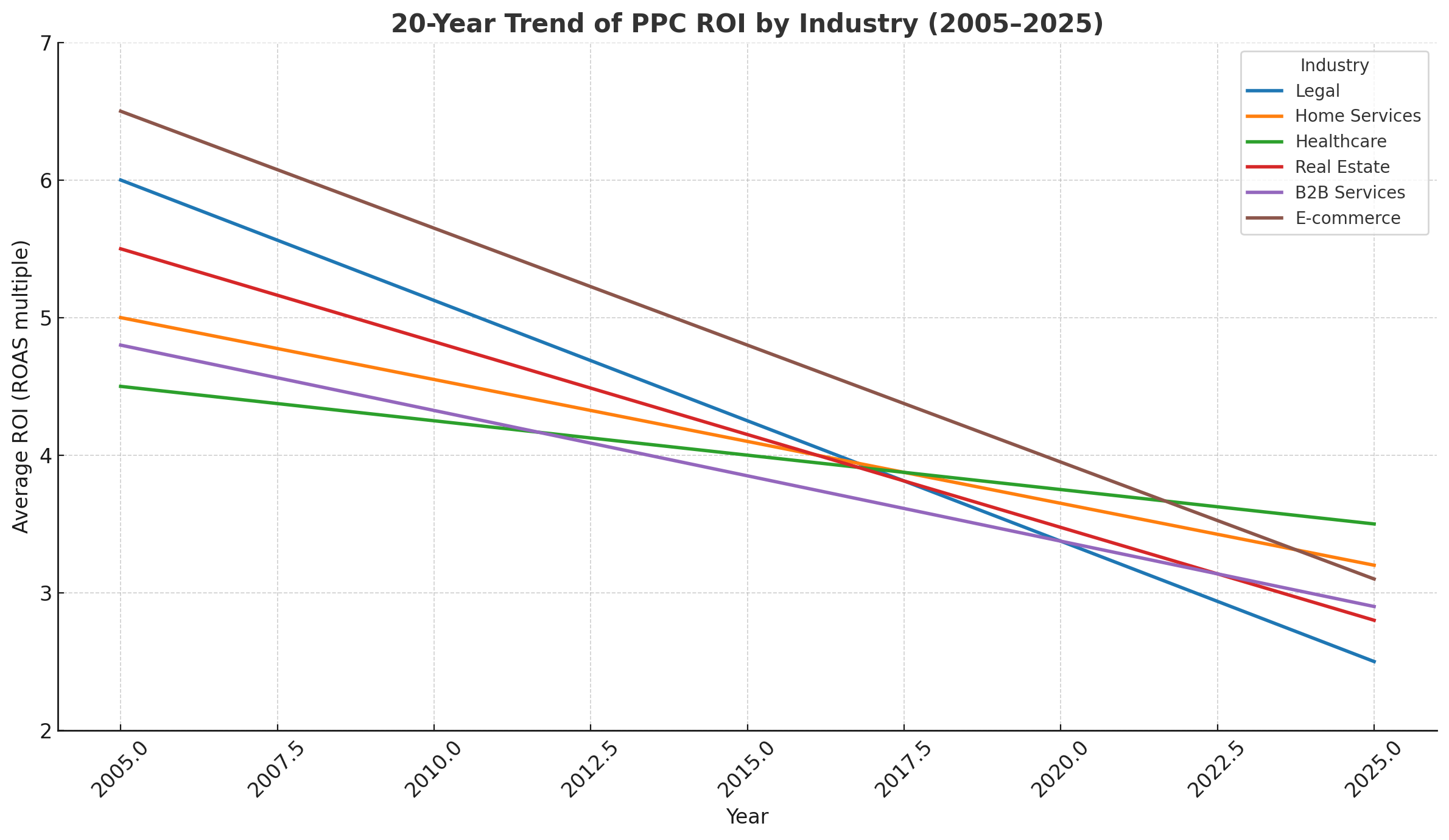
In short, AI is changing the way PPC campaign management is occurring, and it's happening FAST.
ROI ≈ (Close-Rate × Avg Customer LTV ÷ CPL) − 1
Example (legal): if close-rate 12% and LTV $6,000 on CPL $132 → ROI ≈ (0.12×6000 / 132) −1 ≈ 4.45x (345% net). Improve any one input (faster intake bumps close-rate; better routing lowers CPL) and ROI jumps. These insights supplement sector PPC benchmarks, helping define realistic expectations across multiple industries. LocaliQ
Modern paid advertising spans Bing ads, Microsoft ads, Meta ads, Google Display Network, mobile ads, shopping ads, and other different ad formats—each with its own target audience and ad placements. As audiences shift to mobile devices, advertisers refine audience targeting, keyword strategy, negative keywords, and landing pages to maintain better performance.
High‑performing PPC marketers focus on PPC efforts, PPC automation, PPC trends, and PPC performance across ad platforms. Meanwhile, voice search, organic search interactions, and the growth of search ad spending shape how advertisers attract targeted traffic.
Metrics such as average CTR, click through rate CTR, industry average CTR, industry average CVR, industry average CPA, industry average CPC, and average benchmark help guide budget allocation, PPC budgets, and long‑term planning.
PPC will keep paying when two things are true:
(1) you can convert and qualify leads quickly, and
(2) your bidding models are trained on the outcomes that actually make you money.
As AI compresses targeting gaps, the edge shifts to creative velocity, strong measurement, accurate conversion tracking, and agile PPC strategy.
Treat the benchmarks above as starting points, then rebuild your ROI math from the ground up: ROI ≈ (Close Rate × LTV ÷ CPL).
Contact us today for your customized PPC audit to see how we can improve your search engine marketing ad spend.
When you’re running pay-per-click (PPC) ads, it’s easy to assume clicks mean genuine interest, but most car shoppers are just kicking tires online. Seeing your inventory once doesn’t mean they’re ready to buy anytime soon or even at all. If you want to reach the portion of clicks that come from serious buyers, you need to use retargeting ads need to be a core part of your digital marketing strategy.
The reality is that even potential buyers and prospective buyers who intend to buy a car will bounce before contacting you or visiting your physical showroom in person. If your retargeting efforts stop at the first click, those users will continue their car buying journey across multiple dealerships and likely buy from a competitor. Running retargeted campaigns will keep your dealership in front of website visitors who previously visited, building familiarity, brand recall, and trust over time.
According to a 2022 Cox Automotive Car Buyer Journey Study, the average person spends more than 14 hours searching for a new car, which includes visiting around 5 websites across the automotive industry before making a purchase decision. The sites they visit include automakers, dealers, third-party sites, and pre-owned car lots with online inventory. This long purchasing journey means your dealership must stay visible throughout the marketing funnel. Your prospects aren’t going to buy right away, so to get the sale you need to reel them back in. If you’re not using automotive retargeting – also called remarketing – in your PPC campaign, you’re missing out on hot leads.
Buying a car isn’t a small decision. People compare makes, models, and deals and look for car dealerships with great reputations. Getting a single click from a potential car buyer isn’t enough to make the sale. And when they bounce, there’s no guarantee they’ll remember you exist. You’re paying for all those initial clicks, and if potential leads never come back you’ve wasted your ad spend. When you use retargeting strategies, you’ll have another chance to turn their curiosity into a conversation, and that’s why remarketing is an essential component in every PPC ad campaign.
PPC retargeting for automotive dealerships shows your ads to people who have already clicked on an ad or visited your website. When implemented strategically, it keeps your dealership visible across multiple platforms and follows those people across the web. For example, when you run retargeted ads using retargeting platforms like Google Display Network, your display ads will show up on the blogs, news sites, and apps your prospects frequent.
You can also run retargeting campaigns on social media platforms like Facebook and Instagram. As long as your prospects scroll through their daily feed, your ads will show up for them if they’ve already interacted with you and have shown interest in a specific vehicle or offer. YouTube also offers retargeting options with video ads that play right before the content. In fact, don’t underestimate the power of YouTube video advertising. According to data from Wyzowl, video ad copy can convince 84% of people to buy a product or service.
Not all potential customers searching for a new car will respond to the same bland, boilerplate message. For example, someone browsing luxury SUVs isn’t going to click on an ad that says, “Low APR on all models!” That’s where remarketing shines. Automotive retargeting lets you tailor your message based on online behavior, pages viewed, time on site, and engagement depth.
With retargeting, you can segment your audience based on their interests and behavior. For example, someone comparing financing terms won’t be swayed by flashy sports car imagery. With retargeting, you can show truck shoppers truck ads and sports car shoppers sports car ads. It sounds simple, but showing personalized ads is one of the most powerful marketing methods of all time. People are far more responsive to messages that feel personal. You may have caught their attention with a general ad at first, but once they start browsing those SUVs on your website, you can retarget them with SUV ads, which boosts conversions and drive conversions by delivering relevance at scale.
When you use retargeting, you can provide different calls to action (CTAs) to users based on how they’ve engaged with your web pages. A visitor who spent a lot of time on your truck inventory pages can be served ads for your latest truck deals. Someone who checked out your lease specials can be hit with ads that talk about financing offers. It’s deceptively simple and brutally effective. Relevance is everything. When your ads reflect what the prospect was already thinking about, it feels personal and resonates.
A next-level tactic is using engagement depth to determine how strong your call to action should be. For instance:
· Multi-page viewers and long dwell times. These are warm leads and can be retargeted with stronger CTAs like “Book a test drive” and “Get a quote today.” They’re close to converting and just need a little push.
· Single-page bouncers. These are people who just peeked at your site. They can be re-engaged with lighter touchpoints like a general promotion or model comparison guide to reel them back in.
· Abandoned lead forms. If someone started filling out a form but didn’t finish, retarget them with a reminder and a stronger offer to sweeten the deal (e.g., “Complete your form for $500 off!”).
This level of nuance turns retargeting into a conversion machine and allows you to show the customer exactly what they want to see.
People don’t buy cars from whatever dealer they find first. That’s too risky. They buy from dealerships they trust and that feel familiar. You can build that sense of familiarity and trust through effective retargeting ads. For example:
· Consistent branding across ads. Using consistent branding, design, and messaging throughout your ads reinforces your dealership’s identity.
· Frequency builds familiarity. People need to see a brand between 5-7 times before they’ll remember it. Retargeting puts your dealership in front of people over and over again. Even if they don’t click right away, it’s helping to establish your credibility.
· Social proof works. When you use social proof like customer testimonials or awards in your ads it builds trust with your prospects.
Trust is earned over time, and retargeting will help you get it.
If you’re not using retargeting, your competitors definitely are. Car dealerships operate in one of the most brutally competitive markets out there, with national chains and franchise giants dominating search results and flooding ad channels with endless budgets. If you’re not showing up again and again, your competitors will, and they’ll scoop up all your leads.
The good news is you don’t need a massive marketing budget to get results. Retargeting allows smaller, local dealerships to play smart rather than trying to play big. When you focus on local PPC with hyper-targeted remarketing, you can reach a smaller, more qualified audience – people who are actually in your area, browsing your inventory, and likely to buy soon.
And unlike those cookie-cutter campaigns from national dealers, you can adjust strategies and make your messaging feel personal and specific to your local community. That’s an edge big budgets don’t have.
Every visitor who leaves your website without converting is a potential sale but not necessarily lost. With smart retargeting, you can bring warm leads back into your funnel and stay top-of-mind while your competitors waste money shouting into the void. Persistence wins the sale and retargeting is how you stay on the map.
To be blunt, search ads can get expensive fast, especially when clicks can cost a couple dollars per click. Pouring money into cold traffic is gambling on people who may not be ready to engage. Retargeting changes everything.
Display retargeting clicks typically cost a fraction of what you’d pay for search ads using competitive keywords. You’re no longer paying top dollar to get someone’s attention from scratch – you’re nudging people who already know who you are, and those people are more likely to respond. This makes retargeting one of the most cost-effective ways to use your advertising budget.
· Lower CPC, higher intent. Retargeting costs less per click, but you’re targeting people who already visited your site and showed interest.
· Better conversion rates. Familiarity breeds trust. Retargeted visitors are statistically more likely to convert than new users who just clicked an ad out of curiosity.
· Higher ROI. Since retargeting reaches warm leads, the cost of acquiring a lead is usually lower, which means your overall cost per lead is lower and you get better ROI.
If you’re skipping remarketing because you think it’s just something “extra” that doesn’t make a difference, you’re not saving money – you’re losing easy wins. Instead of perpetually chasing new, cold traffic, invest in converting the traffic you’re already getting. That’s exactly what remarketing does.
Generic ads are fine for first impressions, but once users browse inventory, it’s time to get specific with dynamic retargeting ads. Here’s how it works:
When a prospect views a specific vehicle on your site, you can use retargeting ads to show them the exact vehicles they viewed and others like it down to the year, color, trim, and mileage. For example, if they looked at a black 2005 BMW 535i, that’s exactly what they’ll see in the ad – the same photos, same specs, all across sites like YouTube, Facebook, news platforms, and more. This reminds your prospects of exactly what they want.
Dynamic retargeting works by integrating your live inventory feed with your ad platform, like Google Ads or Meta. This means the vehicles displayed in your ads will always be up to date and won’t feature cars you sold last week.
Beyond personalization, dynamic ads are an incredible tool for creating a sense of urgency:
· Leverage scarcity. With these ads, you can leverage the power of scarcity by stating that your inventory won’t last. Using messages like “Only 1 left” or “Recently reduced” signals that the opportunity won’t last.
· Show what’s popular. If a particular model is getting a lot of views, let your prosects know. People don’t want to miss out on a good deal.
· Trigger action with FOMO. Fear of missing out is real, and when people see the car they want again – with a reminder that it might sell soon – they’re more likely to come in for a test drive.
By using retargeted ads, you can increase conversion rates by up to 200% compared to standard display ads. These ads feel more like a helpful reminder than an outright advertisement.
If you’ve never run paid ads before, it’s easy to assume your only options are basic keyword targeting and generic follow-up ads. But today’s ad platforms, such as Google Analytics, give you a buffet of hyper-specific targeting capabilities to fine-tune exactly who sees your ads, where, when, and how.
One of the most effective PPC retargeting strategies for car dealerships is location-based targeting. With radius targeting, you can serve ads to people within a specified distance from your dealership, like within 10-15 miles. These will be prospects who are not only likely to visit your site but could realistically walk into your showroom today. Don’t waste ad spend on clicks from people three states away.
Then there are device-specific campaigns. If your analytics show that 75% or your traffic comes from mobile (this is common), you can launch a mobile-only retargeting campaign with click-to-call buttons, mobile-optimized landing pages, and a map and directions built right into your ads. This will improve the user experience and increase conversion rates.
Timing also matters. When you schedule your ads you can control when they appear. Run them during lunch breaks, in the evenings, or on weekends when people have more time to browse car listings and are more likely to make big purchase decisions.
Other strategic targeting elements include:
· Demographic targeting. You can tailor your messages based on age, income level, and household status. A 25-year-old college grad and a 45-year-old parent are not shopping for the same reasons even though they might buy the same car.
· Behavioral triggers. You can create audiences for your retargeted ads based on repeat visits, clicks, video views, or interaction with a specific feature like a trade-in calculator.
· Lookalike audiences. Build new audiences that resemble your best customers. Platforms like Meta and Google are really good at identifying similar users based on their behavior online.
The bottom line is that retargeting doesn’t have to be broad. With the right strategy, it becomes a smart, cost-effective system for reaching the right prospects at the right time.
Have a sale, lease offer, or year-end clearance? Retargeting can amplify the urgency to act now. By offering short-term discounts and financing deals, you can tap into the urgency people feel when presented with time-sensitive offers. Emphasize the end date using a countdown timer or final deadline to create FOMO (fear of missing out).
With this type of retargeting, you can align your ads with your email messaging to increase conversions even more. For example, if you sent out a promotion to your email list, they’re likely to see your retargeted ads and be reminded of the deal you’re offering.
Retargeting is the PPC secret weapon most car dealerships don’t take advantage of. Using this strategy can make the difference between a one-time curious visitor and a buyer ready to schedule a test drive. If you’re spending money on clicks without retargeting your visitors, you’re wasting your ad spend.
At PPC.co, we specialize in high-performance white label PPC campaigns that include smart retargeting from day one. Whether you’re launching your first campaign or looking to tighten up your existing ad strategy, we can help you capture more leads, drive more traffic, and move cars off your lot. Let’s turn those clicks into closed deals – contact us now to get started.




.jpg)


.jpg)


.jpg)


%20Services.jpg)


.jpg)


