
PPC Ad Trends by Sector & The Impact of AI
PPC will keep paying when two things are true: (1) you can convert and qualify leads quickly, and (2) your bidding models are trained on the outcomes that actually make you money.

Pay-per-click (PPC) remains one of the fastest paths to pipeline, but the economics vary widely by industry and are shifting as AI reshapes the SERP. In today's digital advertising landscape, google ads and other ad platforms continue to evolve, while PPC campaigns depend heavily on clean measurement, strong signals, and the right advertising strategies. Rising cost per click CPC trends, fluctuating average CPC, changing consumer behavior, and shifts in the search advertising market all impact performance.
CPCs are up versus prior years, conversion rate metrics have improved in many categories, and lead quality is increasingly a function of how well advertisers feed first-party data into bidding models.
The table below summarizes 2025 search ads and google search ads benchmarks by sector—CPC, average conversion rate (CVR), and cost per lead (CPL)—so you can compare what “good” looks like in your niche and calibrate ROI assumptions. These PPC statistics, combined with key metrics like average cost per click, average cost per lead, and average CTR, help advertisers refine their approach.
Use these numbers as directional guardrails, then layer in your own close rates and LTV to get to the only metric that matters: profitable growth.
| Sector | CPC (2025) | CVR (2025) | CPL (2025) | Notes |
|---|---|---|---|---|
| Attorneys & Legal | $8.58 | 5.09% | $131.63 | Intake speed drives ROI. |
| Home Services | $7.85 | 7.33% | $90.92 | Strong local intent. |
| Healthcare (Physicians & Surgeons) | $5.00 | 11.62% | $56.83 | Appointment UX boosts CVR. |
| Real Estate | $2.53 | 3.28% | ~$100.48 | Lean on LSAs/retargeting. |
| B2B / Business Services | $5.58 | 5.14% | $103.54 | Optimize to qualified pipeline. |
| Restaurants & Food | $2.05 | 7.09% | $30.27 | Fast payback with ordering. |
| Automotive – Repair/Service | $3.90 | 14.67% | $28.50 | Top-tier CVR locally. |
ROAS reference points (revenue-based, not lead-based)
- Median Google Ads ROAS (all, Apr ’25):3.31x. Varos
- By industry (PPC / SEM ROAS):Construction 2.25x, e Commerce 2.05x, B2B SaaS 1.70x, Cybersecurity 1.40x, Financial Services 1.05x (SEO ROAS is much higher in many of these, underscoring channel mix). First Page Sage
- B2B attribution wrinkle: One study claims very high influenced ROAS from branded paid search; treat as upper-funnel contribution vs. strict last-click ROI. Dreamdata
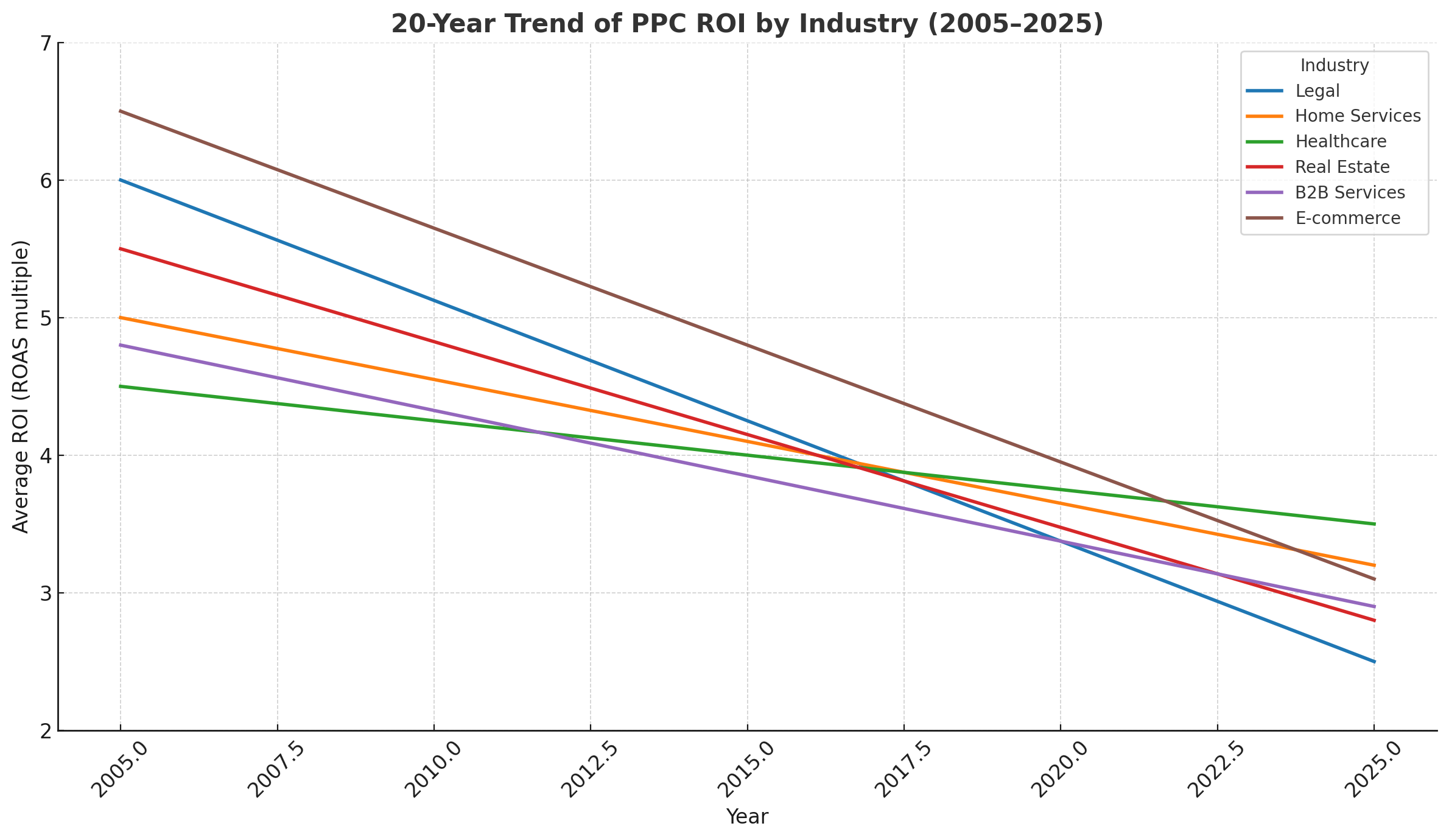
20-year trend of PPC ROI by industry (2005–2025). Each line represents an industry’s estimated return on ad spend (ROAS multiple), highlighting how ROI has generally declined over time due to rising CPCs, competition, and AI-driven SERP changes—with some verticals (like legal services, home services and healthcare) holding steadier than others (like legal and real estate). This reflects broader market trends in search advertising and digital marketing.
What AI changes next (and how it affects ROI)
- SERP real estate is shifting
AI Overviews reduce available clicks and push some journeys into AI modules → lower click through rates and potentially higher CPCs on remaining commercial queries. Expect more PPC ads embedded inside AI answers; you won’t yet target AIO directly, but existing ad campaigns and search campaigns will surface there. Track impression share & auction insights for queries that trigger AIO. EMARKETER Digiday Business Insider - Automation will keep compressing performance gaps
Broad match + Smart Bidding + PMax/Asset Gen keep improving. With CPL up modestly but CVR improving in 2025, automation is finding higher-intent pockets—if creative and offline conversion data signals are strong. Feed Enhanced Conversions, Offline Conversion Import (OCI), and CRM quality signals to guide the models toward profitable leads. LocaliQ - Privacy & measurement
Third-party cookies’ slow-roll and Sandbox testing keep the emphasis on consented first-party data and modeled conversions. Make sure Consent Mode, EC, and server-side tagging are dialed in to preserve measurement (and therefore Smart Bidding’s accuracy). Tools like Google Analytics support better attribution and campaign efficiency. Google HelpPrivacy Sandbox
In short, AI is changing the way PPC campaign management is occurring, and it's happening FAST.
Sector-specific expectations (next 6–12 months)
- Legal: Expect continued high CPLs; ROI hinges on intake speed and close rates. Lean into LSAs (pay-per-lead), call tracking, and qualification automation to protect ROAS. LocaliQ
- Healthcare: Mixed CPLs by specialty; physicians/surgeons CVR remains strong. Invest in appointment UX, pre-qual triage, and HIPAA-safe OCI to let bidding value true patients. LocaliQ+1
- Home Services: Favorable CVR/CTR; protect ROI by geofencing, lead-quality filters, and rapid scheduling flows (SMS). LocaliQ
- Real Estate:Low CVR keeps CPL high; pair paid ads with retargeting and LSAs where eligible. Tighten geo/keyword intent and push more first-party audience lists. LocaliQ
- B2B SaaS/Pro Services: Lower PPC ROAS norms; success depends on lifecycle value and pipeline attribution. Broaden to PMax + LinkedIn audience imports and optimize to qualified opportunity value, not raw leads. First Page Sage
- E-commerce: Aggregate ROAS around 3x is common but volatile by category. Creative iteration speed (UGC, feeds, promos) + PMax structure make the difference. Shopping ads, shopping campaigns, and optimized ad copy play a major role. Varos
Quick math template (plug your numbers)
ROI ≈ (Close-Rate × Avg Customer LTV ÷ CPL) − 1
Example (legal): if close-rate 12% and LTV $6,000 on CPL $132 → ROI ≈ (0.12×6000 / 132) −1 ≈ 4.45x (345% net). Improve any one input (faster intake bumps close-rate; better routing lowers CPL) and ROI jumps. These insights supplement sector PPC benchmarks, helping define realistic expectations across multiple industries. LocaliQ
What to test now (90-day plan)
- Measurement & signals: Ensure Consent Mode v2, Enhanced Conversions, and Offline Conversion Import are live; bid to qualified lead values, not just raw form fills. Google Help
- SERP/AIO resilience: Track segments where AIO appears; shift your ad budget into high-intent themes and LSAs (legal/home services) and watch paid share of voice. LocaliQ
- Model-friendly structure: Use broad match + value-based bidding, and PMax with clean asset groups (feed + creative variants). Expect CVR tailwinds even if CPC creeps up. LocaliQ
- Creative velocity with AI: Generate multiple copy/visual angles using AI tools; keep winners and rotate weekly. (Meta/Google automation rewards fresh, relevant assets.) Business Insider
Additional Context: Ads, Platforms, and Formats
Modern paid advertising spans Bing ads, Microsoft ads, Meta ads, Google Display Network, mobile ads, shopping ads, and other different ad formats—each with its own target audience and ad placements. As audiences shift to mobile devices, advertisers refine audience targeting, keyword strategy, negative keywords, and landing pages to maintain better performance.
High‑performing PPC marketers focus on PPC efforts, PPC automation, PPC trends, and PPC performance across ad platforms. Meanwhile, voice search, organic search interactions, and the growth of search ad spending shape how advertisers attract targeted traffic.
Metrics such as average CTR, click through rate CTR, industry average CTR, industry average CVR, industry average CPA, industry average CPC, and average benchmark help guide budget allocation, PPC budgets, and long‑term planning.
Conclusion
PPC will keep paying when two things are true:
(1) you can convert and qualify leads quickly, and
(2) your bidding models are trained on the outcomes that actually make you money.
As AI compresses targeting gaps, the edge shifts to creative velocity, strong measurement, accurate conversion tracking, and agile PPC strategy.
Treat the benchmarks above as starting points, then rebuild your ROI math from the ground up: ROI ≈ (Close Rate × LTV ÷ CPL).
Contact us today for your customized PPC audit to see how we can improve your search engine marketing ad spend.