
Google Ads vs. Facebook Ads: Which is the Better Advertising Medium for Your Business?
Compare Google Ads and Facebook Ads to choose the platform that best aligns with your goals and delivers impactful campaign results.

If you have been considering Google Ads vs Facebook Ads, you probably wonder which one is better for your particular niche. Below is a close look at both types of Facebook Ads or google ads so you can make an informed decision.
And when the time comes to manage your Google ads campaigns, it’s important to select the best ad management services to obtain the best ROI.
What’s The Difference Between Google Ads And Facebook Ads?
You’ve seen both ad types mentioned when you go into Google or Facebook Ads, but how do they operate?
Both advertising platform use a PPC or pay-per-click model. When you make advertisement on either platform, you go into an auction where you type in a bid for how much you want to spend on ad/ad spend space. Next, you’re charged a certain sum every time a person clicks on your ads/Google ads. Easy, right?
Paid Search Ads vs. Paid Social Ads
It’s essential for making your marketing decision.
Google Ads is a paid search advertisement method, for the most part. This means that you pay to have your ad listed on the Search engine results page for Google.
When you do a paid Google search campaign, your advertisement is served to searchers based on targeted keywords rather than by target audience. However, you can alter your campaign settings in paid Search engines/Google search to target a specific audience based on geographic location and other particulars.
However, Google Ads isn’t just about paid search; you also can serve your ads on:
- YouTube
- Google Display Network
- Google Maps
- Google Shopping Ads
- Google Play
On the other hand, Facebook Ads provides you with paid advertising. As Facebook has changed its algorithm settings, particularly for Facebook retargeting, it’s more complicated than ever to get your products in front of customers organically.
This is where your paid social campaign comes in. With Facebook Ads, you pay to get your ads/google ads in front of customers on major social networks rather than them finding you organically.
As you may know, Facebook isn’t just putting ads on your newsfeed. Some other channels that you can advertise are:
- Instagram Feed
- Facebook Marketplace
- Facebook News Feed
- Facebook Video Feeds
- Facebook Right Column
- Audience search Network
- Facebook Messenger
Now that we’ve covered the basics of these two advertising channels let’s compare them.
Audience Size
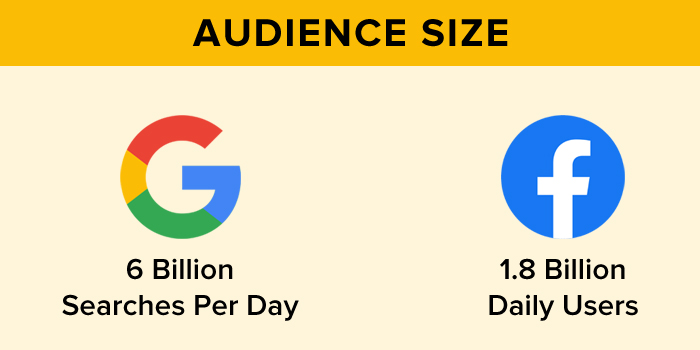
Google and Facebook have massive audience reach. Google gets almost six billion searches per day, and Facebook boasts about 1.8 billion daily users.
Mobile advertising on Facebook makes up almost 90% of the company’s ad revenue. However, mobile advertising isn’t the only method that you should try.
Usually, your target users/audience spends time on both Google and facebook ad/Online advertising platform, so you cannot determine which platform is ideal for you based only on audience’s size.
So, ask yourself, how is your target audience effective on these networks? And is your product oriented towards Google search or social?
Even if Google gets six billion searches per day, it doesn’t help you if no one is looking for your product there.
Have you released a new, exciting product? Have people heard about it? If not, then Facebook Ads could be the best option for you for now.
Cost And ROI
Cost is another significant consideration; the average cost-per-click on Google Advertising/|Google Ads is $2.70, but this varies widely by industry.
It can range from $2.46 for auto to $6.75 for legal services. Also, note that the most costly search term in Google Ads today is ‘insurance’ for $54 per click!
Facebook can be a bit cheaper per click than Google. For example, a company in the apparel local businesses could pay only .45 per click on Facebook. Insurance and finance are more expensive, but the typical CPC is only $3.75.
Also, Instagram feed advertisements are almost double the cost of Facebook ads/Google ads.
CPC is often pricier on Google Ads, remember that people clicking each Google or facebook ad could be further along in the purchase cycle. Facebook ads excels at building awareness, but Google Ads may be better at reaching the user when she is ready to buy.
But CPC is only part of the consideration. Another factor to consider is CPA or cost per action to determine if you have a sufficient ROI for your Google or Facebook advertising campaign.
CPA varies by each campaign you start. It depends mainly on how well you targeted each campaign and if you can convert a lot of viewers.
Wordstream has put together average CPA for most industries to give you a benchmark for how your Facebook or Google ad is performing.
The average CPA for all Facebook advertisements is about $18.75. It can range from $44 for auto to $12 for healthcare to $55 for technology.
Again, Google Ads will cost you more than Facebook Ads, but Facebook Ad management is typically more expensive. The typical CPA in Google Ads is $49 for search and $75 for display. This can range from $34 for auto to $72 for education to $133 for technology.
Buyer Intent
Regarding buyer intent, Google Ads usually beats Facebook Ads. Think about the type of business you have. Do your potential customers search for products or services when they are ready to buy?
For instance, if your car’s air conditioner breaks, they will start looking for car AC repair services. Google Search ads would put your company in front of customers exactly when they need your Google’s local service ads.
But that person won’t repair that AC repair business in six months that they saw on Facebook. Google wins here.
Facebook Ads are not as effective at getting leads to become sales quickly. Most people go to Facebook to hang out and socialize, not to shop. But this robust platform is critical for building an audience over time. If you can create a feeling of community around your company on Facebook, people are more likely to buy when they need your product.
If you want to create brand awareness for your company, Facebook wins.
Which Is Better?
To decide, you need to ask yourself some questions.
First, think about the goal of your campaign. Do you want to make sales fast? Then Google Ads is probably for you this time. But if you want to grow brand recognition or reach a vast audience, Facebook Ads may be the choice.
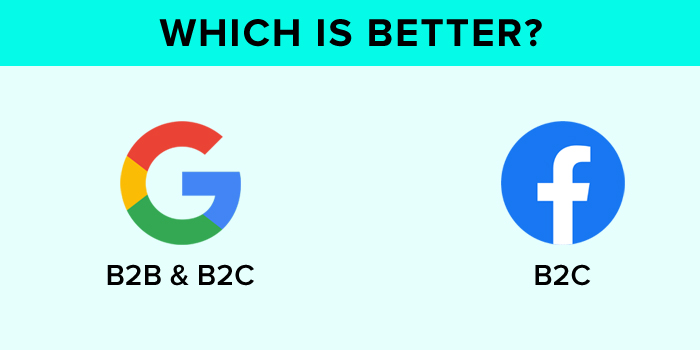
Next, think about your industry. B2B and B2C companies use free Google Ads with great success. But Facebook Ads may work better for B2C companies, especially for people selling less pricey products and services; consumers are more likely to buy these products impulsive after they see them two or three times.
Also, your audience matters. Do people look for your firm with the idea to buy today? If so, Google is the right choice. But if you want to build a new audience, then Facebook will fit you better.