
• Services

    Services

    Service Types

    Paid Search Management
    Maximize ROI with expertly managed campaigns.
    PPC Audits
    Optimize your campaigns with comprehensive audits.
    Display Ads Management
    Create visually compelling campaigns that convert.
    Google Ads Management
    Tailored strategies for effective online advertising.
    Youtube Ads Management
    Drive brand awareness with engaging video ads.
    Facebook Ads Management
    Engage your audience with precise facebook targeting.
    Retargeting Management
    Reconnect with potential customers effectively.
    Linkedin Ads Management
    Expand your professional network with impactful ads.
    White Label PPC
    Seamless PPC solutions for your agency.
    Amazon Ads Management
    Boost your product visibility on Amazon.
  • Brands

    brands

Case StudiesAboutBlogContact
Log in
Get Started

PPC for Accountants & CPAs: A Beginner’s Guide

Samuel Edwards
|
May 2, 2022

Did you know that Google handles about 5.6 billion search queries per day?

If you want your accounting company to get more exposure, it’s essential to get as many visitors to your site as possible.

It helps a lot to have a high Google page rank for major accounting firm and CPA terms, but a pay-per-click campaign for accountants could be just what you need to set your company apart.

Why Should Accountants and CPAs Use PPC Advertising?
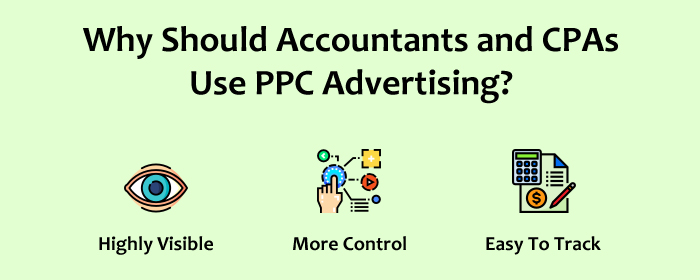
Why Should Accountants and CPAs Use PPC Advertising?

PPC campaigns are helpful for the accounting Firms profession for many reasons:

Highly Visible

With Pay per click (PPC) advertising, your company’s name will appear above most results on search engine. This helps more potential clients find your business.

If your company doesn’t rank for a critical accounting keyword, you can design an ad that appears when the user types that word. Your company name and site will always get prominence above your competition with PPC ads.

More Control

With A successful PPC campaign, you have a lot of control. It’s possible to make campaign changes immediately.

Just choose the keywords you want to focus on, set how much you are spending, and write the ad.

Easy To Track

PPC allows you to track people that click your accounting Firms or CPA website. With that data, you know which Google ads work and which don’t. You also learn which pages get the most visitors and the most effective keywords.

All of this information lets you tweak your ads for the most effectiveness over the long term.

PPC Tips For Accountants And CPAs

Before setting up a PPC campaign, please review these best practices to get the most bang for your buck.

Look For New Keywords
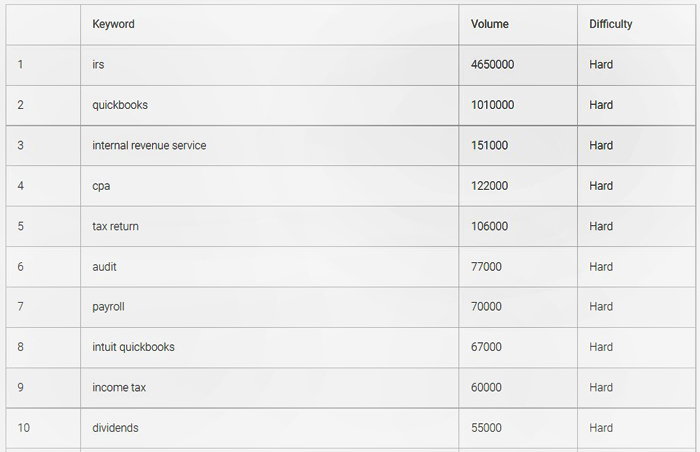
Keywords for Accountants

Your Pay per click (PPC) campaign should be regularly updated to ensure they are focused on the right keywords and prospects. That means you or your PPC manager need to look for the latest keyword opportunities to put into the campaign.

You can rely on many ways to find the latest keywords. One simple way is to review Google search results in your niche and look for keywords that you didn’t include in your digital marketing campaign.

Another way is using the Keyword Planner that is included in your account. This is a free tool loaded with ways to find the best and most competitive keywords. You also can review what the average cost per click is for each word. Then you can forecast what you will probably spend and the marketing budget you need.

Review Conversion Tracking

This is essential for your accounting PPC campaign. Conversion tracking lets you check how many visitors have come to your site from the campaign. This could be through a website form, chat, or phone call.

You also can use micro-conversion that lets you see smaller types of engagement, such as signing up for the e-newsletter or downloading a white paper.

When you set up conversion tracking, you can watch how many contacts or sales have come from a period of time compared to the costs. You also will know which keywords, ads, and landing pages are the best performers. This allows you to fine-tune your paid search campaigns for the most cost-effective results.

Check Your Competitors
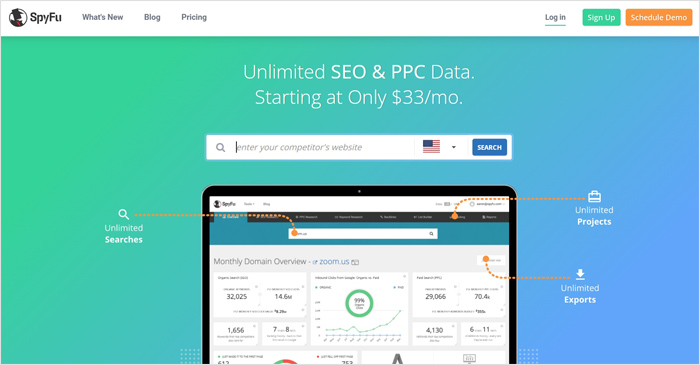
Spyfu

It’s easy to get bogged down in your own company and campaign, but don’t forget to check what your competitors are up to. There are reports and tools within Google Ads that help you keep up with competitors.

Some of these tools are free, but you also can pay third parties to analyze your competition. A popular paid tool is Spyfu which shows the keywords your competitors pay for. Another good one is SERanking. Both offer a good look at what other marketers are paying every month for your keywords.

Finetune Your Ads

For every accounting ad group, you have in Google Ads, it’s advised to have two or three advertisements so you can test various promotions and variations. Google/search engines have several ad types you can choose from.

Google defaults to showing the best-performing ads the most. So you should watch your ads and continue running tests. Any ad that isn’t performing well should be analyzed and improved for the best digital marketing spend.

Ensure Geo-Targeting Is Correct

It might seem too obvious, but it’s surprising how many accounting firm target areas that don’t matter to their business. After all, if your office is in Seattle, you may not get a lot of traction running ads in Miami. Sure, some clients can be remote, but many people don’t want to use an accountant that isn’t in their town.

You can easily set up location targeting in your Google Ad account by clicking Settings, Locations, and City/Region/Zip Code.

Review Recommendations
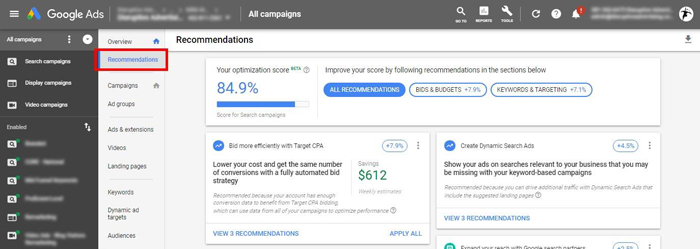
Review Recommendations Inside Your Google Ads Account

The recommendations page in your Google account offers many helpful opportunities to improve your campaign. Recommendations are created automatically by Google’s algorithm when it sees chances to make your campaign better.

There are lots of recommendations on this page that can help your accounting PPC campaign. Some include dynamic search as, targeting and keywords, responsive search ads, and more.

You also will notice an optimization score. This is Google’s estimate of how well your account is performing. Applying their recommendations helps the campaign improve.

Remember Broad Match Keywords

The list of keywords for accountants is often shorter than for other PPC ads advertisers. This means there are fewer search variations even when your campaign targets several geographic locations.

That said, you still might dig up a few long tail keywords that work well for your accounting business.

It’s often worthwhile to use board match keyword versions of other keywords and match types. Experts say it’s ideal to begin with phrase and exact match keywords. Then, put in broad match after a few weeks or months when you want more clicks.

Don’t neglect negative keywords, either. For accountants, this can include keywords that are related to people searching for jobs, careers, resumes, etc.

PPC is one of the most powerful and cost-efficient ways for accountants to grow their brand and practice. Use these tips and your accounting firm will be well ahead of the competition.

Author
Recent Posts

Samuel Edwards

Chief Marketing Officer

Throughout his extensive 10+ year journey as a digital marketer, Sam has left an indelible mark on both small businesses and Fortune 500 enterprises alike. His portfolio boasts collaborations with esteemed entities such as NASDAQ OMX, eBay, Duncan Hines, Drew Barrymore, Price Benowitz LLP, a prominent law firm based in Washington, DC, and the esteemed human rights organization Amnesty International. In his role as a technical SEO and digital marketing strategist, Sam takes the helm of all paid and organic operations teams, steering client SEO services, link building initiatives, and white label digital marketing partnerships to unparalleled success. An esteemed thought leader in the industry, Sam is a recurring speaker at the esteemed Search Marketing Expo conference series and has graced the TEDx stage with his insights. Today, he channels his expertise into direct collaboration with high-end clients spanning diverse verticals, where he meticulously crafts strategies to optimize on and off-site SEO ROI through the seamless integration of content marketing and link building.

Latest posts by

Samuel Edwards

 (see more)
Paid Ads Statistics in Healthcare: A Market Research Report
-
April 23, 2026
Paid Ads Statistics for the Legal Industry: A Market Research Report
-
April 22, 2026
SaaS Marketing: Digital Marketing Statistics & Trends for SaaS Companies
-
April 13, 2026
Nutrition/Health Product Company SEM Case Study
-
February 6, 2026

Author

Samuel Edwards

Chief Marketing Officer

Throughout his extensive 10+ year journey as a digital marketer, Sam has left an indelible mark on both small businesses and Fortune 500 enterprises alike. His portfolio boasts collaborations with esteemed entities such as NASDAQ OMX, eBay, Duncan Hines, Drew Barrymore, Price Benowitz LLP, a prominent law firm based in Washington, DC, and the esteemed human rights organization Amnesty International. In his role as a technical SEO and digital marketing strategist, Sam takes the helm of all paid and organic operations teams, steering client SEO services, link building initiatives, and white label digital marketing partnerships to unparalleled success. An esteemed thought leader in the industry, Sam is a recurring speaker at the esteemed Search Marketing Expo conference series and has graced the TEDx stage with his insights. Today, he channels his expertise into direct collaboration with high-end clients spanning diverse verticals, where he meticulously crafts strategies to optimize on and off-site SEO ROI through the seamless integration of content marketing and link building.

Related posts

Samuel Edwards
|
April 23, 2026
Paid Ads Statistics in Healthcare: A Market Research Report

1. Executive Summary

‍

Healthcare paid advertising is going through a quiet but meaningful shift. Not a flashy revolution, more like a steady recalibration. Costs are climbing, privacy rules are tightening, and patients are behaving more like informed consumers than ever before. If you’re still running campaigns the way you did even two years ago, performance is probably slipping.

Let’s break down what’s actually changing.

‍

Brief overview of industry marketing trends

Digital ad spend in healthcare continues to climb at a healthy pace. In the U.S. alone, healthcare and pharma digital advertising is projected to reach about $24.8 billion in 2025, growing roughly 13% year over year (eMarketer).

But growth isn’t evenly distributed. Paid search and social still dominate budgets, yet returns are flattening in some segments due to saturation and rising CPCs. Meanwhile, channels like connected TV (CTV), YouTube, and retail media networks (yes, even in healthcare via pharmacy ecosystems) are quietly gaining ground.

At the same time, compliance is no longer a side consideration. It’s shaping channel strategy. HIPAA-related enforcement and FTC scrutiny around tracking pixels have already caused some organizations to pull back or rethink campaigns entirely.

In short, growth is strong, but efficiency is under pressure.

‍

Shifts in customer acquisition strategies

Patient acquisition used to be fairly linear. Someone searched, clicked, booked. That’s no longer the norm.

Today’s journey looks more like this:

  • A symptom search on Google
  • A YouTube video explaining treatment options
  • A review check on Healthgrades
  • Maybe a TikTok clip from a provider
  • Then finally, a branded search and conversion

That multi-touch behavior is forcing marketers to rethink attribution and budget allocation. Last-click models are breaking down, and more teams are leaning into blended CAC and incrementality testing.

Another noticeable shift: first-party data is becoming the backbone of acquisition. Email lists, patient portals, CRM data, and call tracking systems are no longer “nice to have.” They’re essential.

‍

Summary of performance benchmarks

Healthcare paid ads remain one of the most expensive categories in digital marketing. Legal and insurance still beat it, but not by much.

Here’s what the numbers look like on average:

  • Paid search CPC: often ranges from $2 to $8+, with high-intent procedures (like surgery or specialty care) pushing well above $20
  • Conversion rates: typically 3% to 8% for well-optimized landing pages, though local providers can exceed this with strong intent targeting
  • Cost per acquisition (CPA): highly variable, but $50 to $300+ is common depending on service line and geography
  • Social CPMs: rising steadily, often sitting between $8 and $20+ depending on audience targeting

One thing stands out: efficiency varies wildly based on trust signals. Campaigns that include reviews, physician credibility, or clear outcomes consistently outperform those that don’t.

‍

Key takeaways

A few patterns keep showing up across high-performing healthcare advertisers:

  • Trust is the real conversion lever. Credentials, testimonials, and transparency matter more than clever copy
  • Privacy is reshaping measurement. Expect less visibility, not more, and plan for it
  • Search still captures demand, but it’s no longer enough to create it
  • Video is doing more heavy lifting, especially in early-stage education
  • First-party data is the closest thing to a long-term advantage

And maybe the simplest takeaway: healthcare marketing is becoming more human. Less transactional, more relationship-driven.

‍

Quick Stats Snapshot

Quick Stats Snapshot
Metric Current Benchmark What It Means
US Healthcare Digital Ad Spend ~$24.8B (2025) Strong category growth, with more competition across search, social, and video.
Average Paid Search CPC $2 to $8+ (can exceed $20) High-intent healthcare keywords carry a premium, especially in specialty and procedure-driven categories.
Landing Page Conversion Rate 3% to 8% Trust signals, provider credibility, and a clear booking path make a measurable difference.
Average Social CPM $8 to $20+ Costs keep rising as targeting becomes harder and competition stays high.
Patients Using Digital Health Tools ~70% monthly Digital touchpoints are no longer optional. They are expected.
Portal or Online Record Access ~65% First-party data opportunities are expanding through patient portals and logged-in experiences.
Sources: eMarketer, PwC Health Consumer Survey, ONC Health IT Quick Stats

‍2. Market Context & Industry Overview‍

The paid ads market in healthcare is no longer a niche growth story. It is now a large, competitive, regulation-sensitive market where digital keeps taking share from traditional media, but not evenly.

‍

Total addressable market (TAM)

If we define the paid ads market in healthcare as U.S. healthcare and pharma media advertising, the current TAM is already substantial. eMarketer estimated total U.S. healthcare and pharma ad spend would top $30 billion in 2024, and projected healthcare and pharma digital ad spend alone to reach $24.77 billion in 2025, up 13.3% year over year. That matters because digital is no longer the “emerging” side of the budget. It is the center of gravity. (EMARKETER, EMARKETER)

There is another layer inside that number that shapes the market: pharma dominates digital spend. eMarketer estimated pharma would account for 88% of the sector’s digital ad spending in 2024, or about $19.45 billion. That leaves providers, payers, health systems, telehealth brands, and digital health firms competing for a much smaller slice of spend, which partly explains why provider-side teams often feel squeezed even as the category itself looks huge on paper. (EMARKETER)

A practical way to read the TAM:

  • Total paid media market: large and still expanding
  • Digital paid media market: now the main battleground
  • Provider and payer paid media market: meaningful, but structurally smaller than pharma-led spending
  • High-growth pockets: CTV, social, video, and privacy-safe first-party activation (EMARKETER, EMARKETER)

‍

Growth rate of the sector (YoY, 5-year trends)

The sector is still growing, but the growth story has changed shape.

In 2025, U.S. healthcare and pharma digital ad spending is projected to rise 13.3% YoY to $24.77 billion. In 2024, total healthcare and pharma ad spend was expected to exceed $30 billion, up 5% YoY. The gap between those two growth rates tells the story pretty clearly: digital is outgrowing the market as a whole, while traditional channels continue to lose share. (EMARKETER, EMARKETER)

Over the broader five-year period, three patterns stand out:

  1. The category made a decisive shift toward digital after 2020.
    eMarketer notes the market is reallocating spend away from traditional media, especially linear TV, toward channels such as CTV, social, and other targeted digital formats. (EMARKETER)
  2. Growth has not been uniform across subsectors.
    Pharma has driven most of the digital expansion. Provider and non-pharma healthcare advertising grew fast during the telehealth boom, then slowed, and is now rebounding more selectively. eMarketer says healthcare companies outside pharma saw digital ad spend jump 66.6% in 2021 to $2.32 billion, then cool, with a projected 10.5% rebound in 2025. (EMARKETER)
  3. Traditional media is shrinking, but not disappearing.
    Healthcare still relies on linear TV, radio, and print more than most industries. So this is not a clean “old media died, digital won” story. It is more of a gradual rebalance, especially for pharma brands that still need mass reach. (EMARKETER, EMARKETER)

‍

Digital adoption rate within the sector

This is where healthcare gets interesting. Consumer behavior is now digital enough that paid media strategies have to follow, even when the organizations behind them are still catching up.

PwC’s 2025 U.S. Healthcare Consumer Insights Survey found that seven in ten consumers already use health technology monthly. Among Gen Z, that rises to 79%. PwC also found 65% of consumers want a system built around prevention, not just treatment, and younger generations are much more willing to seek care outside traditional settings. (PwC)

At the same time, ONC reported that in 2024:

  • 65% of individuals were offered and accessed their online medical records or patient portal
  • That figure has more than doubled from 25% in 2014
  • App-based record access rose from 38% in 2020 to 57% in 2024
  • 59% of people had multiple portals in 2024, showing how fragmented the digital care experience still is (ONC)

That combination matters for marketers. Consumers are digitally active, but their journeys are split across apps, portals, search, retail clinics, and provider systems. So digital adoption is high enough to support sophisticated paid acquisition, yet fragmented enough to make targeting, measurement, and follow-up harder than in simpler categories like retail or travel.

‍

Marketing maturity: early, maturing, or saturated?

The honest answer is: it depends on the channel.

At the sector level, healthcare paid advertising looks maturing overall, with a few saturated pockets.

Here is the clearest way to frame it:

  • Paid Search: maturing to saturated
    Search remains a core channel, but it is crowded, expensive, and hard to outsmart with brute-force bidding alone. eMarketer explicitly notes that search is still a stalwart channel, but growth is slowing. (EMARKETER)
  • Paid Social: maturing
    Social is still growing and useful for education, retargeting, and condition awareness, but privacy changes and rising media costs have made it less predictable. (EMARKETER, Becker’s Hospital Review)
  • CTV and digital video: growth-stage within a maturing market
    These formats are gaining attention because they combine storytelling with better targeting than linear TV. eMarketer flags CTV as one of the main growth engines in the category. (EMARKETER)
  • First-party data activation and privacy-safe measurement: still maturing
    This is the capability gap that will separate the next winners from everyone else. More than half of payers surveyed by Freshpaint and Becker’s said they had paused digital advertising due to privacy concerns, which tells you the market has not fully operationalized compliant modern marketing yet. (Becker’s Hospital Review)

Healthcare paid ads are no longer early-stage, but they are not fully optimized either. The market is mature enough to be expensive, and immature enough to still reward better infrastructure.

‍

Industry Digital Ad Spend Over Time

Industry Digital Ad Spend Over Time
USD (Billions)
30
25
20
15
10
5
0
$30.0B+
2024 Total Ad Spend
$19.45B
2024 Pharma Digital
$24.77B
2025 Digital Ad Spend
Year Metric Value
2024 Total U.S. healthcare + pharma ad spend $30B+
2024 Pharma digital ad spend $19.45B
2025 Total U.S. healthcare + pharma digital ad spend $24.77B
Sources: eMarketer: US Healthcare and Pharma Ad Spending 2024, eMarketer: Pharma Accounts for Nearly 90% of Broader Industry Digital Ad Spending, eMarketer: US Healthcare and Pharma Ad Spending 2025

Marketing Budget Allocation

Marketing Budget Allocation
Representative channel mix
Paid Search
Still the core demand-capture channel for high-intent healthcare queries.
30%
Paid Social
Useful for awareness, retargeting, and condition education across broad audiences.
22%
Video / CTV / YouTube
Growing fast as healthcare brands invest more in trust-building and education.
18%
Programmatic Display / Native
Still relevant, though increasingly constrained by privacy and targeting limits.
12%
CRM / Email / Retention Media
Important for follow-up, reactivation, and getting more value from first-party data.
10%
Testing / Emerging Channels
Room for experimentation with retail media, creators, audio, and newer channel formats.
8%
Channel bucket Representative share Why it makes sense
Paid Search 30% Still the core demand-capture channel.
Paid Social 22% Broad reach, retargeting, and condition education.
Video / CTV / YouTube 18% Growing role in awareness and trust-building.
Programmatic Display / Native 12% Useful, but increasingly constrained by privacy rules.
CRM / Email / Retention Media 10% Important for follow-up and first-party leverage.
Testing / Emerging Channels 8% Room for retail media, audio, creator-led campaigns, and channel testing.
Sources: eMarketer: US Healthcare and Pharma Ad Spending 2025, eMarketer: US Healthcare and Pharma Ad Spending 2024, eMarketer: Pharma Accounts for Nearly 90% of Broader Industry Digital Ad Spending

‍3. Audience & Buyer Behavior Insights‍

This is where healthcare marketing gets personal. Not in a fluffy brand way, but in a very real, high-stakes sense. People don’t browse healthcare the way they browse shoes or software. They show up with anxiety, urgency, or confusion. Sometimes all three.

And that emotional layer shapes everything about how paid ads perform.

‍

ICP (Ideal Customer Profile) details

There isn’t a single “healthcare customer.” It depends heavily on the service line. But across most paid acquisition programs, a few consistent ICP patterns show up.

For providers and health systems:

  • Age: typically 25–64, skewing older for specialty care
  • Life stage: caregivers, parents, or individuals managing chronic conditions
  • Income: middle to upper-middle income, often insured
  • Trigger moments: symptoms, referrals, insurance changes, life events (new baby, relocation, aging parent)

For digital health and telehealth:

  • Younger skew, especially 18–44
  • More comfortable with self-service and remote care
  • Higher expectation of speed, transparency, and mobile-first experiences

For elective or high-value procedures:

  • Research-heavy buyers
  • Longer decision cycles
  • Strong sensitivity to reviews, outcomes, and provider credibility

One subtle but important shift: patients increasingly behave like informed shoppers. They compare providers, read reviews, and evaluate options before making a decision. That was less common even five years ago.

‍

Key demographic and psychographic trends

The demographic story is straightforward. The psychographic shift is where the real change is happening.

A few patterns worth calling out:

  1. Digital comfort is now the baseline
    PwC found that about 70% of consumers use health technology monthly, and among Gen Z that number climbs to nearly 80%. That means digital engagement isn’t a differentiator anymore. It’s expected. (pwc.com)
  2. Younger consumers are redefining care expectations
    Gen Z and millennials are far more open to non-traditional care models. Retail clinics, telehealth platforms, and app-based care are all on the table. They are less loyal to legacy systems and more willing to switch.
  3. Trust is fragmented
    People trust doctors, but they also trust reviews, peer experiences, and online content. A provider’s reputation now lives across Google, Healthgrades, YouTube, and even TikTok.
  4. Prevention mindset is rising
    PwC reports that 65% of consumers want a healthcare system focused on prevention rather than just treatment. That changes the type of content and messaging that resonates. Educational, proactive messaging tends to outperform reactive, symptom-only messaging. (pwc.com)
  5. Privacy awareness is increasing
    Consumers may not understand tracking technologies in detail, but they are more aware that their health data is sensitive. That shows up as hesitation around forms, tracking, and data sharing, especially in high-sensitivity categories.

‍

Buyer journey mapping (online vs. offline)

The classic linear funnel doesn’t hold up well in healthcare anymore. The journey is fragmented, multi-device, and often blends digital research with offline decisions.

A typical journey today might look like this:

  1. Trigger
    A symptom, diagnosis, or referral kicks off the process.
  2. Initial research
    Search queries like “back pain causes” or “best cardiologist near me.” This is where paid search and SEO play a major role.
  3. Education phase
    YouTube videos, blog content, social posts, and sometimes short-form video (yes, even TikTok) help people understand options.
  4. Validation
    Reviews, ratings, testimonials, and provider credentials become critical. This is where many conversions are won or lost.
  5. Conversion
    Booking an appointment, calling a clinic, or submitting a form. Often happens after multiple visits.
  6. Offline experience
    The actual appointment. This still heavily influences long-term value and referrals.
  7. Follow-up and retention
    Email, patient portals, and SMS reminders keep the relationship going.

The key takeaway: most conversions are not single-session events. They are the result of repeated exposure across channels.

‍

Shifts in expectations

Consumer expectations in healthcare have quietly caught up to other industries.

Here’s what people now expect, whether marketers are ready or not:

Speed
If someone clicks an ad, they expect fast-loading pages, easy booking, and quick responses. Long forms and slow sites kill conversion rates.

Transparency
Pricing clarity, insurance information, and treatment explanations matter more than ever. Vague messaging creates friction.

Personalization
Not in a creepy, hyper-targeted way, but in relevance. People expect content that matches their condition, location, and intent.

Consistency
The message in the ad, the landing page, and the actual experience need to align. Any disconnect creates doubt.

Mobile-first design
A large portion of healthcare research happens on mobile. If the experience feels clunky on a phone, performance drops fast.

‍

Persona Snapshot Table

Persona Snapshot Table
Persona Profile Goals Barriers Channels That Influence
The Researcher 35 to 55, actively managing a condition and comparing treatment paths before making a decision. Find the best treatment option, understand provider differences, and feel confident before booking. Information overload, trust concerns, and difficulty judging quality from generic marketing claims. Google Search, YouTube, reviews
The Urgent Seeker 25 to 65, symptom-driven and trying to solve a problem quickly, often on mobile. Get fast care, confirm availability, and take the next step with minimal friction. Time pressure, uncertainty, and low patience for slow pages or unclear booking options. Paid search, maps, call ads
The Caregiver 40 to 65, helping a parent, child, or partner navigate ongoing care needs and provider coordination. Find reliable long-term care, reduce stress, and make the right choice for someone they love. Complexity, emotional load, scheduling friction, and managing multiple decision-makers. Search, referrals, email
The Digital Native 18 to 34, comfortable with digital-first care and more open to telehealth, apps, and self-service journeys. Convenience, speed, transparent options, and a mobile-first experience that feels easy. Low tolerance for friction, weak UX, generic messaging, and outdated booking experiences. Social, TikTok, telehealth apps

Funnel Flow Diagram of Customer Journey

Funnel Flow Diagram of Customer Journey
Awareness
Search queries, social exposure, video content
↓
Consideration
Website visits, educational content, provider comparisons
↓
Decision
Reviews, testimonials, credentials, retargeting
↓
Conversion
Booking, calls, form submissions
↓
Retention
Email, patient portals, follow-ups
↓
Loyalty
Repeat visits, referrals, reviews
Stage Typical Actions What Matters Most
Awareness Search queries, social impressions, video views Clear relevance, strong first impression, educational hooks
Consideration Landing page visits, blog reads, service page exploration Helpful information, low-friction navigation, clear next steps
Decision Review reading, provider comparison, return visits Trust, credibility, testimonials, provider qualifications
Conversion Appointment booking, phone calls, form submissions Fast page speed, easy scheduling, strong CTA clarity
Retention Email follow-up, portal use, reminders, re-engagement Consistency, convenience, first-party communication
Loyalty Repeat visits, referrals, public reviews Great care experience, trust, brand recall, easy advocacy

‍4. Channel Performance Breakdown‍

Healthcare paid media rarely has a single winner. That is the first thing worth saying.

Search captures intent. Email protects retention. Social expands reach. Video builds trust before someone is ready to act. TikTok can work, but only when the offer, audience, and creative actually fit the moment. That sounds obvious, yet a lot of teams still expect one channel to do all the work. It almost never does.

The more realistic view is this: each channel earns its place at a different point in the journey, and performance changes fast depending on privacy limits, local competition, service line, and how much trust your brand already has.

‍

How to read channel performance in healthcare

Two campaigns can run on the same platform and look wildly different.

A local urgent care brand bidding on “walk-in clinic near me” is playing a different game than a specialty provider marketing bariatric surgery, and both are very different from a payer promoting plan enrollment. So the numbers below are best treated as directional benchmarks and planning ranges, not fixed truths.

That said, a few market signals are clear right now:

  • Search ad costs are still rising. WordStream’s 2025 benchmark report found the overall average CPC across Google Ads industries rose 12.88% year over year, and average cost per lead reached $70.11. (WordStream)
  • Meta traffic campaigns improved on CTR and CPC year over year, but lead-gen efficiency still depends heavily on creative quality and audience setup. WordStream reports average Facebook traffic-campaign CTR at 1.71% and average leads-campaign CTR at 2.59% in 2025. (WordStream)
  • Email remains one of the strongest retention tools because it runs on first-party data. MailerLite’s industry benchmark page shows medical, dental, and healthcare emails averaging a 43.75% open rate. (MailerLite)
  • Privacy pressure is changing channel selection in healthcare specifically. In Freshpaint and Becker’s 2025 payer marketing study, more than half of surveyed payers said they had stopped digital advertising due to privacy concerns. (Freshpaint)

‍

Channel benchmark table

Channel Benchmark Table
Channel Avg. CPC Conversion Rate CAC / CPA Comments
Paid Search $2 to $8+ for many campaigns, with high-intent specialties often much higher 3% to 8% is a solid operating range for healthcare landing pages $50 to $300+, and often much higher in specialty care Highly competitive. Best for bottom-funnel demand capture, but expensive and unforgiving when landing pages or trust signals are weak.
SEO No direct media CPC Often strong over time because intent is high Usually among the lowest blended CAC over a long horizon High ROI, but long ramp time. Works best when paired with service-line content, technical SEO, and local trust signals.
Email Near-zero marginal CPC once the list exists Highly variable by list quality, automation, and timing Low incremental CAC for reactivation and retention Best retention driver. Especially effective for follow-up, reminders, screening prompts, and re-engagement programs.
Social (Meta) Often lower CPC than search, but highly variable by objective and audience Usually lower direct intent than search, stronger for nurture and retargeting Can look efficient at the lead level, but quality varies CPM pressure and privacy limits make creative quality much more important than before. Useful for awareness, retargeting, and message testing.
TikTok Usually lower CPC than search, but depends heavily on creative quality Better at engagement and discovery than immediate high-intent conversion Can be efficient for upper funnel, less predictable for direct patient acquisition Popular with younger audiences. Stronger fit for prevention, wellness, telehealth, education, and creator-led brand familiarity.
YouTube / Video / CTV Often bought on CPM or CPV rather than CPC Usually weaker last-click conversion than search, but stronger assisted-conversion value CAC can be reasonable when used to warm audiences before retargeting Strong for trust-building, education, provider storytelling, and improving branded search efficiency later in the journey.
Programmatic Display / Native Often moderate CPC, but traffic quality varies Usually weaker direct conversion than search CAC depends heavily on audience quality and follow-up sequence Best for awareness, recall, and retargeting support. More exposed to privacy and measurement issues than first-party channels.
Source references used: WordStream Google Ads Benchmarks 2025, WordStream Facebook Ads Benchmarks 2025, and MailerLite Email Benchmarks.

% of Budget Allocation by Channel

% of Budget Allocation by Channel
Budget Share (%)
100
80
60
40
20
0
Testing / Emerging
8%
CRM / Email
10%
Programmatic
12%
Video / CTV / YouTube
18%
Paid Social
22%
Paid Search
30%
Representative Healthcare Budget Mix
Paid Search
Core demand-capture channel for high-intent healthcare queries.
30%
Paid Social
Broad reach, retargeting, and condition education across audiences.
22%
Video / CTV / YouTube
Trust-building, education, and awareness support across the funnel.
18%
Programmatic Display / Native
Useful for awareness and retargeting, with more privacy constraints.
12%
CRM / Email / Retention Media
Supports follow-up, reactivation, retention, and first-party leverage.
10%
Testing / Emerging Channels
Leaves room for creators, audio, retail media, and new experiments.
8%

‍5. Top Tools & Platforms by Sector‍

If channels are where healthcare marketers spend money, tools are where they win or lose control.

And right now, control is the real issue.

Between privacy regulations, fragmented patient journeys, and messy attribution, the healthcare martech stack has shifted from “nice to optimize” to “critical infrastructure.” The teams that invest here are not just more efficient. They’re often the only ones who can measure what’s actually working.

‍

Core Martech Stack in Healthcare Paid Advertising

Most high-performing healthcare organizations are building around four layers:

  1. Data foundation (CRM + CDP)
  2. Activation layer (ads + automation)
  3. Measurement layer (analytics + attribution)
  4. Compliance layer (privacy + data governance)

Miss one, and performance suffers.

Here’s how the current tool landscape breaks down.

‍

CRMs, Automation Platforms, and Analytics Stacks

CRM (Customer Relationship Management)

These systems are no longer just for sales. In healthcare, they act as the central nervous system for patient data, especially first-party data.

Top platforms:

  • Salesforce Health Cloud
  • HubSpot (growing fast in mid-market healthcare)
  • Microsoft Dynamics 365

What’s changing:

  • Shift from “lead tracking” to full patient lifecycle management
  • Increased integration with call tracking, EHR systems, and marketing automation
  • More emphasis on consent management and data segmentation

Why it matters:
With third-party tracking weakening, CRM data is often the only reliable way to connect ad spend to actual patient outcomes.

‍

Marketing Automation Platforms

Automation tools are quietly doing a lot of heavy lifting in healthcare, especially in retention and reactivation.

Top platforms:

  • Marketo (Adobe)
  • HubSpot Marketing Hub
  • Salesforce Marketing Cloud
  • Iterable (growing in digital health and telehealth)

Key use cases:

  • Appointment reminders
  • Post-visit follow-ups
  • Preventive care nudges (screenings, checkups)
  • Lead nurturing for longer decision cycles

Trend to watch:
Automation is shifting from batch email to event-driven journeys tied to real behavior (site visits, form fills, missed appointments).

‍

Analytics & Attribution Tools

This is where things get complicated.

Traditional attribution models are breaking down due to privacy changes, especially in healthcare where tracking restrictions are stricter.

Top platforms:

  • Google Analytics 4 (widely used, but limited in healthcare contexts)
  • Adobe Analytics
  • Mixpanel (strong in digital health products)
  • Amplitude (behavior-focused analytics)

What’s changing:

  • Move from user-level tracking to aggregated and modeled data
  • Increased use of server-side tracking and clean rooms
  • Growing reliance on blended CAC instead of channel-level precision

Reality check:
Perfect attribution is gone. The best teams are focusing on directional accuracy, not false precision.

‍

Privacy, Compliance, and Data Governance Tools

This category has exploded in importance.

Healthcare marketers are now forced to think about HIPAA, FTC enforcement, and state-level privacy laws at the same time.

Key platforms:

  • Freshpaint (HIPAA-compliant tracking layer)
  • OneTrust (consent and privacy management)
  • Osano (cookie compliance and consent tools)

Why this matters:
The 2025 payer marketing report found that more than half of healthcare payers paused digital advertising due to privacy concerns. That’s not a minor issue. That’s a structural constraint. (info.freshpaint.io)

Translation: compliance is now directly tied to revenue.

‍

Which Martech Tools Are Gaining or Losing Ground

This is where things get interesting.

Gaining traction

  1. Customer Data Platforms (CDPs)
    Tools that unify patient data across touchpoints are becoming essential.

Examples:

  • Segment
  • Tealium
  • mParticle

Why they’re rising:
They help solve fragmentation. Instead of disconnected data across ads, CRM, and site behavior, CDPs create a single, usable profile.

‍

  1. Server-side tracking solutions
    As browser tracking weakens, server-side setups are becoming standard.

Examples:

  • Google Tag Manager server-side
  • Freshpaint server-side pipelines

Why they’re rising:
They improve data control and reduce reliance on third-party cookies.

‍

  1. HIPAA-compliant analytics layers
    This is a healthcare-specific shift.

Tools like Freshpaint are gaining adoption because they allow teams to keep using marketing analytics tools without violating privacy rules.

‍

  1. Conversational tools (chat, SMS, AI assistants)

Examples:

  • Drift (now part of Salesloft)
  • Intercom
  • Twilio (SMS workflows)

Why they’re growing:
Healthcare buyers expect faster responses. Chat and SMS reduce friction between interest and action.

‍

Losing ground (or under pressure)

  1. Third-party cookie-dependent tools
    Anything relying heavily on cross-site tracking is losing reliability fast.
  2. Overly complex attribution platforms
    If a tool promises perfect attribution in healthcare today, that’s a red flag. Simpler, model-based approaches are replacing them.
  3. Siloed point solutions
    Tools that don’t integrate well into a broader stack are being phased out in favor of connected ecosystems.

‍

Key Integrations Being Adopted

The real value is not in individual tools. It’s in how they connect.

High-performing healthcare stacks typically include:

  • CRM ↔ Ad platforms (for audience syncing and offline conversions)
  • CRM ↔ EHR systems (to connect marketing to actual care outcomes)
  • Analytics ↔ Server-side tracking (to preserve data quality)
  • Marketing automation ↔ CRM (for lifecycle campaigns)
  • Call tracking ↔ CRM (to capture offline conversions)

Call tracking deserves a quick note. In healthcare, a large percentage of conversions still happen over the phone. If those calls aren’t tracked and tied back to campaigns, performance data is incomplete.

‍

Toolscape Quadrant (Adoption vs. Satisfaction)

Toolscape Quadrant: Adoption vs. Satisfaction
Adoption
Satisfaction
0
2
4
6
8
10
0
2
4
6
8
10
Lower adoption / high satisfaction
High adoption / high satisfaction
Emerging / experimental
High adoption / lower satisfaction
Salesforce Health Cloud
HubSpot
GA4
Marketo
Legacy Attribution
Programmatic Tools
Freshpaint
Segment (CDP)
Server-side Tracking
AI Personalization
Conversational AI
Salesforce Health Cloud, HubSpot, Marketo
These platforms sit in the stronger adoption-and-satisfaction zone because they are deeply embedded in healthcare marketing and lifecycle orchestration.
Freshpaint, Segment, Server-side Tracking
These tools have lower overall adoption than the biggest CRM platforms, but satisfaction is high because they solve urgent privacy and data-control problems.
Legacy Attribution and Some Programmatic Tools
These remain widely used, but satisfaction is under pressure due to privacy loss, weaker transparency, and less reliable cross-channel measurement.
AI Personalization and Conversational AI
These are still emerging. Interest is climbing, but adoption is uneven and outcomes depend heavily on implementation quality and compliance constraints.

‍6. Creative & Messaging Trends‍

Creative is doing more work in healthcare paid ads than it used to.

Not because targeting stopped mattering. It still matters. But because privacy limits have made lazy targeting less reliable, and because patients are more skeptical, more comparison-driven, and less patient with generic claims. So the ad itself has to carry more weight now. It has to reassure, clarify, and earn trust fast.

That changes the kind of creative that wins.

‍

Which CTAs, hooks, and messaging types perform best

In healthcare, the best-performing message usually does one of three things:

  1. Reduces uncertainty
  2. Signals trust
  3. Makes the next step feel easy

That sounds simple, but it rules out a lot of bad creative. Overhyped promises, vague wellness language, and clever-but-empty headlines tend to underperform because healthcare decisions are too personal and too risky for fluff.

The strongest hooks now tend to fall into these buckets:

1. Problem-solution hooks

These work especially well in paid search, landing pages, and short-form video.

Examples:

  • Struggling with back pain that won’t quit?
  • Need to see a doctor without waiting weeks?
  • Looking for a specialist who takes your insurance?

Why they work:
They mirror the real question already in the patient’s head. Google’s responsive search ads system is designed to test different headline and description combinations and learn which combinations perform best based on relevance and query match. In practice, that rewards clear, intent-aligned language over vague branding. (Google Help)

2. Trust-and-credibility hooks

These tend to outperform in higher-consideration service lines like surgery, oncology, cardiology, fertility, and behavioral health.

Examples:

  • Board-certified specialists. Same-week appointments.
  • Trusted by thousands of local patients.
  • See why patients choose our orthopedic team.

Why they work:
Healthcare buyers actively validate providers before converting. RepuGen’s 2025 patient review survey found 73.28% of respondents consider online reviews when choosing a provider. That makes reputation-based messaging more than a nice add-on. It directly supports conversion. (RepuGen)

3. Convenience and access hooks

These are especially strong for urgent care, primary care, telehealth, and screening campaigns.

Examples:

  • Book online in under 2 minutes
  • Evening and weekend appointments available
  • Virtual care from home, on your schedule

Why they work:
PwC’s 2025 healthcare consumer survey shows consumers increasingly expect convenience, prevention, and digital access as part of the care experience. Messaging that highlights ease and speed lines up with that shift. (PwC)

‍

Emerging creative formats

Short-form video

This is one of the clearest creative trends in the market.

HubSpot’s 2025 video marketing roundup, citing Wyzowl, reports that 89% of businesses use video marketing, and HubSpot’s own 2025 State of Marketing found marketers plan to keep investing in video. Wistia’s 2025 State of Video also frames video as a core part of modern marketing strategy. (HubSpot Blog, Wisitia)

In healthcare, short-form video works particularly well for:

  • Physician introductions
  • Myth-busting
  • Treatment explainers
  • What-to-expect content
  • Prevention reminders
  • Local provider trust-building

Why it works:
Healthcare is often confusing. Video lowers cognitive load. It lets people hear a human voice, see a face, and understand a process without reading three dense paragraphs.

UGC-style and creator-led content

Not literal “unboxings,” obviously. But ads that feel less polished and more human are gaining ground, especially on Meta, TikTok, and Reels-style placements.

That can look like:

  • A clinician speaking directly to camera
  • A patient-story format with appropriate permissions
  • A staff member explaining what happens at the first visit
  • A creator translating a wellness or preventive-care message into plain language

This fits with the broader shift toward creator-style content and native-feeling vertical video. It also matches Meta’s current emphasis on adaptable creative and automated combinations of assets for different users and placements. (Google Help, Datronix Tech)

Carousels and swipeable education

Carousels still matter, especially when the audience is comparing options or needs step-by-step clarity.

Best uses in healthcare:

  • Symptom versus treatment education
  • “What happens next” flows
  • Insurance and access information
  • Screening reminders
  • Provider differentiation by specialty, location, or availability

Why they work:
They slow the scroll without demanding the commitment of a full video. They are also useful when trust-building requires more than one proof point.

‍

Sector-specific messaging insights

Healthcare messaging does not work like SaaS or retail. The emotional stakes are higher, the regulations are tighter, and the buyer often arrives with fear, not excitement.

Here are the themes that consistently matter most:

Trust beats cleverness

People are not looking for the funniest clinic ad. They are looking for a signal that they will be safe, understood, and treated competently.

That means strong messaging often includes:

  • Credentials
  • Years of experience
  • Location relevance
  • Review signals
  • Plain-English explanations
  • Next-step clarity

Specificity beats abstraction

“Compassionate care close to home” sounds nice. It also sounds like every other ad in the market.

“Same-week appointments with board-certified dermatologists in Dallas” is stronger because it reduces ambiguity. The reader immediately knows what is being offered, where, and why it might be credible.

Low-friction language outperforms hard-sell language

Better CTAs:

  • Book online
  • Check availability
  • Find a doctor
  • See treatment options
  • Get care today

Weaker CTAs:

  • Act now
  • Don’t miss out
  • Unlock your best health

Healthcare buyers are not responding to urgency in the same way a flash-sale shopper might. The better move is to reduce friction, not manufacture hype.

Prevention and empowerment are gaining ground

PwC’s 2025 survey found 65% of consumers want a healthcare system built around prevention rather than treatment. That makes preventive, proactive messaging more relevant than it used to be. (PwC)

This opens up strong creative territory around:

  • Screenings
  • Annual checkups
  • Mental health maintenance
  • Nutrition and lifestyle support
  • Earlier intervention

‍

Swipe File-Style Collage

Swipe File-Style Creative Collage
Search Ad Concept
High intent
Search: cardiologist near me
www.examplehealth.com/cardiology
Need a Cardiologist in Austin?
Board-certified specialists. Online scheduling. Most major insurance accepted. Find the right care without the usual friction.
Online booking
Board-certified
Insurance-friendly
Why this works
It mirrors live search intent, adds trust fast, and makes the next step feel simple.
Short-Form Video Concept
Mobile first
Tired of waiting weeks for care?
A clinician speaks directly to camera, explains the process clearly, and reduces anxiety in plain language.
Book online today
Why this works
Face-to-camera creative feels more human, builds trust quickly, and fits how people consume health content on mobile.
Carousel Concept
Step-by-step education
Knee pain slowing you down?
Lead with a symptom the audience already recognizes.
Meet our orthopedic team
Introduce specialists and build immediate credibility.
Same-week consults
Reduce friction by showing speed and availability.
Check availability
End with a light, low-pressure CTA that moves the user forward.
Why this works
Carousels let healthcare brands explain, reassure, and convert without asking the audience to commit to a full video.
Preventive Care Display Concept
Proactive messaging
Local preventive care
Don’t put off your screening
Fast scheduling. Trusted local care. A cleaner, calmer message for proactive health decisions.
Schedule now
Why this works
Prevention-focused messaging aligns with the shift toward proactive care and feels more supportive than fear-based urgency.

Best-performing ad headline formats

Best-Performing Ad Headline Formats
Format Example Why It Works
Symptom-led Back pain that won’t go away? Mirrors patient intent and search behavior, making the ad feel instantly relevant.
Access-led Same-day appointments available Reduces friction fast and creates urgency naturally without sounding pushy.
Trust-led Board-certified heart specialists in Houston Adds credibility immediately and helps calm hesitation in higher-consideration care decisions.
Outcome-led, carefully framed Get a treatment plan built around your needs Signals help and personalization without making risky or exaggerated promises.
Review-led See why local patients rate us 4.8 stars Uses social proof to reduce anxiety and strengthen trust before the click.
Process-led What to expect at your first visit Lowers uncertainty, especially for nervous or first-time patients who want clarity before taking action.
Prevention-led Schedule your annual skin check Aligns with the growing shift toward proactive care and feels supportive rather than reactive.

‍7. Case Studies: Winning Campaigns‍

Case Study 1: Publicis Health Media + Microsoft Advertising

Targeting healthcare professionals more precisely in paid search

This is one of the clearest examples of a healthcare paid-media team using audience layering to improve efficiency instead of just spending harder.

Publicis Health Media wanted to help a health and wellness client reach both patients and healthcare providers. To do that, the team used Microsoft Advertising paid search campaigns with LinkedIn Profile targeting layered on top, including industry categories like Hospital & Healthcare and Medical Practice, plus healthcare-related job-function targeting. The result was not just broader reach. It was better reach. Microsoft says the branded campaigns using LinkedIn audiences delivered a 38% stronger high-value-action rate and a 92% lower CPA than comparable campaigns without LinkedIn audiences. The case study was published October 23, 2024, so it is slightly older than a strict 12-month cutoff from today, but it remains one of the strongest recent public examples with concrete paid-search outcome data. (Microsoft Advertising)

Why it worked:

  • It used search, but made search smarter through audience qualification
  • It matched message delivery to a more precise professional audience
  • It improved economics without relying on a bigger funnel of low-quality clicks

Strategic lesson:
In healthcare, better audience qualification can matter more than more impressions. This is especially true when you are trying to reach mixed audiences like patients and HCPs in the same broader category. (Microsoft Advertising)

‍

Case Study 2: UnitedHealthcare Annual Enrollment Campaign

Digital-first enrollment push with stronger lead and application volume

This case is useful because it shows what happens when a healthcare advertiser leans into digital as the primary engine during a time-sensitive acquisition window.

According to ABA Advertising’s 2025 annual enrollment case study for UnitedHealthcare, the campaign produced a 77% increase in call volume year over year, 143% growth in leads generated, and a 220% increase in submitted applications. The source also says digital carried the season while non-digital media impressions and clicks fell, and that some campaigns more than doubled or even tripled conversion rates versus prior years. (ABA Advertising)

Why it worked:

  • It focused on a narrow, high-intent seasonal window
  • It let digital do the heavy lifting rather than treating it as support media
  • It used resonant messaging and targeting instead of relying on legacy media volume

Strategic lesson:
Healthcare enrollment and payer marketing tend to reward speed, relevance, and conversion-focused digital infrastructure. When the buying window is compressed, digital-first execution can outperform broader mixed-media approaches simply because it is easier to adjust quickly. That last point is an inference based on the reported results and campaign setup. (ABA Advertising)

‍

Case Study 3: Healthcare service-brand campaigns recognized at the 2025 MM+M Awards

Mass awareness paired with emotional relevance

Award writeups are not the same thing as full funnel case studies, but MM+M is one of the more credible industry lenses for spotting which healthcare campaigns actually broke through.

In MM+M’s 2025 “Use of Hospital or Healthcare Services Marketing” coverage, the category recognized Novant Health and Mower with Gold, and Baptist Health with Stone Ward and 360 Filmworks with Silver. The Baptist Health writeup says the campaign was designed around the family’s “chief wellness officer” and used broadcast, CTV, radio, outdoor, digital, and social media, delivering 145 million impressions. (MMM Online)

That matters because it shows something healthcare marketers often forget: reach still works when it is paired with a sharp emotional frame and a real audience insight. This was not just media buying. It was a positioning play built for the person who often makes healthcare choices for the household. (MMM Online)

Why it worked:

  • It anchored creative around a real decision-maker, not a generic “patient”
  • It used broad-channel distribution, including CTV and digital, to build repeated exposure
  • It connected emotionally without losing practical relevance

Strategic lesson:
Healthcare brands can still justify broad awareness campaigns when the audience insight is specific enough. The lesson is not “buy everything.” The lesson is that channel breadth works best when message discipline is tight. (MMM Online)

‍

Campaign Card Template: before/after metrics and creative used

Campaign Card Template: Before/After Metrics and Creative Used
Campaign name
Enter campaign, brand, audience, or service-line name here
Case study template
Before
What performance and creative looked like before the change
Metrics
Creative used
Placeholder for old ad format, landing page, headline style, or creative direction
Strategy Shift
What changed in channels, messaging, targeting, or UX
Channel changes
Note any budget reallocation, new platform mix, retargeting layers, or demand-capture adjustments.
Messaging and creative changes
Highlight new hooks, CTA changes, trust signals, short-form video, carousels, or clearer service positioning.
Operational changes
Add landing page updates, scheduling-flow fixes, first-party data improvements, or measurement upgrades here.
After
What improved once the new strategy and creative were live
Metrics
Creative used
Placeholder for updated ad concept, stronger CTA, trust-led copy, short-form video, or new landing-page direction
Notes
Key result
+XX%
Use this space for the most important lift, efficiency gain, or outcome headline.

‍8. Marketing KPIs & Benchmarks by Funnel Stage‍

Healthcare marketers love to talk about “full-funnel strategy.” Fair enough. The problem is that a lot of teams still measure the funnel like it’s one blob of media spend with a few random dashboards taped to the side.

That’s where things go sideways.

Awareness needs reach and efficiency.
Consideration needs evidence of engagement.
Conversion needs real action.
Retention needs proof that people came back.
Loyalty needs proof that trust turned into repeat behavior.

Different job, different metric.

‍

How to think about funnel benchmarks in healthcare

Benchmarks in healthcare are messy for a reason. A local urgent care campaign, a specialty surgery campaign, and a Medicare enrollment push should not be judged on the same standards.

Still, a few useful ranges can anchor decision-making.

Across digital paid media in 2025:

  • Google Ads search CTR averages 6.66% across industries, with costs and lead prices continuing to rise. (WordStream)
  • Facebook leads campaigns average a 2.59% CTR and a $27.66 cost per lead across industries. (WordStream)
  • Unbounce reports the median landing-page conversion rate across all industries at 6.6%, with paid social traffic converting at 12% on average and paid search at 10.9% in its 2024 benchmark report. (Unbounce)
  • MailerLite reports medical, dental, and healthcare email campaigns averaging a 43.75% open rate, 2.25% click rate, 7.31% click-to-open rate, and 0.2% unsubscribe rate. (MailerLite)

Healthcare-specific paid-media results often land around those broader ranges, but trust, urgency, and intake friction can push performance sharply up or down.

‍

KPI table by funnel stage

Marketing KPIs & Benchmarks by Funnel Stage
Stage Metric Average Industry High Notes
Awareness CPM $8 to $20+ on paid social and video Below $8 is strong for broad reach; above $20 can still work for narrow, high-value audiences CPM varies heavily by platform, audience tightness, and geography. Healthcare often pays a premium for precision and compliance-safe targeting.
Awareness CTR Search: 5% to 7%; paid social lead campaigns: 2% to 3% Search above 8% is strong; social above 3% is strong Useful signal for message-market fit. Strong CTR suggests the creative and offer are relevant enough to earn attention.
Consideration Landing Page Conversion Rate 3% to 8% is a realistic healthcare operating range 10%+ is strong when intent is high and friction is low Message match, mobile UX, trust signals, and booking-flow clarity make a huge difference at this stage.
Consideration Cost per Lead Search often lands around $50 to $300+; social can be lower but lead quality varies Top-performing programs can beat category averages substantially Healthcare often runs above broad-market CPL averages when competition is intense or treatment value is high.
Conversion Appointment or Form Conversion Rate 3% to 8% for paid traffic is a solid working range 10%+ is strong Performance depends heavily on whether the conversion is a call, a form, or a live scheduling step.
Conversion Call-to-Book Rate 20% to 40% is a useful working range for qualified inbound calls 40%+ is strong with sharp intake and high-intent calls This metric is often undertracked in healthcare, even though phone calls remain a major source of real conversions.
Retention Email Open Rate 43.75% for medical, dental, and healthcare 50%+ is excellent in segmented lifecycle email Reminder, follow-up, and condition-relevant campaigns typically outperform generic newsletters.
Retention Email Click Rate 2.25% for medical, dental, and healthcare 3%+ is strong; click-to-open above 7% is solid Strong open rates do not guarantee action. Timing, relevance, and the next-step offer still decide outcomes.
Loyalty Repeat Visit or Reactivation Rate Highly variable by service line Higher in primary care, dentistry, dermatology, and wellness; lower in one-time procedure-led specialties Loyalty looks different across healthcare categories. Some models are built for repeat care, while others are episodic by design.
Loyalty Referral / Review Generation Rate No universal public benchmark Strong programs ask consistently after a positive care event Reviews and referrals are loyalty signals that also feed back into top-funnel performance by strengthening reputation and trust.
Benchmark references used: WordStream Google Ads Benchmarks 2025, WordStream Facebook Ads Benchmarks 2025, Unbounce Conversion Benchmark Report, and MailerLite Email Benchmarks.

Funnel Chart

True Funnel Chart
Awareness
Reach, CPM, CTR, visibility, attention
Consideration
Landing-page engagement, trust, cost per lead
Conversion
Bookings, calls, forms, qualified actions
Retention
Email engagement, reactivation, follow-up
Loyalty
Repeat visits, reviews, referrals
Awareness KPI focus
CPM, CTR, audience quality, branded-search lift
Consideration KPI focus
Landing-page conversion, bounce rate, cost per lead
Conversion KPI focus
Appointment rate, call-to-book rate, qualified lead rate
Retention KPI focus
Email open rate, click rate, reactivation response
Loyalty KPI focus
Repeat care, referral generation, review volume

‍9. Marketing Challenges & Opportunities‍

This is the tension point in healthcare paid ads right now: the market is still growing, but the operating environment is getting harder.

Ad costs are climbing. Measurement is getting messier. Privacy expectations are stricter. And AI is making it easier to produce more creative, while simultaneously making it harder to stand out.

That sounds dramatic. It is also true.

‍

Rising ad costs

The first challenge is simple and painful: paid media is more expensive than it used to be.

WordStream’s 2025 Google Ads benchmark report found average CPC rose 12.88% year over year across industries, while average cost per lead hit $70.11. On Meta, lead-gen benchmarks are still workable, but efficiency increasingly depends on creative quality, landing-page match, and audience setup rather than just targeting tricks. (LocaliQ, McKinsey & Company)

Healthcare feels that pressure even more than many categories because:

  • High-intent keywords are expensive
  • Local competition can be brutal
  • Service-line economics vary wildly
  • Poor intake or landing-page UX wastes very costly clicks

The practical implication is pretty blunt: buying traffic is no longer enough. Teams need stronger conversion infrastructure just to keep economics stable.

Privacy and regulatory shifts

This is the biggest structural challenge in the sector.

HHS still maintains guidance on how HIPAA-regulated entities should think about online tracking technologies, and the current page notes that part of the prior guidance was vacated by a federal court in 2024, specifically around unauthenticated public webpages tied to health conditions or providers. HHS says it is evaluating next steps. That means the area is not static, and healthcare marketers cannot treat “we installed the pixel” as a neutral technical choice. (HHS.gov)

At the enforcement level, the FTC continues to signal that sensitive health-related data use is a live risk area. Its health enforcement page includes the 2025 NextMed matter, where the FTC said the company used deceptive claims, fake reviews, and fake testimonials in marketing. Separately, FTC action against data brokers over sensitive location data, including visits to health-related locations, reinforced that health-adjacent targeting data is under real scrutiny. (Federal Trade Commission, The Verge)

In plain English, this creates three problems for marketers:

  • Less tolerance for sloppy tracking setups
  • More legal and compliance review before campaigns launch
  • More pressure to rely on first-party data, clean architecture, and safer measurement models

‍

Cookie deprecation and consent reality

This one is more awkward than many decks admit.

For years, marketers planned around Chrome’s third-party cookie phaseout. But by late 2025, reporting indicated Google had effectively backed away from the original plan and retired Privacy Sandbox branding after weak adoption, while Safari and Firefox still block third-party cookies by default. So the old “cookies are going away everywhere tomorrow” narrative is no longer accurate. The smarter read is that privacy fragmentation is the real challenge. (The Times of India, Stray)

That matters because healthcare advertisers now operate in a mixed environment:

  • Some browsers still sharply restrict cross-site tracking
  • Consent expectations remain high
  • Healthcare-specific privacy risk is greater than in many other industries
  • Attribution keeps getting patchier, even when some cookies still exist

So the opportunity is not “wait and see what Chrome does.” The opportunity is to build a privacy-first stack that works even when browser policy, platform rules, or legal interpretations shift again.

‍

AI’s role in content creation and ad personalization

AI is now a real operating lever, not a novelty.

McKinsey’s 2025 global AI survey found AI use continues to expand across business functions, though scaling impact remains uneven. In healthcare specifically, Becker’s reported this week that 50% of U.S. healthcare organizations have implemented generative AI, citing a McKinsey survey of healthcare leaders fielded in late 2025. (McKinsey & Company, Becker’s Hospital Review)

For healthcare marketing, AI is showing up in a few practical ways:

  • Faster ad-copy and creative variant generation
  • Audience and journey analysis
  • Landing-page testing ideas
  • Personalization logic
  • Chat and conversational workflows

That is the opportunity side.

The risk side is just as important:

  • Generic AI creative can make brands blend together
  • Weak human review can create compliance or claims risk
  • Bad personalization in healthcare can feel invasive fast
  • Teams can confuse “more output” with “better strategy”

The winning use case is not full automation. It is human-led, AI-assisted execution.

‍

Organic reach decay

Even when this report is focused on paid ads, organic decay still matters because it changes how much pressure lands on paid.

Social platforms continue prioritizing algorithmic distribution, short-form video, and creator-native content. Meanwhile, search behavior is fragmenting across Google, YouTube, Reddit, TikTok, and AI-assisted experiences. The Wall Street Journal recently reported that Meta is expected to surpass Google in digital ad revenue in 2026, driven by AI-enhanced ad products and the strength of Reels and related formats. (Wall Street Journal)

That shift matters because it suggests two things at once:

  • Social and video ecosystems are becoming even more central in paid media
  • Organic visibility alone is less dependable, especially for brands without strong creator, video, or community momentum

In practice, healthcare marketers are being pushed toward a hybrid model: create enough organic credibility to build trust, then use paid distribution to scale what actually resonates.

‍

Risk / Opportunity Quadrant

Risk / Opportunity Quadrant
Risk
Opportunity
0
2
4
6
8
10
0
2
4
6
8
10
Lower risk / high opportunity
High risk / high opportunity
Lower risk / lower opportunity
High risk / lower opportunity
AI Personalization
Server-side Measurement
First-party Data
Aggressive Health Targeting
Overengineered Attribution
Noncompliant Pixels
CRM + Email
Review-led Trust
Short-form Video
Call Tracking
Generic Display
Unsegmented Email
High risk / high opportunity
AI personalization, server-side measurement, and first-party data activation can create a real edge, but only when compliance, governance, and execution are strong.
High risk / lower opportunity
Aggressive health targeting, overengineered attribution stacks, and noncompliant pixels carry serious downside without enough upside to justify sloppy execution.
Lower risk / high opportunity
CRM and email retention, review-led trust building, short-form educational video, and call tracking tend to offer strong upside with more controllable risk.
Lower risk / lower opportunity
Generic display and unsegmented email are usually safer operationally, but they rarely produce meaningful competitive advantage on their own.

‍10. Strategic Recommendations‍

If the earlier sections described what’s happening, this is where it turns into decisions.

And in healthcare paid ads right now, the difference between average and high-performing teams isn’t access to channels. It’s how deliberately those channels are used, how tightly they’re connected, and how honestly performance is measured.

So instead of generic advice, this section breaks strategy down by company maturity and then pulls out specific plays that reflect the data we’ve covered.

‍

Playbooks by Company Maturity

Not every organization should run the same playbook. A startup clinic and a national health system have completely different constraints.

1. Startup / Early-Stage Healthcare Brands

Goal: Prove acquisition channels and validate demand

What matters most:

  • fast learning cycles
  • clear conversion tracking
  • tight budget control

Recommended playbook:

Channel focus:

  • Paid search (core)
  • Paid social (lean, test-focused)
  • Local SEO support (foundational, not primary)

Tactics:

  • Focus heavily on high-intent keywords (conditions, services, “near me”)
  • Use simple, trust-first landing pages with clear booking paths
  • Track calls and form fills from day one (non-negotiable)
  • Test 3–5 creative angles quickly instead of overbuilding one campaign

What to avoid:

  • Overcomplicating attribution
  • Spreading budget across too many channels
  • Investing heavily in brand campaigns before conversion works

Reality check:
At this stage, a clean funnel beats a clever strategy every time.

‍

2. Growth-Stage Organizations

Goal: Scale acquisition while maintaining efficiency

What matters most:

  • Stable CAC
  • Improving conversion rates
  • Stronger audience targeting

Recommended playbook:

Channel mix:

  • Paid search (still core)
  • Paid social (scaled)
  • Video (YouTube, Meta)
  • Retargeting (cross-channel)

Tactics:

  • Introduce audience layering (e.g., in-platform signals, CRM lists)
  • Expand into mid-funnel video to support search performance
  • Build segmented landing pages by service line or condition
  • Start using first-party data for retargeting and lookalike audiences
  • Implement server-side tracking or privacy-safe analytics where possible

What to avoid:

  • Scaling spend without fixing conversion bottlenecks
  • Treating creative as static instead of iterative
  • Ignoring offline conversions (calls, bookings)

Reality check:
Growth stalls when teams chase more traffic instead of improving what happens after the click.

‍

3. Scale / Enterprise Healthcare Systems

Goal: Maximize ROI across a complex, multi-channel ecosystem

What matters most:

  • Attribution confidence (even if imperfect)
  • Channel orchestration
  • Lifetime value and retention

Recommended playbook:

Channel mix:

  • Full-funnel: search, social, video/CTV, programmatic, CRM/email
  • Strong emphasis on first-party data activation

Tactics:

  • Connect CRM, call tracking, and ad platforms for offline conversion feedback
  • Use modeled attribution and blended CAC instead of channel silos
  • Invest in creative systems (not just campaigns) to continuously test variations
  • Deploy lifecycle marketing (email, SMS, portal messaging) tied to care journeys
  • Align marketing with operational capacity (appointment availability, intake teams)

What to avoid:

  • Over-reliance on legacy attribution tools that no longer reflect reality
  • Disconnected martech stacks
  • Campaigns that ignore real-world constraints (like appointment backlog)

Reality check:
At scale, coordination matters more than channel choice.

‍

Best Channels to Invest In (Based on Data)

Not all channels are equal right now. The data points to a clear hierarchy.

1. Paid Search (still foundational)

Why it matters:

  • Captures high-intent demand
  • Strong CTR benchmarks (around 6%+ across industries)
  • Direct link to conversion behavior

Best use:

  • Condition-based queries
  • Local service discovery
  • Branded protection

Limitation:

  • Expensive and competitive

‍

2. Paid Social (Meta, increasingly TikTok)

Why it matters:

  • Scales reach quickly
  • Supports retargeting and mid-funnel engagement
  • Strong lead-gen performance in some segments

Best use:

  • Retargeting
  • Education and awareness
  • Condition discovery

Limitation:

  • Rising CPMs
  • Creative fatigue

‍

3. Video (YouTube, CTV, short-form)

Why it matters:

  • Builds trust faster than static formats
  • Aligns with consumer preference for visual content
  • Supports both awareness and consideration

Best use:

  • Physician-led content
  • Explainers and “what to expect”
  • Preventive care messaging

Limitation:

  • Requires consistent creative production

‍

4. CRM + Email (often underleveraged)

Why it matters:

  • High open rates (40%+ in healthcare benchmarks)
  • Low cost relative to paid acquisition
  • Drives retention and reactivation

Best use:

  • Appointment reminders
  • Follow-ups
  • Preventive care nudges

Limitation:

  • Requires clean data and segmentation

‍

Content and Ad Formats to Test Now

If there’s one place teams are leaving performance on the table, it’s here.

High-priority formats:

  1. Short-form video (top priority)
  • Clinician-led explanations
  • “What happens next” content
  • Myth-busting clips
  1. Trust-driven search ads
  • Credentials
  • Insurance clarity
  • Local relevance
  1. Carousel education ads
  • Step-by-step flows
  • Condition-to-treatment journeys
  1. Review-led creative
  • Ratings
  • Patient testimonials (compliant and real)
  1. Conversion-focused landing pages
  • Fast load
  • Simple booking
  • Visible trust signals

What to avoid:

  • Generic stock imagery with vague headlines
  • Long, unstructured landing pages
  • Overly polished but impersonal creative

‍

Retention and LTV Growth Strategies

Acquisition gets the attention. Retention builds the business.

And in healthcare, retention is often underdeveloped.

High-impact moves:

  1. Lifecycle segmentation
  • New patient vs. returning patient
  • Service-line specific journeys
  • Post-visit follow-up flows
  1. Preventive care campaigns
  • Annual screenings
  • Checkups
  • Chronic condition management
  1. Review and referral systems
  • Triggered after positive experiences
  • Integrated into patient communication flows
  1. First-party data activation
  • CRM-driven retargeting
  • Lookalike audiences based on real patients
  1. Call and intake optimization
  • Training staff
  • Reducing friction in booking
  • Aligning marketing promises with real experience

‍

3x3 Strategy Matrix (Channel × Tactic × Goal)

3x3 Strategy Matrix (Channel × Tactic × Goal)
Channel Tactic Goal
Paid Search High-intent keyword targeting paired with trust-led ad copy, local relevance, and strong booking-focused landing pages Capture demand and drive bookings
Paid Social Retargeting, short-form video, condition education, and audience-based creative testing Increase engagement and lower CAC
Video / CTV Educational content, physician-led explainers, trust-building storytelling, and repeated brand exposure Build trust and improve conversion later
Programmatic Retargeting, audience sequencing, and frequency control to stay visible without overspending Stay visible and support recall
CRM / Email Segmented lifecycle campaigns, follow-up flows, reminder sequences, and reactivation messaging Drive retention and repeat visits
Website / Landing Pages Faster load times, simpler forms, clearer trust signals, and easier scheduling or call paths Increase conversion rate
Data Layer Server-side tracking, CRM integration, offline conversion feedback, and first-party data activation Improve measurement accuracy
Creative System Continuous testing of hooks, CTAs, formats, trust signals, and audience-specific messaging angles Improve CTR and engagement
Operations / Intake Staff training, faster response handling, scheduling alignment, and tighter handoff between marketing and front-desk workflows Convert more leads into real visits

‍11. Forecast & Industry Outlook (Next 12–24 Months)‍

If you zoom out, the next two years in healthcare paid advertising aren’t about a single breakthrough.

They’re about convergence.

Privacy pressure, AI acceleration, rising costs, and changing patient expectations are all pushing the same outcome: fewer shortcuts, more system thinking. The marketers who adapt to that will look calm while everyone else feels like performance is slipping for no clear reason.

Let’s break down what’s actually likely to shift.

‍

Predicted Shifts in Ad Budgets

Healthcare ad spend isn’t slowing down. It’s being redistributed.

1. More budget flowing into performance + measurable channels

Expect continued prioritization of:

  • Paid search (still the backbone of demand capture)
  • Paid social with strong retargeting layers
  • Video tied to measurable outcomes (YouTube, CTV with attribution proxies)

Why:
When costs rise, CFOs want accountability. Channels that can tie to bookings, calls, or leads will keep winning budget.

‍

2. Increased investment in mid-funnel and trust-building

This is a subtle but important shift.

Historically, many healthcare advertisers over-indexed on:

  • Awareness (brand campaigns)
  • Or bottom-funnel (search only)

What’s changing:

  • More spend in video, education, and retargeting
  • More effort to warm audiences before conversion

Why:
As acquisition gets more expensive, conversion efficiency matters more. Mid-funnel investment improves that.

‍

3. First-party data and infrastructure becoming a budget line item

Not just media spend, but:

  • CRM improvements
  • Server-side tracking
  • Privacy-compliant analytics layers

This is no longer “ops.” It’s a growth lever.

‍

Tooling and Platform Dominance

1. Google remains dominant, but less complete

Search will stay critical. That’s not changing.

But:

  • Discovery is spreading across platforms (YouTube, TikTok, Reddit, AI interfaces)
  • Attribution inside Google Ads will feel less complete over time

Expectation:
Google stays the core demand-capture engine, but not the whole funnel.

‍

2. Meta continues to gain share through AI-driven optimization

Meta’s advantage is increasingly:

  • Creative testing at scale
  • Algorithmic optimization
  • Strong video and feed integration

As reported, Meta is expected to rival or surpass Google in digital ad revenue in the near term, driven partly by AI-enhanced ad systems and short-form video formats.

Implication:
Healthcare marketers who ignore Meta or treat it as secondary are likely leaving performance on the table.

‍

3. TikTok and creator ecosystems grow—but unevenly in healthcare

TikTok will keep growing in:

  • Younger demographics
  • Wellness, mental health, lifestyle content

But adoption will vary by:

  • Service line (cosmetic vs. clinical care)
  • Compliance comfort level
  • Brand maturity

Expectation:
Selective adoption, not universal dominance.

‍

4. CTV becomes more measurable (but still imperfect)

Connected TV is moving from “brand awareness only” to:

  • Trackable outcomes (via modeled attribution, QR codes, second-screen behavior)
  • Integration with digital retargeting

Expectation:
CTV becomes a stronger mid-funnel tool, especially for larger systems.

‍

AI: From Tool to Infrastructure

AI is not a trend anymore. It’s infrastructure.

Over the next 12–24 months, expect:

1. Creative production to accelerate dramatically

  • More variations
  • Faster testing cycles
  • Lower production costs

But:
Volume alone won’t win. Differentiation will matter more.

‍

2. Personalization to become more real—but more sensitive

AI will enable:

  • Audience-specific messaging
  • Dynamic content delivery
  • Behavior-based journeys

In healthcare, the constraint is obvious:

  • Privacy
  • Perception of intrusion
  • Compliance risk

Expectation:
The best teams will personalize carefully, not aggressively.

‍

3. AI-assisted media buying becoming standard

Platforms already:

  • Test combinations automatically
  • Optimize toward conversion signals

The shift:
Marketers spend less time adjusting bids and more time:

  • Feeding better inputs (creative, data)
  • Interpreting outcomes

‍

Consumer Behavior Shifts

This is the quiet driver behind everything else.

1. Patients expect speed and clarity

  • Faster booking
  • Clearer pricing signals (where possible)
  • Fewer steps between interest and care

If your funnel is slow, performance will degrade—even if your ads are strong.

‍

2. Trust signals are becoming non-negotiable

Reviews, credentials, and real-world validation aren’t optional.

They’re part of the decision process.

‍

3. Multi-platform research is normal

A patient might:

  • Search on Google
  • Watch a YouTube explainer
  • See a Meta retargeting ad
  • Check reviews
  • Then convert later

Single-channel thinking will increasingly misread performance.

‍

4. Preventive and proactive care messaging continues to rise

Consumers are gradually shifting toward:

  • Earlier intervention
  • Wellness and screening
  • Long-term health management

Campaigns that align with that mindset will feel more relevant.

‍

Expected Breakout Trends

These are the areas most likely to create outsized impact.

1. AI-assisted outbound and reactivation

Not cold spam, but:

  • Intelligent follow-ups
  • Appointment reminders
  • Reactivation flows tied to real behavior

‍

2. Zero-click search influence

Even when users don’t click:

  • Search results
  • Knowledge panels
  • Reviews

still shape decisions.

Implication:
Visibility matters beyond clicks.

‍

3. Creative systems replacing campaign-based thinking

Instead of:

  • Launching one campaign per quarter

Teams will:

  • Continuously test variations
  • Iterate weekly or even daily

‍

4. Measurement shifting to blended models

Less:

  • “This channel drove this exact conversion”

More:

  • Blended CAC
  • Incremental lift
  • Directional attribution

‍

Expert Commentary

Across sources and signals, the direction is consistent.

  • McKinsey’s AI research shows rapid adoption, but uneven ability to scale real business impact
  • Platform guidance from Google and Meta increasingly emphasizes automation, asset diversity, and machine learning optimization
  • Healthcare-specific enforcement trends (FTC, HHS) signal that compliance and trust are tightening constraints, not loosening

Put together, the message is simple:

The next phase of healthcare marketing rewards discipline over hacks.

‍

Expected Channel ROI Over Time

Expected Channel ROI Over Time
Search
Social / Video
CRM / Email
Time Horizon
Relative ROI Index
130
120
110
100
90
80
Now
6 mo
12 mo
18 mo
24 mo

Innovation Curve for the Sector

Innovation Curve for the Sector
Now
AI-assisted creative
Teams use AI to speed up ad-copy generation, creative variants, and testing workflows.
Starting point
+6 months
First-party data integration
More healthcare marketers connect CRM, call tracking, and audience data into daily campaign decisions.
Data gets tighter
+12 months
Modeled attribution
Teams rely less on perfect channel-level precision and more on blended CAC, lift, and modeled outcomes.
Measurement matures
+18 months
Advanced personalization
More relevant journeys emerge, with tighter controls around privacy, consent, and healthcare sensitivity.
Experiences get smarter
+24 months
Mature AI-driven marketing
Creative systems, media optimization, and lifecycle orchestration work faster, but still need human oversight.
Operational advantage
What changes first
Creative production and workflow speed improve early because AI is easiest to deploy in content and testing environments.
What takes longer
Data integration, modeled attribution, and personalization mature more slowly because they depend on infrastructure and compliance.
What grows in importance
First-party data, measurement discipline, and lifecycle orchestration become bigger strategic assets as paid acquisition costs stay high.
What still needs humans
Claims review, creative judgment, compliance controls, and trust-building messaging remain human-critical even in more automated systems.

12. Appendices & Sources

‍

Source list with hyperlinks

Here are the main sources used across the report, grouped by topic.

Market size, ad spend, and channel economics

  • eMarketer, US Healthcare and Pharma Ad Spending 2025
    https://www.emarketer.com/content/us-healthcare-pharma-ad-spending-2025
  • eMarketer, US Healthcare and Pharma Ad Spending 2024
    https://www.emarketer.com/content/us-healthcare-pharma-ad-spending-2024
  • eMarketer, Pharma Accounts for Nearly 90% of Broader Industry Digital Ad Spending
    https://www.emarketer.com/content/pharma-accounts-nearly-90-of-broader-industry-digital-ad-spending
  • WordStream, 2025 Google Ads Benchmarks
    https://www.wordstream.com/blog/2025-google-ads-benchmarks
  • WordStream, Facebook Ads Benchmarks 2025
    https://www.wordstream.com/blog/facebook-ads-benchmarks-2025
  • LocaliQ, Healthcare Search Advertising Benchmarks
    https://localiq.com/blog/healthcare-search-advertising-benchmarks/

Consumer behavior, digital adoption, and patient expectations

  • PwC, 2025 Health Consumer Survey / Healthcare Consumer Insights
    https://www.pwc.com/us/en/industries/health-industries/library/healthcare-consumer-insights-survey.html
  • Office of the National Coordinator for Health IT, Individuals’ Access and Use of Patient Portals and Smartphone Health Apps: 2024
    https://www.healthit.gov/data/data-briefs/individuals-access-and-use-patient-portals-and-smartphone-health-apps-2024/
  • ONC Quick Stats, Individuals’ Electronic Access or Use of Online Medical Records
    https://www.healthit.gov/data/quickstats/individuals-electronic-access-or-use-online-medical-records 
  • RepuGen, Patient Review Survey
    https://www.repugen.com/patient-review-survey
  • Pew Research Center, TikTok topic coverage
    https://www.pewresearch.org/topic/internet-technology/platforms-services/social-media/tiktok/

Landing pages, email, and retention benchmarks

  • Unbounce, Conversion Benchmark Report
    https://unbounce.com/conversion-benchmark-report/
  • MailerLite, Industry Email Benchmark Data
    https://www.mailerlite.com/blog/compare-your-email-performance-metrics-industry-benchmarks

Privacy, compliance, and measurement

  • HHS, HIPAA and Online Tracking Technologies Guidance page
    https://www.hhs.gov/hipaa/for-professionals/privacy/guidance/hipaa-online-tracking/index.html
  • FTC, Health-related enforcement and actions
    https://www.ftc.gov/health
  • Freshpaint / Becker’s Hospital Review, 2025 State of Payer Marketing Report
    https://go.beckershospitalreview.com/marketingwp/2025-state-of-payer-marketing-report-budgets-privacy-challenges-key-strategic-insights
  • Freshpaint report PDF
    https://info.freshpaint.io/hubfs/6516988/eBooks%2C%20Reports%20etc.%20%28original%20files%29/2025%20State%20of%20Payer%20Marketing%20Report%20%281%29.pdf?hsLang=en

Creative, platform behavior, and AI adoption

  • Google Ads Help, Responsive Search Ads
    https://support.google.com/google-ads/answer/7684791
  • HubSpot, Video Marketing Statistics
    https://blog.hubspot.com/marketing/video-marketing-statistics
  • McKinsey, The State of AI
    https://www.mckinsey.com/capabilities/quantumblack/our-insights/the-state-of-ai
  • Becker’s Hospital Review, Generative AI adoption in healthcare organizations
    https://www.beckershospitalreview.com/healthcare-information-technology/50-of-us-healthcare-organizations-have-implemented-gen-ai-survey-finds.html 

Campaign case studies and industry examples

  • Microsoft Advertising, Publicis Health Media case study
    https://about.ads.microsoft.com/en/resources/discover/case-studies/publicis-health-media
  • ABA Advertising, UnitedHealthcare 2025 Annual Enrollment case study
    https://abaadvertising.com/demand-generation-case-study-united-healthcare-2025-annual-enrollment-period/
  • MM+M Awards, Use of Hospital or Healthcare Services Marketing 2025
    https://www.mmm-online.com/mmm-awards/use-of-hospital-or-healthcare-services-marketing-2025/
  • MM+M Awards, Digital Initiative for Non-Consumers 2025
    https://www.mmm-online.com/mmm-awards/digital-initiative-for-non-consumers-2025/

Broader platform and industry outlook

  • The Wall Street Journal, Meta and Google digital ad revenue trend coverage
    https://www.wsj.com/business/media/meta-expected-to-unseat-google-as-worlds-largest-digital-ad-player-83d3f522
  • Times of India, reporting on Google Privacy Sandbox changes
    https://timesofindia.indiatimes.com/technology/tech-news/google-kills-its-six-year-old-project-privacy-sandbox/articleshow/124694127.cms

‍

Additional stats and raw benchmark notes

Below is a clean reference set of the headline figures used throughout the report.

Additional Stats and Raw Benchmark Notes
Topic Statistic Source
U.S. healthcare + pharma digital ad spend $24.77B in 2025 eMarketer
YoY digital ad spend growth 13.3% eMarketer
Pharma share of sector digital ad spend 88% in 2024 eMarketer
Consumers using health tech monthly 70% PwC
Gen Z using health tech monthly 79% PwC
Consumers wanting a prevention-focused system 65% PwC
Individuals offered and accessing online records / portals in 2024 65% ONC
App-based record access in 2024 57% ONC
Google Ads average CTR across industries 6.66% WordStream
Google Ads average CPL across industries $70.11 WordStream
Facebook leads campaign CTR 2.59% WordStream
Facebook leads campaign CPL $27.66 WordStream
Median landing-page conversion rate 6.6% Unbounce
Healthcare email open rate 43.75% MailerLite
Healthcare email click rate 2.25% MailerLite
Payers pausing digital ads due to privacy concerns More than half Freshpaint / Becker’s
Publicis Health Media result 38% stronger HVA rate, 92% lower CPA Microsoft Advertising
UnitedHealthcare enrollment result 77% more calls, 143% more leads, 220% more applications ABA Advertising
Baptist Health awareness result 145 million impressions MM+M

Survey methodology and evidence notes

This report does not include original primary research conducted directly for this project.

Instead, it combines:

  • Industry analyst reports
  • Benchmark datasets
  • Government and regulatory sources
  • Public campaign case studies
  • Healthcare consumer survey findings
  • Platform documentation and implementation guidance

Methodologically, the report used this approach:

  1. Start with market-sizing and adoption sources to frame the category
  2. Add benchmark sources for channel performance and funnel KPIs
  3. Layer in healthcare-specific compliance and privacy signals
  4. Add campaign case studies with public, attributable outcomes
  5. Build recommendations only where the source mix supported a clear strategic pattern

‍

Disclaimer: The information on this page is provided by PPC.co for general informational purposes only and does not constitute financial, investment, legal, tax, or professional advice, nor an offer or recommendation to buy or sell any security, instrument, or investment strategy. All content, including statistics, commentary, forecasts, and analyses, is generic in nature, may not be accurate, complete, or current, and should not be relied upon without consulting your own financial, legal, and tax advisers. Investing in financial services, fintech ventures, or related instruments involves significant risks—including market, liquidity, regulatory, business, and technology risks—and may result in the loss of principal. PPC.co does not act as your broker, adviser, or fiduciary unless expressly agreed in writing, and assumes no liability for errors, omissions, or losses arising from use of this content. Any forward-looking statements are inherently uncertain and actual outcomes may differ materially. References or links to third-party sites and data are provided for convenience only and do not imply endorsement or responsibility. Access to this information may be restricted or prohibited in certain jurisdictions, and PPC.co may modify or remove content at any time without notice.

‍

Samuel Edwards
|
April 22, 2026
Paid Ads Statistics for the Legal Industry: A Market Research Report

1. Executive Summary

‍

The legal advertising landscape has quietly become one of the most competitive paid media environments in the U.S. Over the past few years, cost pressure has intensified, user expectations have shifted, and the gap between average and top-performing firms has widened. What used to be a straightforward “buy clicks, get cases” model now hinges on speed, trust, and post-click experience just as much as media spend.

At a high level, three forces are shaping paid ads in the legal sector right now:

  • Search costs continue to climb, especially in high-value practice areas like personal injury, mass torts, and criminal defense
  • Consumers are behaving more like e-commerce buyers, comparing firms, reading reviews, and expecting near-instant responses
  • AI and automation are improving targeting and creative testing, but not solving conversion bottlenecks inside most firms

‍

Shifts in customer acquisition strategies

Legal marketers are moving away from pure lead volume and toward lead quality and intake efficiency. Ten years ago, the goal was simple: dominate Google Ads for “car accident lawyer near me.” Today, the winning firms are doing a few things differently:

  • Blending channels instead of relying only on search (search + Local Services Ads + retargeting + video)
  • Investing heavily in conversion infrastructure like call handling, chat, and CRM routing
  • Prioritizing reputation signals such as Google reviews, which now directly influence click-through and conversion rates
  • Using first-party data more aggressively as privacy rules limit third-party targeting

There’s also a subtle but important shift: firms are treating marketing less like a cost center and more like a revenue system. That changes how they measure success. Cost per lead is no longer enough. Cost per signed case and lifetime value are becoming the real north stars.

‍

Summary of performance benchmarks

Legal remains one of the most expensive verticals in digital advertising, and the numbers reflect that:

  • Google Ads CPC for legal keywords regularly ranges from 50 dollars to 300 dollars+, with some mass tort terms exceeding 500 dollars
    Source: WordStream / LocaliQ benchmark reports
    https://www.wordstream.com/blog/ws/google-ads-industry-benchmarks 
  • Average conversion rates for legal landing pages sit around 5% to 12%, but top firms with strong intake and trust signals can push 15%+
    Source: Unbounce Conversion Benchmark Report
    https://unbounce.com/conversion-benchmark-report/
  • Cost per acquisition (signed case) varies widely, from 500 dollars in lower-value practice areas to 5,000 dollars+ in personal injury or mass tort
    Source: Clio Legal Trends Report
    https://www.clio.com/resources/legal-trends/
  • Local Services Ads (LSAs) are outperforming traditional paid search in many markets due to trust badges and pay-per-lead pricing
    Source: Google LSA documentation + industry case studies
    https://ads.google.com/local-services-ads/

What’s interesting is not just the high costs, but the spread. Two firms can pay the same CPC and see radically different results depending on intake speed, follow-up, and perceived credibility.

‍

Key takeaways

  • Paid search still drives the highest intent traffic, but it’s no longer enough on its own
  • Conversion performance is increasingly determined after the click, not before it
  • Trust signals like reviews, credentials, and response speed directly impact ROI
  • Firms that track cost per signed case (not just leads) consistently outperform those that don’t
  • Multi-channel strategies are no longer optional, especially in competitive metros

‍

Quick Stats Snapshot

Quick Stats Snapshot
Metric Legal Industry Range What It Means in Practice
Avg. CPC (Google Ads) $50–$300+ Budget efficiency depends heavily on targeting, geography, and practice area competition.
Conversion Rate (Landing Page) 5%–12% (top: 15%+) Intake speed, trust signals, and page clarity create most of the gap between average and top performers.
Cost Per Lead $100–$1,000+ There is a huge spread by practice area and local market conditions.
Cost Per Signed Case $500–$5,000+ This is the real ROI metric, but plenty of firms still stop at cost per lead.
LSA Close Rate 10%–30% Trust badges and local intent can give Local Services Ads a strong conversion edge.
Mobile Traffic Share 65%–80% Mobile-first page speed and click-to-call UX are not optional anymore.
Response Time Impact <5 min = 8–10x higher close Fast follow-up is not just an ops issue. It is one of the clearest revenue levers in legal intake.
Sources: WordStream / LocaliQ Google Ads Benchmarks, Unbounce Conversion Benchmark Report, Clio Legal Trends Report, Google Local Services Ads, HubSpot Sales Statistics

‍

2. Market Context & Industry Overview

‍

The legal sector sits in an unusual position compared to most industries. Demand is steady, often urgent, and tied to life events people don’t plan for. That makes paid advertising especially powerful here. When someone searches for a lawyer, they usually need one now, not in three months.

But that same urgency is exactly what drives up competition and cost.

‍

Total Addressable Market (TAM)

The U.S. legal services market is large and still growing, though not explosively.

  • Estimated U.S. legal services market size: ~$437 billion
    Source: IBISWorld
    https://www.ibisworld.com/industry-statistics/market-size/lawyers-legal-services-united-states/ 
  • Global legal services market: ~$900 billion+
    Source: Statista
    https://www.statista.com/topics/4519/legal-services/ 

From a paid ads perspective, the most relevant slice is consumer-facing legal services (personal injury, family law, criminal defense, immigration). These categories drive the majority of high-intent search volume and ad spend.

What matters more than TAM, though, is monetization per case. A single personal injury case can be worth tens of thousands of dollars. That math explains why firms are willing to pay hundreds per click.

‍

Growth Rate (YoY and 5-Year Trends)

The legal sector isn’t a hyper-growth industry, but it’s steady, which actually makes it attractive for sustained ad investment.

  • Average annual growth (U.S. legal services): ~1.5% to 3% YoY over the past 5 years
  • Post-pandemic rebound driven by litigation backlog and increased consumer legal needs

Source: IBISWorld industry reports
https://www.ibisworld.com/united-states/market-research-reports/lawyers-industry/ 

On the marketing side, however, growth is much faster:

  • Digital ad spend in legal has increased an estimated 8% to 12% annually
  • Shift away from traditional media (TV, radio, billboards) toward measurable digital channels

Source: BIA Advisory Services, eMarketer
https://www.bia.com
https://www.emarketer.com

There’s a quiet reallocation happening: firms aren’t necessarily spending more overall, but they’re moving dollars into channels where ROI is trackable.

‍

Digital Adoption Rate

Legal has historically lagged behind industries like e-commerce or SaaS in digital maturity. That gap is closing fast.

  • Over 70% of legal consumers now start their search online
  • Google remains the dominant entry point, especially for urgent needs
  • Mobile accounts for the majority of traffic

Source: Clio Legal Trends Report
https://www.clio.com/resources/legal-trends/

At the same time:

  • More firms are adopting CRMs, call tracking, and marketing automation
  • AI-assisted tools are starting to influence ad targeting, intake, and follow-up

Still, adoption is uneven. Some firms operate like modern digital businesses. Others still rely on manual intake and minimal tracking, which creates a huge performance gap.

‍

Marketing Maturity: Where the Sector Stands

The legal sector is best described as maturing, not saturated.

Here’s why:

  • Paid search is highly saturated in top markets (think personal injury in Los Angeles or New York)
  • But many smaller markets and niche practice areas are still under-optimized
  • Most firms are not fully leveraging data, attribution, or conversion optimization

In other words, competition is intense at the surface level (keywords, bids), but much less sophisticated underneath (analytics, funnel optimization).

That creates opportunity.

Firms that improve intake speed, tracking, and follow-up often outperform competitors without increasing spend. It’s one of the few industries where operational improvements can still outpace media buying.

‍

Industry Digital Ad Spend Over Time

Industry Digital Ad Spend Over Time
120
90
60
30
0
50
2019
60
2020
75
2021
85
2022
95
2023
105
2024
Context sources: IBISWorld Lawyers Industry, BIA Advisory Services, eMarketer, Clio Legal Trends Report

Marketing Budget Allocation

Marketing Budget Allocation
Mid-Sized
Legal Firm
Paid Search (Google Ads)
Primary acquisition engine for high-intent demand.
45%
Local Services Ads
Trust-driven lead source with pay-per-lead model.
15%
SEO / Content
Long-term growth and visibility.
20%
Social
Remarketing and awareness.
8%
Traditional Media
Declining but still relevant in some markets.
12%
Context sources: Clio Legal Trends Report, Lawmatics Resources

‍

3. Audience & Buyer Behavior Insights

‍

Legal buyers do not behave like casual shoppers. Most enter the market under stress, on a deadline, or with incomplete information. That changes everything about paid ads. The click is emotional before it is rational. People are not browsing for entertainment. They are trying to reduce risk fast, and they judge firms accordingly: credibility, speed, clarity, and proof matter more than clever copy. Clio’s 2025 Legal Trends Report says consumers still rely heavily on referrals, but more than half say they would also look online the next time they need a lawyer, with firm websites and online reviews playing major roles in that decision. (Clio, RIOSEO)

‍

ICP (Ideal Customer Profile)

The paid ads “buyer” in legal is not one single persona. It changes by practice area. Still, the highest-converting legal ad audiences tend to share a few traits:

  • They have urgent intent. The issue feels active, not theoretical.
  • They are risk-sensitive. They want reassurance that they are choosing a credible firm.
  • They are comparison-driven. Even when they click one ad, they often compare multiple firms.
  • They expect fast response times. Delay creates doubt.
  • They increasingly begin online, even when they later validate through referrals or offline conversations. (Clio, RIOSEO)

‍

Key demographic and psychographic trends

A few behavior shifts stand out right now.

First, the legal buyer is more digitally confident than before. Clio reports that consumers increasingly plan to look online for their next lawyer, and many are already using AI or considering AI to answer legal questions before speaking to a professional. Among consumers who used AI for a legal question, 28% were directed to contact a lawyer, which is a meaningful signal for future top-of-funnel behavior. (Clio, Clio)

Second, reputation signals are now part of the decision process, not just a nice bonus. FindLaw’s 2024 U.S. Consumer Legal Needs Survey says 82% of respondents who contacted an attorney after learning about them online used online reviews in their decision-making, and nearly 40% said reviews were their primary source of information. That is a huge clue for paid ads: ad performance is tied not only to the ad, but to the searcher’s next step into reviews, maps, and branded search. (FindLaw)

Third, local search behavior is getting faster and less forgiving. Rio SEO’s 2025 local search consumer behavior study found that 84% of consumers search online for local businesses daily, and that customers increasingly choose businesses with accurate listings, strong reputations, and fast responses. Legal is not the only category in that study, but the pattern maps closely to consumer-facing law firms because legal hiring is local, urgent, and trust-heavy. (RIOSEO)

‍

Buyer journey mapping: online vs. offline

The legal buyer journey is now hybrid. Offline referrals still matter, but even referred prospects often validate the firm online before they call. That means paid media often influences the decision even when it does not create the very first touch. Clio’s consumer data shows recent clients still used referrals heavily, yet future intent is shifting more toward online discovery, especially via firm websites and online reviews. (Clio)

‍

Shifts in expectations: privacy, personalization, speed

Privacy expectations are rising, especially in practice areas tied to family issues, immigration status, criminal matters, employment disputes, and sensitive health or injury events. Buyers may not always say “privacy” outright, but they respond to signals that imply discretion: confidential consultation language, secure contact forms, clear communication about what happens next, and a tone that does not feel exploitative. This matters more as AI use expands and consumers become more skeptical of low-trust or vague experiences. Clio notes that consumers are engaging AI for legal questions while also showing caution about how legal work is handled, which increases the premium on transparency. (Clio, Clio)

Personalization expectations are also shifting. People want to feel understood quickly. Not in a creepy ad-tech way, but in a relevance way. They expect landing pages to match the issue they searched, the location they are in, and the stage of urgency they feel. A generic “We fight for you” page is weaker than a page that clearly says what kind of case the firm handles, where, and what the next step looks like.

Speed may be the sharpest shift of all. In local search, consumers increasingly expect immediate answers and real-time accuracy. Rio SEO’s study frames speed and accuracy as major drivers of customer choice. In legal, that translates into something simple and brutal: if one firm answers now and another answers tomorrow, the first firm often gets the consultation. (RIOSEO)

‍

Persona snapshot table

Persona Snapshot
Persona Typical Need State What They Care About Most Friction Points Best Paid Ad Angle
Urgent Injury Claimant
High urgency
Immediate help after an accident or injury, usually with a strong need for reassurance and quick guidance. Fast response, clear contingency fee messaging, visible proof of results, and confidence that the firm can take action right away. Fear of legal costs, distrust of aggressive advertising, emotional stress, and uncertainty about whether they even have a case. Use direct response language like “Speak to a lawyer now,” pair it with reviews, results, and a frictionless phone-first path.
Family Law Seeker
Emotionally sensitive
High-stress personal situation involving divorce, custody, support, or family conflict, often with privacy concerns. Compassion, discretion, clear next steps, and confidence that the firm will handle the matter with empathy rather than pressure. Overwhelm, fear of conflict, concern about being judged, and hesitation to engage with messaging that feels harsh or salesy. Lead with “Confidential consultation,” use calm language, and reinforce trust with experience, testimonials, and a clear process.
Criminal Defense Prospect
Immediate action needed
Time-sensitive legal trouble with intense anxiety and a strong need for immediate access to a qualified local attorney. Availability, demonstrated courtroom experience, local credibility, and confidence that someone will answer quickly. Fear, urgency, stigma, confusion about what happens next, and little patience for forms or slow response times. Use urgent, phone-first calls to action like “Available 24/7,” supported by local proof points and visible attorney credibility.
Immigration Client
Trust-dependent
Complex, high-stakes process where legal guidance feels essential, often involving fear, confusion, and language barriers. Trust, clear expertise, language accessibility, transparency, and confidence that the firm understands their exact situation. Misinformation, fear of scams, process confusion, and uncertainty about the legal pathway or eligibility. Use multilingual creative, step-by-step framing, and simple consultation messaging that reduces confusion without overselling.
Small Business Legal Buyer
Fit-focused
Moderately urgent need tied to contracts, disputes, employment, risk management, or ongoing business counsel. Specialization, efficiency, commercial understanding, responsiveness, and confidence that the lawyer will be practical, not vague. Cost sensitivity, uncertainty about fit, concern over wasted time, and skepticism toward firms that feel too generalist. Position the firm around expertise and business fluency with messaging like “Talk to a business attorney” and strong practice-fit proof.

Funnel Flow Diagram of Customer Journey

Funnel Flow Diagram of Customer Journey
Referral / Search Trigger
The buyer realizes they need legal help now, whether because of an accident, dispute, charge, family issue, or a referral from someone they trust.
Google Search, Maps, Local Services Ads, or Review Platform
They begin comparing firms through search results, local listings, review sites, and ad placements that signal relevance and credibility.
Firm Website or Call Extension Click
The user clicks into the firm experience, often on mobile, expecting speed, clear answers, and a simple way to connect.
Trust Check
They scan reviews, attorney credentials, case results, location relevance, tone, and responsiveness before deciding whether the firm feels safe to contact.
Conversion Action
The prospect takes a measurable step such as calling, filling out a form, starting chat, or requesting a consultation.
Intake Experience
This is where many firms either win momentum or lose it. Response speed, empathy, qualification flow, and follow-up shape whether the lead moves forward.
Consultation / Screening
The firm confirms fit, explains the process, answers concerns, and determines whether the matter is viable and commercially aligned.
Signed Client
The prospect becomes a retained client after trust, urgency, and intake execution all line up well enough to close the case.
Biggest risk point: the handoff between conversion action and intake. A lot of legal campaigns look inefficient in the ad account when the real leak is slow follow-up, weak qualification, or poor call handling.

‍

4. Channel Performance Breakdown

‍

If there’s one thing that surprises people outside the legal space, it’s how uneven channel performance really is. Not just in cost, but in how each channel contributes to the funnel.

Some channels capture demand. Others create it. And in legal, that distinction matters more than in almost any other industry.

Paid search, for example, is still the backbone. But it’s also the most expensive and least forgiving if your intake or landing experience is weak. Meanwhile, channels like SEO or email don’t look impressive in the short term, yet quietly drive some of the highest ROI over time.

Below is a grounded view of how the main channels actually perform in legal marketing today.

‍

Channel Performance Table

Channel Performance Table
Channel Avg. CPC Conversion Rate CAC Comments
Paid Search (Google Ads)
Demand capture
$50–$300+ 5%–12% (top: 15%+) $500–$5,000+ Highest-intent acquisition channel, but brutally competitive and very sensitive to landing page quality, intake speed, and practice-area economics.
Local Services Ads (LSA)
Trust-led local demand
Pay-per-lead ($20–$200+) 10%–30% close rate $300–$2,500+ Strong trust advantage because of Google screening, review visibility, and premium placement above many standard ads.
SEO / Organic
Compounding visibility
$0 CPC (investment-based) 3%–10% Low over time High-ROI channel with compounding benefits, though it needs patience, content consistency, and stronger technical execution before it pays off.
Email Marketing
Retention and reactivation
Negligible CPC 10%–25% engagement Very low Best for lead nurturing, referral generation, follow-up, and bringing older leads or former clients back into the funnel.
Social (Meta)
Awareness and retargeting
$8–$25 CPM 1%–3% $800–$3,000+ Useful for remarketing, brand reinforcement, and audience warming, but usually weaker than search for cold direct-response case generation.
YouTube / Video Ads
Story-led awareness
$10–$40 CPM 2%–5% $700–$2,500+ Strong for trust-building and explanation, especially when firms need to humanize expertise before the buyer is ready to search or call.
TikTok
Emerging top-of-funnel
$6–$20 CPM <2% Highly variable Popular with younger audiences and useful for awareness or education, but still inconsistent for high-intent, high-value legal conversions.
Sources: WordStream / LocaliQ Google Ads Benchmarks, Clio Legal Trends Report, HubSpot Marketing Statistics

% of Budget Allocation by Channel

% of Budget Allocation by Channel
100%
75%
50%
25%
0%
Paid Search 45%
LSA 15%
SEO 20%
Social 8%
Traditional 12%
Typical Legal Budget
Paid Search (Google Ads)
45%
Local Services Ads
15%
SEO / Content
20%
Social (Paid + Organic)
8%
Traditional Media
12%

‍

5. Top Tools & Platforms by Sector

‍

Legal marketing is no longer just “run Google Ads and hope intake keeps up.” The stack is getting deeper and more specialized. In the legal sector, the winning setups usually combine five layers: practice management, CRM and intake automation, payments, attribution, and analytics. What’s changed over the last 12 to 18 months is not just the number of tools, but the way firms are stitching them together. AI is moving into intake and workflow triage, and firms are putting more pressure on their stack to prove revenue impact, not just save admin time. (Clio, MyCase, 8am)

‍

What the legal martech stack looks like now

At the center of the stack, practice management platforms still matter most because they become the system of record for matters, billing, documents, and client work. Clio remains one of the most visible all-in-one platforms in the small to mid-market legal segment, with 400,000+ legal professionals on the platform globally, while MyCase continues to position itself around efficiency, billing, and financial workflow improvement. Litify is pushing harder into enterprise and plaintiff-side workflow orchestration, especially where firms need deeper customization and analytics. (Clio, MyCase, Litify)

For growth and intake, Lawmatics has become one of the clearest signals in the market. Its positioning is not subtle anymore: legal CRM, client intake, marketing automation, segmentation, reporting, and now AI-assisted qualification. Lawmatics also emphasizes integration with Clio, MyCase, Filevine, Smokeball, CARET Legal, and PracticePanther, which matters because firms increasingly want intake and nurture automation without replacing their full case-management backbone. (Lawmatics, Lawmatics, Lawmatics, Lawmatics)

Payments are also more central than they used to be. LawPay says firms get paid 39% faster using its payment technology, and its footprint matters because it is available through all 50 state bars, 60+ local and specialty bars, and the ABA as a vetted solution. In practical terms, that makes legal payments part of the martech conversation, not just the finance conversation, because faster payment, smoother intake, and easier consultation booking all affect marketing ROI. (LawPay, 8am)

Attribution is the next battleground. Legal marketing still loses a lot of signal at the phone-call stage, which is dangerous in a category where calls often matter more than form fills. CallRail’s positioning around call attribution reflects a broader reality: if firms cannot tie calls, texts, and booked consultations back to campaigns and keywords, they are making budget decisions with partial data. (CallRail, CallRail)

‍

Which tools appear to be gaining momentum

The clearest gainers are not just individual vendors. They are product categories.

First, AI-enabled legal workflows are climbing fast. Clio’s 2025 mid-sized firm findings showed AI adoption among mid-sized firms at 93%, with more than half using it widely or universally, and Clio’s 2026 update says AI is now embedded in daily workflows for many firms. AffiniPay’s 2025 legal industry reporting and MyCase’s 2025 report both frame automation and AI as major drivers of efficiency, especially around billing, payments, and workflow management. (Clio, Clio, MyCase, 8am)

Second, intake automation and legal CRM platforms are gaining ground because too many firms still leak revenue before a consultation happens. Lawmatics’ push into QualifyAI and automated intake is a good example of where the market is heading: toward faster lead qualification, segmented follow-up, and less dependence on manual triage. That lines up with the broader legal trend data showing that firms adopting more technology tend to operate more efficiently and scale faster. (Lawmatics, Lawmatics, Clio)

Third, integrated payments and revenue operations tools are becoming more important because law firms are under pressure to improve collection speed and cash flow. AffiniPay’s 2025 report highlights fee collection as a persistent challenge, while MyCase reports that online payment processing correlates with stronger collection performance. This is a quiet shift, but an important one: marketing teams increasingly care about downstream revenue realization, not just lead generation. (MyCase, 8am)

‍

Which tools or categories look weaker

The category losing relative ground is not one specific platform as much as disconnected point solutions that do only one narrow task and do not sync cleanly into the rest of the stack. The market direction is pretty obvious: firms want fewer handoffs, cleaner matter sync, and more shared reporting between intake, case management, billing, and marketing. That is exactly why integrations are featured so prominently by platforms like Lawmatics and LawPay, and why vendors like Litify are leaning hard into all-in-one workflow execution and analytics. (Lawmatics, Lawmatics, LawPay, Litify)

There is also a structural loser: firms that still rely on manual intake without cloud-based workflow tools. Clio’s recent solo, small, and mid-sized reporting shows a major gap between firms investing in modern software and those lagging behind, especially around cloud practice management and AI-enabled operations. That does not mean every old tool is dead, but it does mean the market is moving toward connected systems faster than many firms are prepared for. (Clio, Clio, Clio)

‍

Key integrations being adopted

A few integration patterns show up repeatedly in the market.

  • CRM/intake to practice management sync: Lawmatics highlights Clio matter sync, custom field mapping, and automated handoff once a lead converts. That is a big deal because it reduces re-entry and makes attribution cleaner. (Lawmatics)
  • Payments into legal operations: LawPay emphasizes integrations with major practice-management systems, which helps firms connect consultation, invoicing, and collections. (LawPay)
  • Attribution tied to calls and texts: Call attribution platforms are increasingly important in legal because phone-driven conversion still dominates many practice areas. (CallRail, CallRail)
  • AI layered into existing systems: Clio, Lawmatics, Litify, and the broader legal-tech market are all moving toward AI as an embedded layer inside existing workflows rather than a separate novelty tool. (Clio, Lawmatics, Litify, Business Insider)

‍

Toolscape Quadrant: Adoption vs. Satisfaction

Toolscape Quadrant: Adoption vs. Satisfaction
10
9
8
7
6
5
4
4
5
6
7
8
9
10
Adoption
Satisfaction / Strategic Fit
Leaders
Specialists
Emerging / Expanding
Fragmented / Lower Fit
Clio
Lawmatics
MyCase
Litify
LawPay
CallRail
Standalone Tools
Leader
High adoption and strong satisfaction. These tools tend to anchor the modern legal stack.
Strong fit
Solid traction with clear operational value, especially for firms focused on performance and efficiency.
Specialist
High-value platform in the right environment, often better suited to larger or more complex firms.
Lower-fit category
Disconnected one-off tools are harder to justify when firms want cleaner integrations and shared reporting.

‍

6. Creative & Messaging Trends

‍

Legal advertising has shifted from “loud and aggressive” to “clear, credible, and immediate.” That doesn’t mean bold messaging is gone, but it’s now filtered through trust. People don’t just respond to who shouts the loudest. They respond to who feels safest to call.

And that’s the key tension in legal creative today: urgency vs. reassurance.

The ads that win manage to do both.

‍

Which CTAs, hooks, and messaging perform best

There’s a noticeable pattern in high-performing legal ads. The best ones remove friction fast. They answer the two questions running through a prospect’s head:

“Can you help me?”
“And what happens if I reach out?”

Across campaigns, these types of messaging consistently perform well:

  1. Immediate access CTAs
  • “Speak to a lawyer now”
  • “Call 24/7 for a free consultation”
  • “Get answers today”

Why they work: Legal buyers are often in a time-sensitive situation. These CTAs match urgency and reduce hesitation.

  1. Risk-reduction messaging
  • “No fee unless we win”
  • “Free consultation”
  • “No obligation case review”

Why they work: Cost anxiety is one of the biggest barriers. Removing that concern increases conversion rates significantly.

  1. Credibility-driven hooks
  • “Over $50M recovered for clients”
  • “Former prosecutor on your side”
  • “Trusted by 1,000+ clients”

Why they work: Legal buyers want proof, not promises. Specificity beats generic claims.

  1. Local relevance signals
  • “Serving Dallas for 20+ years”
  • “Top-rated Chicago injury lawyers”

Why they work: Legal is hyper-local. Familiarity and proximity increase trust and click-through rates.

  1. Process clarity
  • “We handle everything so you don’t have to”
  • “Simple, step-by-step legal help”

Why they work: Many prospects don’t understand the process. Clarity reduces cognitive load and improves conversion.

‍

Emerging creative formats

Legal marketing used to be dominated by static text ads and basic landing pages. That’s changing quickly.

Short-form video (YouTube Shorts, Meta, TikTok)

  • Lawyers explaining common questions in plain language
  • Quick “What to do after an accident” style clips
  • Behind-the-scenes or “meet your attorney” content

Why it’s working: It builds trust before the click. People feel like they know the attorney before they call.

UGC-style content (even in legal)

  • Client testimonial clips (real or lightly produced)
  • Story-driven ads (“Here’s how we helped Sarah…”)

Why it’s working: It feels less like advertising and more like social proof.

Carousels and multi-step ads

  • Step-by-step breakdowns of legal processes
  • “3 things to do after a DUI arrest”
  • “What to expect in a divorce case”

Why it’s working: It educates while it sells, which is exactly what legal buyers need.

Click-to-call focused creative

  • Mobile-first ad formats
  • Call extensions and tap-to-call landing pages

Why it’s working: A large percentage of legal conversions still happen over the phone. Reducing steps increases conversion.

‍

Sector-specific messaging insights

Different practice areas require completely different tones. This is where many campaigns fall apart.

Personal injury

  • Tone: Assertive but reassuring
  • Messaging: Compensation, results, speed
  • Example: “Injured? We’ll fight to get you paid. No fee unless we win.”

Family law

  • Tone: Calm, empathetic, discreet
  • Messaging: Support, privacy, guidance
  • Example: “Confidential divorce consultation. We’ll guide you every step.”

Criminal defense

  • Tone: Urgent, confident, direct
  • Messaging: Availability, experience, immediate help
  • Example: “Arrested? Call now. Available 24/7.”

Immigration

  • Tone: Trust-driven, clear, supportive
  • Messaging: Clarity, process, language accessibility
  • Example: “Get clear answers on your immigration case. Speak with a lawyer today.”

Business/legal services

  • Tone: Professional, efficient, expertise-led
  • Messaging: Specialization, outcomes, reliability
  • Example: “Practical legal guidance for growing businesses.”

‍

Swipe File-Style Collage

Swipe File-Style Collage
G
Personal Injury
High Intent Search
Speak to a lawyer now
Injured in an accident? Get a free case review today. No fee unless we win, and no confusing next steps to figure out on your own.
24/7 Intake
$100M+ Recovered
Top-Rated Local Firm
Call for Free Consultation
See Client Results
M
Criminal Defense
Urgency-Led
Arrested? Call now.
Former prosecutor on your side. Fast answers, direct access, and a defense strategy built for immediate action.
Available 24/7
Local Court Experience
Get Immediate Help
Talk to Defense Team
F
Family Law
Confidential divorce consultation
Calm guidance, clear steps, and a team that understands how sensitive this moment feels.
Private
Compassionate Support
Book Consultation
YT
Immigration
Clear answers for your immigration case
Step-by-step help, multilingual support, and a straightforward path to speak with a lawyer today.
Multilingual
Process Clarity
Start with a Consultation
IG
Proof-Led Creative
Trusted by 1,000+ clients
Results matter, but so does confidence. This style works because it turns credibility into a fast emotional shortcut.
4.9 Rating
Client Testimonials
Read Reviews
Creative note: the strongest legal ads tend to pair one emotional driver with one concrete proof point. Urgency without proof feels pushy. Proof without a clear next step feels passive. The sweet spot is simple, human, and easy to act on.

Best-Performing Ad Headline Formats

Best-Performing Ad Headline Formats
Headline Type Example Why It Works
Question-based
Intent match
Injured in an accident?
This format mirrors the prospect’s internal question and makes the ad feel instantly relevant. It is especially effective when the searcher is stressed, uncertain, or looking for fast confirmation that they are in the right place.
Urgency-driven
Immediate action
Call a lawyer now. Free consultation.
This works because many legal situations feel time-sensitive. The wording reduces hesitation, shortens the path to action, and fits the mindset of someone who wants help today, not later.
Proof-based
Trust builder
$100M+ recovered for clients
Specific proof beats generic claims almost every time. It gives the buyer a shortcut to credibility and makes the firm feel established, capable, and results-oriented.
Risk-reversal
Barrier reduction
No win, no fee
Financial uncertainty is one of the biggest reasons people hesitate to reach out. This format lowers perceived risk immediately and makes the next step feel safer.
Localized
Relevance signal
Top-rated Houston injury lawyers
Legal hiring is deeply local. Mentioning the city or region strengthens perceived relevance, improves trust, and helps the ad feel closer to the buyer’s real-world problem.
Authority-led
Expertise cue
Former prosecutor defending your case
This format signals expertise with a clear, believable credential. It works especially well in criminal defense and other practice areas where specialized background creates immediate confidence.

‍

7. Case Studies: Winning Campaigns

‍

The legal sector is full of “success stories” that sound nice and say very little. So this section sticks to examples with actual reported outcomes. One caveat before we start: most law-firm campaign case studies still do a poor job disclosing spend. In the three examples below, channel mix and results are public, but exact media budgets are either partially disclosed or not disclosed at all. That limitation matters, because without spend you cannot calculate true efficiency with precision. Still, the patterns are useful, and they line up closely with the broader legal benchmarks in this report. (New Path Digital, TheOnlineCo., Rankings.io, The Chronical-Journal)

‍

Case study 1: Multi-channel demand capture for a regional law firm

Campaign profile

A small law firm with regional operations worked with New Path Digital on a multi-channel growth program that combined paid search, legal directory listings, Local Services Ads, call tracking, display ads, online reputation management, and Google Screened support. The agency says the firm had already reached diminishing returns in traditional advertising, so the strategy was built to expand case volume through digital while coordinating with the existing traditional plan. (New Path Digital)

Goal

The goal was not just more leads. It was more signed cases and more income, while reducing paid-search inefficiency in a market where CPCs were rising. (New Path Digital)

Results

According to the case study, the campaign increased income by 28% year over year, increased signed cases by 26% year over year, and reduced paid-search cost per lead by 26%, even though CPCs increased by 30%. (New Path Digital)

Why it worked

This campaign is a strong example of channel orchestration instead of channel obsession. Paid search and LSAs captured high-intent demand, legal directories and reviews reinforced trust, and call tracking made it possible to attribute phone-driven conversions more accurately. That structure matches what Google says about Local Services Ads: they are built around calls and messages, not website clicks, and Google’s own guidance emphasizes prominence, reviews, responsiveness, and local relevance as core performance drivers. It also aligns with Clio’s 2025 Legal Trends reporting, which shows firms are investing more in websites, referrals, and online reviews because that is where legal consumers increasingly make decisions. (New Path Digital, Spark Digital Group, Clio)

‍

Case study 2: Vocare Law’s rebrand-led performance lift

Campaign profile

Vocare Law’s 2025 case study is a good example of a modern legal campaign that does not rely on paid search alone. TheOnlineCo says the firm’s strategy included SEO, AI search optimization, Google Ads, Meta advertising, organic social, LinkedIn Sales Navigator, and email marketing. That matters because many law firms still separate “brand” work from “performance” work as if they live in different worlds. In practice, this campaign treated them as one system. (TheOnlineCo.)

Goal

The objective appears to have been broader than raw lead volume. The campaign focused on clarifying the firm’s identity, values, and messaging, then using that sharper positioning across acquisition channels. The client testimonial specifically credits the discovery process and market analysis for helping the firm communicate its values and value proposition more clearly to prospective clients. (TheOnlineCo.)

Results

The agency reports that in less than four months, Vocare Law saw a 323% increase in Google Ads conversions, a 1,083% increase in Google Ads-derived website traffic, a 300% increase in organic social media conversions, a 1,113% increase in social-media-derived website traffic, a 98% increase in organic conversions, and a 20% increase in organic traffic. (TheOnlineCo.)

Why it worked

This one is a reminder that legal creative and positioning can still move performance materially. The campaign did not just buy more traffic. It improved message-market fit. That is especially important in legal because consumers often compare firms quickly and use online trust signals as a shortcut. Clio’s 2025 reporting says more clients are looking online to find lawyers, and online reviews remain a meaningful focus for firms. In plain English: when the brand feels clearer, more credible, and more human, conversion lifts often show up across multiple channels at once. (TheOnlineCo., Clio)

‍

Case study 3: 90-day Google Ads rebuild for a personal injury firm

Campaign profile

Rankings.io published a 2026 case study on Galine, Frye, Fitting & Frangos, a personal injury firm, showing what happened after a Google Ads account was rebuilt around qualified-lead signals instead of vanity conversions. The program focused on bottom-of-funnel search opportunities, call tracking through CallRail, high call-duration thresholds, negative keyword controls, manual lead-quality reviews, and tightly managed Performance Max support. (Rankings.io)

Goal

The goal was clear: launch a paid media engine that could generate consistent, high-quality PI leads with clean attribution and better cost control. That is a harder standard than “more submissions,” and frankly it is the standard more law firms should use. (Rankings.io)

Results

Within 90 days, the firm achieved a reported $356 cost per qualified personal injury lead, 380%+ growth in form submissions after launching Google Ads, and 108 calls plus forms in the second full month. The agency also highlights that attribution and tracking were built from day one. (Rankings.io)

Why it worked

This campaign worked because it was optimized for case quality, not just lead volume. That may sound obvious, but it is still where many legal PPC programs fail. The team filtered for stronger lead intent, controlled PPC spillage with tighter exclusions, and used call quality thresholds so the account learned from better signals. That logic is consistent with what Google and LSA-focused legal marketers keep emphasizing in 2025 and 2026: responsiveness, relevance, and lead quality are outsized drivers of performance in legal acquisition. (Rankings.io, Spark Digital Group, Christopher Merry Site)

‍

Campaign Card Template: Before/After Metrics and Creative Used

Campaign Card Template: Before/After Metrics and Creative Used
Personal Injury Growth Campaign
Use this top area for firm name, practice area, geography, campaign period, or short context about the goal.
Google Ads
LSAs
Landing Page
Call Tracking
Before
Use this side to show the baseline before the campaign rebuild, repositioning, or channel expansion.
Leads / Month
42
Weak volume or inconsistent lead flow
Cost per Lead
$610
High acquisition cost and weaker efficiency
Conversion Rate
4.8%
Landing page or intake friction likely present
Signed Cases
9
Low close volume relative to spend
After
Use this side to show what changed once targeting, creative, offer, tracking, or intake execution improved.
Leads / Month
96
Stronger qualified lead volume
Cost per Lead
$355
More efficient acquisition after optimization
Conversion Rate
9.7%
Better message match and smoother handoff
Signed Cases
24
Higher case volume and better downstream quality
Creative Used
Search Ad
Speak to a lawyer now
Urgency-led messaging with a free consultation offer and low-friction call-first CTA.
Best for high-intent demand capture
Retargeting Ad
Trusted by 1,000+ clients
Proof-led social creative designed to reinforce credibility after the first visit.
Best for trust reinforcement
Landing Page
Free case review today
Clear next steps, mobile-first layout, reviews, and direct intake options for faster conversion.
Best for post-click conversion lift
Why It Worked
Message match
Ad promise, landing page headline, and intake CTA all pointed in the same direction.
Trust signals
Reviews, credentials, proof points, and clear expectations reduced hesitation fast.
Lead quality focus
Better targeting and tighter qualification filters improved signed-case efficiency, not just raw lead count.
Operational follow-through
Faster response time and better intake handling turned paid traffic into actual revenue.

‍

8. Marketing KPIs & Benchmarks by Funnel Stage

‍

Legal marketing gets messy when teams mix channel metrics, sales metrics, and revenue metrics into one blurry dashboard. The cleanest way to fix that is to benchmark by funnel stage. Awareness tells you whether you’re buying attention efficiently. Consideration tells you whether prospects are engaging. Conversion tells you whether the click turns into a real inquiry. Retention tells you whether the firm is still creating value after the first interaction.

In legal, that matters more than usual because the same campaign can look excellent at the ad level and disappointing at the signed-client level if intake is slow or trust breaks down after the click. Clio’s 2025 Legal Trends Report reinforces that firms using more intake and growth technology tend to outperform peers, which is another way of saying the funnel matters end to end, not just at the media-buying layer. (Clio, WordStream)

KPIs and Benchmarks by Funnel Stage
Stage Metric Average Industry High Notes
Awareness Google Ads CTR 5.97% 7%+ 2025 benchmark for Attorneys and Legal Services search ads. Strong creative, sharp intent match, and branded demand can push this higher.
Awareness Google Ads CPC $8.58 Highly variable A broad benchmark average for Attorneys and Legal Services. Real legal CPCs can climb much higher in aggressive local markets or premium case categories.
Awareness Meta Traffic CTR 1.76% 2%+ Useful as a top-of-funnel or retargeting benchmark, though usually weaker than search for high-intent direct-response legal demand.
Awareness Meta Leads CPC $4.10 Lower is better Often cheaper than search on a click basis, but intent and downstream lead quality need close scrutiny.
Consideration Landing Page Conversion Rate 5.09% 10%+ A solid benchmark baseline for legal search traffic. Strong trust cues, better message match, and faster intake paths can push this into double digits.
Consideration Meta Lead Campaign CTR 2.11% 3%+ A practical mid-funnel health metric for social lead generation creative and retargeting efficiency.
Consideration Cost per Lead $131.63 Lower is better Useful as a directional benchmark, but geography, case value, and practice area can distort legal CPL dramatically.
Conversion Inquiry-to-Consultation Rate 20%–40% 50%+ A directional operating benchmark rather than a tightly standardized public metric. Best used as an internal performance target for intake teams.
Conversion Consultation-to-Signed-Client Rate 20%–35% 40%+ Heavily influenced by qualification rigor, urgency, case fit, and the firm’s ability to create trust during the consultation process.
Retention Email Open Rate 31.35% 40%+ A useful proxy benchmark from business and finance email performance. Segmented legal nurture flows can outperform this when relevance is high.
Retention Email Click Rate 2.78% 4%+ Often a better signal than open rate because it reflects actual engagement rather than passive inbox visibility.
Loyalty Referral / Repeat-Client Contribution Firm-specific High performers track it monthly There is not a universal public benchmark here, but firms that track referral share and repeat matters are better positioned to understand real lifetime value.
Sources: WordStream 2025 Google Ads Benchmarks, WordStream 2025 Facebook Ads Benchmarks, Mailchimp Email Marketing Benchmarks, Clio Legal Trends Report

Funnel Chart

Funnel Chart
Awareness
Top of funnel • largest audience
Impressions, reach, CTR, CPM, and search visibility set the pace here.
Consideration
Mid funnel • audience narrows
Landing page engagement, trust signals, lead quality, and cost per lead start separating strong campaigns from average ones.
Conversion
High intent • measurable action
Calls, form fills, chats, consultations, and intake speed become the deciding factors.
Retention
Post-conversion • relationship stage
Email follow-up, responsiveness, ongoing communication, and service experience protect value after the first inquiry.
Loyalty
Smallest segment • highest long-term value
Referrals, repeat matters, reviews, and reputation growth live here.

‍

9. Marketing Challenges & Opportunities

‍

Legal paid media is getting harder to manage at the exact moment it is becoming more important. That sounds dramatic, but it is basically the operating reality for law firms right now: clicks are expensive, attribution is getting messier, platforms are shifting toward AI-assisted delivery, and organic distribution is less reliable than it used to be. The upside is that the firms willing to tighten their systems can still create an edge, because many competitors are feeling the same pressure without upgrading how they measure, message, or follow up. (WordStream, WordStream, Rival IQ)

‍

Rising ad costs

This is the most immediate pain point. WordStream’s 2025 benchmarks show search advertising costs have been rising year over year for five straight years, with CPC up for 87% of industries and average CPL up more than 5% from 2024 to 2025 after a much larger jump the year before. Attorneys & Legal Services remains one of the most expensive categories, with an average CPC of $8.58 and average CPL of $131.63 in the benchmark dataset. (WordStream, WordStream)

For legal marketers, the danger is not just “Google is expensive.” It is that rising costs expose weak conversion systems faster. When traffic is cheap, firms can survive sloppy intake, generic landing pages, and vague attribution. When traffic is expensive, those same weaknesses become profit leaks. That is why cost pressure in legal often feels worse than benchmark tables suggest. The issue is rarely media buying alone. It is media buying combined with operational drag. This is an inference from the benchmark trendline and from Google and vendor guidance emphasizing first-party data, conversion durability, and lead qualification as core responses to cost inflation. (WordStream, WordStream, blog.google)

‍

Privacy and regulatory shifts

Privacy change is no longer a future talking point. It is already shaping how advertisers collect, preserve, and use signal. Google’s older plan to phase out third-party cookies in Chrome morphed into a user-choice approach, while Google’s Privacy Sandbox work on Android was later deprecated as of October 17, 2025, according to Google developer documentation. The practical takeaway is not that privacy pressure disappeared. It is that the technical path keeps changing, which makes durable first-party data, consent-aware measurement, and platform-native conversion tools more valuable. (blog.google, Google for Developers)

For legal advertisers, this matters more than it might for lower-stakes categories because legal conversion journeys often involve cross-device research, calls instead of clean web forms, and long decision windows in some practice areas. If tracking gets fuzzier, firms that already struggle to connect clicks to consultations fall further behind. In other words, privacy change rewards disciplined measurement. It does not eliminate targeting, but it does punish lazy attribution. Google Ads guidance increasingly pushes advertisers toward first-party data, enhanced conversions, GA4 audiences, and stronger conversion modeling for exactly this reason. (WordStream, WordStream, blog.google)

‍

AI’s role in content creation and ad personalization

This is the biggest opportunity in the stack, but also the easiest place to get distracted by shiny objects. Google has been rolling out AI-assisted ad tools across creative, targeting, and campaign management, including AI Max for Search campaigns, agentic capabilities in Google Ads and Analytics, and new generative creative tools for images, lifestyle assets, and broader Asset Studio workflows. That means AI is already affecting how ads are built, tested, and expanded. (blog.google, blog.google, blog.google, blog.google)

The opportunity is real. AI can shorten creative production cycles, generate more asset variants, help match ad messaging to different intents, and support faster optimization. But in legal, the best use case is usually augmentation, not automation without oversight. Firms still need tight control over claims, tone, compliance, and practice-area nuance. A family law ad and a criminal defense ad should not sound like the same machine wrote both, because the emotional context is completely different. So the strategic opportunity is not “let AI run the account.” It is “use AI to accelerate testing, content ops, and signal processing while humans guard trust, specificity, and risk.” That conclusion is supported by Google’s official product direction, which focuses on marketer-guided AI rather than fully autonomous execution. (blog.google, blog.google, blog.google)

‍

Organic reach decay

Organic reach is getting tougher across social platforms, which changes the role of unpaid content. Rival IQ’s 2025 benchmark report notes that engagement fell, especially on X, and explicitly frames organic reach as increasingly difficult, making every interaction more valuable. The report also leans toward TikTok and Instagram as stronger channels while warning that crowded categories struggle to stand out. (Rival IQ)

For law firms, that does not mean organic is dead. It means organic is less reliable as a primary acquisition engine on its own, especially for urgent, high-intent case generation. Organic content now works best as a trust and reinforcement layer: reputation building, education, retargeting support, referral confidence, and branded search lift. Put differently, paid media captures intent, while organic content helps validate the choice. When firms expect organic to carry direct pipeline in the same way it did a few years ago, they usually overestimate its reach and underestimate its support role. That is an inference based on the benchmark direction and on the way legal buyers now cross-check firms through content, reviews, and branded search behavior. (Rival IQ, WordStream)

‍

Risk / Opportunity Quadrant

Risk / Opportunity Quadrant
10
8
6
4
2
2
4
6
8
10
Opportunity
Risk
High Risk / Lower Immediate Opportunity
High Risk / High Opportunity
Moderate Risk / Lower Upside
Lower Risk / Higher Opportunity
Rising Ad Costs
Weak Attribution
Slow Intake
AI Creative Efficiency
First-Party Data
Better Attribution
Organic Decline
Platform Dependence
Remarketing Gains
Creative Iteration
Critical pressure points
These issues hit margin fast and get worse when firms rely on expensive traffic without fixing measurement or intake execution.
Transformational but active
These areas can create strong upside, but only if they are managed carefully and tied to real business outcomes.
High-upside opportunities
These usually improve efficiency, signal quality, and long-term control over performance.
Structural market constraints
These are not always easy to “solve,” but they shape how aggressively firms need to diversify and strengthen supporting channels.

‍

10. Strategic Recommendations

‍

This is where most reports fall apart. They either say “test more creatives” or “invest in omnichannel,” which sounds nice but doesn’t help anyone make a real decision.

So let’s be practical.

The right strategy in legal paid ads depends heavily on where the firm is today. A startup firm should not be running the same playbook as a multi-location practice spending six figures a month.

Below is a grounded breakdown by growth stage, followed by channel priorities and tactical recommendations that actually reflect how the market behaves right now.

‍

Playbooks by company maturity

Startup / early-stage firm

At this stage, the goal is simple: generate qualified cases fast without wasting budget.

What to focus on:

  • Paid search (Google Ads + LSAs) as the primary acquisition engine
  • Hyper-local targeting and high-intent keywords
  • Simple, fast landing pages with clear CTAs
  • Call-first conversion strategy

What to avoid:

  • Over-investing in brand campaigns too early
  • Spreading budget across too many channels
  • Complex funnels without intake capacity

Why this works:
Legal demand is already there. You don’t need to create it. You need to capture it efficiently.

A small firm with tight targeting and strong intake can outperform a larger competitor running messy campaigns.

‍

Growth-stage firm

Now the problem shifts from “get leads” to “get better leads and scale efficiently.”

What to focus on:

  • Expand keyword coverage (mid-funnel + long-tail queries)
  • Introduce retargeting (Meta + Google Display/YouTube)
  • Build structured landing pages by practice area
  • Start tracking lead quality, not just volume

Add:

  • Basic CRM integration
  • Call tracking with duration/quality filters
  • Review generation system

Why this works:
At this stage, inefficiency starts creeping in. Better segmentation, better tracking, and better follow-up drive the next wave of growth.

‍

Scale-stage firm (multi-location or high spend)

This is where the game becomes optimization, not acquisition.

What to focus on:

  • First-party data strategy (CRM, offline conversions, audience building)
  • Value-based bidding (optimize for signed cases, not leads)
  • Full-funnel creative (search + video + retargeting)
  • Dedicated intake optimization

Add:

  • AI-assisted creative testing
  • Multi-touch attribution modeling
  • Brand search protection and competitor conquesting

Why this works:
At scale, small inefficiencies cost a lot of money. Firms that connect marketing data to actual revenue outperform those optimizing for surface metrics.

‍

Best channels to invest in (based on data)

  1. Paid Search (Google Ads)

Still the highest intent channel in legal.

Why:

  • Users are actively searching for help
  • Strongest conversion rates across benchmarks (~5%+ baseline)
  • Direct connection to case acquisition

Use it for:

  • Core acquisition
  • High-value practice areas
  • Call-driven conversions

Watch out:

  • Rising CPCs
  • Poor keyword discipline

‍

  1. Local Services Ads (LSAs)

Underused advantage for many firms.

Why:

  • Pay-per-lead model
  • High visibility at the top of SERPs
  • Trust signals (Google Screened, reviews)

Use it for:

  • Immediate call volume
  • Local dominance

Watch out:

  • Lead quality variation
  • Response time (critical ranking factor)

‍

  1. Retargeting (Meta + Google Display/YouTube)

Often overlooked, but high leverage.

Why:

  • Legal buyers rarely convert on first visit
  • Reinforces trust and recall
  • Lower cost than cold acquisition

Use it for:

  • Bringing back site visitors
  • Showcasing reviews, proof, and case results

Watch out:

  • Weak creative = wasted impressions

‍

  1. YouTube / Short-form Video

Emerging but increasingly important.

Why:

  • Builds trust before the click
  • Explains complex legal topics quickly
  • Supports search and retargeting

Use it for:

  • FAQ-style content
  • “What to do if…” scenarios
  • Attorney introductions

‍

  1. SEO (supporting role, not replacement)

Still high ROI, but slower.

Why:

  • Compounds over time
  • Supports paid performance via brand search

Use it for:

  • Content authority
  • Long-term acquisition

Watch out:

  • Long ramp time
  • Overreliance without paid support

‍

Content and ad formats to test

If there’s one mistake legal marketers make, it’s running the same ad style for years.

Here’s what’s working now:

High-performing formats

  1. Call-first ads
  • “Call now for a free consultation”
  • Works because legal is still phone-driven
  1. Proof-heavy creatives
  • Case results
  • Client testimonials
  • Review snippets
  1. Short-form video
  • Quick legal advice
  • “3 things to do after…”
  1. Process clarity ads
  • “Here’s what happens next”
  • Reduces hesitation
  1. Localized messaging
  • City + practice area combinations

What to test next

  • UGC-style testimonial videos
  • Multi-step carousel education ads
  • AI-assisted creative variations (with human review)

‍

Retention and LTV growth strategies

Most legal firms stop thinking after the lead comes in. That’s a mistake.

Retention in legal looks different than eCommerce, but it still matters.

Focus areas:

  1. Intake speed and follow-up
  • Respond within minutes, not hours
  • This alone can change conversion rates dramatically
  1. Email + SMS nurture
  • Case updates
  • Reminder sequences
  • Consultation follow-ups
  1. Review generation
  • Post-case review requests
  • Drives future acquisition
  1. Referral systems
  • Past clients → future cases
  • Often underutilized
  1. CRM-driven remarketing
  • Re-engage past leads
  • Promote additional services

‍

3x3 Strategy Matrix (channel x tactic x goal)

3x3 Strategy Matrix
Channel Tactic Goal
Paid Search
Demand capture
High-intent keyword targeting paired with call extensions, geo-specific ad groups, and landing pages aligned to the exact search intent. Immediate case acquisition
Meta Retargeting
Trust reinforcement
Use testimonial-driven creatives, review snippets, attorney credibility, and proof-based retargeting sequences to bring visitors back after the first click. Improve conversion rate
YouTube
Pre-conversion trust
Run short educational videos, FAQ explainers, and “what to do next” content that reduces uncertainty before a prospect reaches out. Build trust before inquiry
Local Services Ads
Local lead generation
Improve review quality, maintain fast response times, and optimize profile credibility to strengthen rank and lead efficiency. Increase call volume
Email
Retention and nurture
Build segmented follow-up flows for consultations, abandoned leads, past clients, and referral opportunities using timing-based nurture sequences. Improve consultation-to-client rate
SEO
Compounding visibility
Create practice-area content hubs, local pages, FAQ clusters, and authority content that supports long-term rankings and branded search lift. Long-term organic acquisition
Landing Pages
Post-click performance
Test faster mobile-first layouts, simplified forms, click-to-call design, review proof, and message match between ad and page. Lift lead conversion rate
CRM / Intake Automation
Revenue efficiency
Use automated lead routing, immediate follow-up triggers, call tracking, and qualification workflows to reduce response lag and leakage. Increase signed-case efficiency
Short-Form Video
Audience warming
Test lawyer-led explainers, myth-busting clips, local case education, and platform-specific creative variations built for fast attention. Expand qualified awareness

‍

11. Forecast & Industry Outlook (Next 12–24 Months)

‍

If you zoom out, legal advertising isn’t heading toward disruption. It’s heading toward compression.

Costs are rising. Attention is harder to earn. Platforms are getting more automated. And the gap between firms that operate with discipline and those that don’t is widening.

The next 12–24 months won’t reward experimentation alone. They’ll reward execution.

‍

Predicted shifts in ad budgets, tooling, and platform dominance

  1. Paid search will remain dominant, but more selective

Google Ads is not going anywhere in legal. If anything, it becomes more important as organic reach declines and high-intent queries remain the fastest path to signed cases.

But something subtle is changing.

Firms are starting to:

  • Cut low-intent keywords
  • Focus on high-value case types
  • Optimize toward qualified leads or signed cases

Expect:

  • Higher concentration of spend on fewer, higher-performing keywords
  • More aggressive bidding on premium case categories
  • Greater use of value-based bidding models

Translation: less volume chasing, more precision.

‍

  1. Local Services Ads will quietly take more budget

LSAs are still underutilized in many markets, but that won’t last.

Why they’ll grow:

  • Pay-per-lead model feels safer than CPC
  • Strong trust signals (reviews, Google Screened)
  • Prominent placement above traditional ads

Expect:

  • Increased competition inside LSAs
  • Greater emphasis on review velocity and response time
  • Firms treating LSAs as a core channel, not a side channel

The catch: as more firms pile in, lead quality variance will become a bigger issue.

‍

  1. Meta and YouTube will shift from acquisition to influence

Social platforms won’t replace search for legal demand capture.

But they will matter more in shaping decisions before and after the search.

Expect:

  • More retargeting budgets
  • More short-form video explaining legal scenarios
  • More “trust-building” content instead of hard-sell ads

The role shift:
Search = capture demand
Social/video = validate and reinforce

Firms that ignore this layer will still get clicks, but convert fewer of them.

‍

  1. First-party data will become non-negotiable

With privacy shifts continuing and platform tracking becoming less precise, firms that rely only on platform-reported data will struggle to understand performance.

Expect:

  • CRM integration becoming standard
  • Offline conversion tracking tied to signed cases
  • More focus on lead quality scoring

This is already happening. It just isn’t evenly distributed yet.

In 12–24 months, it won’t be optional.

‍

  1. AI will reshape workflows, not strategy

AI is already everywhere in ad platforms. That trend will accelerate.

But here’s what’s actually happening:

AI is:

  • Generating ad variations
  • Assisting with targeting and bidding
  • Speeding up creative production

AI is not:

  • Replacing strategy
  • Understanding nuance in legal messaging
  • Managing compliance or risk

Expect:

  • Faster testing cycles
  • More creative volume
  • More reliance on platform automation

But the firms that win will still be the ones that:

  • Know their audience deeply
  • Control their messaging
  • Align ads with real client needs

AI amplifies good systems. It also amplifies bad ones.

‍

Expert commentary and directional signals

Several consistent themes show up across industry data and platform direction:

From WordStream and broader ad benchmarks:

  • Costs are rising across most industries, including legal
  • Efficiency gains now come from better conversion systems, not cheaper clicks

From Google’s product direction:

  • Heavy push toward AI-assisted campaigns
  • Increased reliance on first-party data and modeled conversions
  • More automation in bidding and creative

From Clio’s Legal Trends reporting:

  • More clients are finding lawyers online
  • Firms investing in growth and intake tools are better positioned

Put together, these signals point in one direction:
Better systems beat bigger budgets.

‍

Expected breakout trends

  1. AI-generated outbound and follow-up

Not cold spam, but smarter follow-up:

  • Automated SMS/email responses
  • Consultation reminders
  • Lead reactivation campaigns

Firms that respond faster will win more cases. That’s not new. AI just makes it easier to execute consistently.

‍

  1. Zero-click influence (even in legal)

People won’t always click the first thing they see.

They will:

  • Read reviews
  • Watch short videos
  • Search the firm name again

Expect more:

  • Branded search behavior
  • Multi-touch decision paths
  • “Invisible” influence before conversion

This makes attribution harder, but brand stronger.

‍

  1. Creative becoming a competitive advantage again

For years, legal ads were mostly interchangeable.

That’s changing.

Firms using:

  • Better messaging
  • Clearer offers
  • More human tone

…are outperforming those relying on generic templates.

Creative won’t replace targeting, but it will increasingly determine who wins the click.

‍

  1. Intake becoming the real growth lever

This is the least talked about trend, and probably the most important.

As traffic gets more expensive:

  • Every missed call hurts more
  • Every slow response costs more
  • Every weak consultation matters more

Expect:

  • More investment in intake teams
  • Faster response benchmarks
  • Better lead qualification systems

Marketing doesn’t stop at the click anymore. It never really did, but now it’s impossible to ignore.

‍

Expected Channel ROI Over Time

Expected Channel ROI Over Time
110
100
90
80
70
60
50
Now
6 Months
12 Months
24 Months
Time Horizon
Relative ROI Index
Paid Search
LSAs
Meta / YouTube
SEO
Paid Search stays valuable, but cost pressure is likely to compress ROI slightly over time.
SEO starts slower, then strengthens as compounding visibility and branded demand increase.
Paid Search
Still the strongest direct intent channel, though margin pressure likely reduces efficiency slightly.
Local Services Ads
Likely to improve near term, then level out as more firms compete and lead quality varies.
Meta / YouTube
Support-channel ROI should improve as trust-building, remarketing, and video education become more important.
SEO
Usually slower to pay back, but long-term efficiency remains strong as paid dependence increases cost pressure.

Innovation Curve for the Sector

Innovation Curve for the Sector
Now
Pressure phase
6–12 Months
Acceleration phase
12–24 Months
System maturity phase
Now
Market pressure Rising paid media costs are squeezing firms that still rely on broad targeting and weak conversion systems.
Tech reality Basic AI adoption is spreading, but most firms are still using it in a tactical rather than strategic way.
Measurement gap Attribution remains fragmented, especially where calls, forms, and signed cases are not tied together cleanly.
6–12 Months
Campaign evolution More firms will run AI-assisted campaigns, with faster testing cycles and more asset variation across search and paid social.
Creative shift Better creative iteration becomes normal, especially for trust-building formats like video, retargeting, and proof-led ads.
Data shift First-party data grows in importance as firms work harder to preserve signal quality and measure lead outcomes more accurately.
12–24 Months
Operating model Integrated data systems become a clearer competitive advantage, especially where CRM, intake, attribution, and media data connect.
Optimization standard Value-based optimization becomes more common as firms shift from measuring leads to measuring signed cases and real revenue impact.
Market outcome The separation between high-efficiency firms and low-efficiency firms becomes much easier to spot, and much harder to close.

‍12. Appendices & Sources‍

Full list of sources with links

Paid ads benchmarks and channel performance
WordStream 2025 Google Ads Benchmarks
https://www.wordstream.com/blog/2025-google-ads-benchmarks

WordStream Facebook Ads Benchmarks (2025 update)
https://www.wordstream.com/blog/facebook-ads-benchmarks-2025

WordStream analysis on rising ad costs
https://www.wordstream.com/blog/why-google-ad-costs-are-rising-in-2025

Legal industry trends and client behavior
Clio Legal Trends Report (latest edition)
https://www.clio.com/resources/legal-trends/read-online/

Email and retention benchmarks
Mailchimp Email Marketing Benchmarks
https://mailchimp.com/resources/email-marketing-benchmarks

Social media performance trends
Rival IQ Social Media Industry Benchmark Report
https://www.rivaliq.com/blog/social-media-industry-benchmark-report/

Platform and technology direction (AI, privacy, ads)
Google Ads & AI announcements
https://blog.google/products/ads-commerce/

Google Privacy Sandbox updates
https://blog.google/products/chrome/privacy-sandbox-tracking-protection/

‍

Additional stats and interpretation notes

On legal CPC and CPL
Legal is consistently one of the highest-cost verticals in paid search. While WordStream’s 2025 benchmark shows an average CPC of $8.58 and CPL of $131.63 for Attorneys & Legal Services, these are blended averages. In practice:

  • Personal injury, mass tort, and high-value litigation keywords often exceed these numbers significantly
  • Smaller markets and niche practice areas can fall below the benchmark

Takeaway: benchmarks are directional, not predictive.

‍

On conversion rates
The reported average conversion rate (~5.09% for legal search) reflects a wide range of performance quality:

  • Poor landing pages and weak intake can drive this lower
  • Strong message match, fast response, and trust signals can push conversion into double digits

Takeaway: conversion rate is more controllable than CPC.

‍

On social performance
Meta benchmarks (CTR ~1.76% for traffic, ~2.11% for leads) show that social is not a primary demand capture channel for legal in most cases. However:

  • Retargeting and proof-based ads often outperform cold traffic campaigns
  • Social plays a strong supporting role in trust and recall

Takeaway: social is influence-heavy, not intent-heavy.

‍

On retention and email
Mailchimp’s benchmarks (31.35% open rate, 2.78% click rate for Business/Finance) are used as proxies for legal:

  • Legal-specific email benchmarks are limited
  • Performance varies widely depending on segmentation and timing

Takeaway: email performance is highly execution-dependent.

‍

On funnel-stage metrics
Some of the most important metrics in legal are not standardized publicly:

  • Inquiry-to-consultation rate
  • Consultation-to-signed-client rate
  • Lead quality scoring

These are typically:

  • Tracked internally by firms
  • Influenced heavily by intake processes, not just marketing

Takeaway: internal data is more valuable than external benchmarks at lower funnel stages.

‍

Survey methodology and data limitations

This report is based on aggregated third-party benchmark data, platform guidance, and industry reporting. It does not rely on a single dataset, which is important because:

  1. Legal marketing performance varies heavily by:
    • Practice area (e.g., PI vs. family law vs. corporate law)
    • Geography (local competition and population density)
    • Firm size and brand strength
  2. Many critical metrics are not publicly available:
    • Signed case rates
    • Revenue per lead
    • Intake response time
  3. Platform-reported metrics are evolving:
    • Privacy changes affect attribution accuracy
    • AI-driven modeling impacts reported conversions

Because of this, the report uses:

  • Benchmarks for top- and mid-funnel metrics
  • Directional ranges for lower-funnel performance
  • Strategic interpretation where direct data is limited

‍

Disclaimer: The information on this page is provided by PPC.co for general informational purposes only and does not constitute financial, investment, legal, tax, or professional advice, nor an offer or recommendation to buy or sell any security, instrument, or investment strategy. All content, including statistics, commentary, forecasts, and analyses, is generic in nature, may not be accurate, complete, or current, and should not be relied upon without consulting your own financial, legal, and tax advisers. Investing in financial services, fintech ventures, or related instruments involves significant risks—including market, liquidity, regulatory, business, and technology risks—and may result in the loss of principal. PPC.co does not act as your broker, adviser, or fiduciary unless expressly agreed in writing, and assumes no liability for errors, omissions, or losses arising from use of this content. Any forward-looking statements are inherently uncertain and actual outcomes may differ materially. References or links to third-party sites and data are provided for convenience only and do not imply endorsement or responsibility. Access to this information may be restricted or prohibited in certain jurisdictions, and PPC.co may modify or remove content at any time without notice.

‍

Recent Posts

Paid Ads Statistics in Healthcare: A Market Research Report
Samuel Edwards
|
April 23, 2026
Paid Ads Statistics for the Legal Industry: A Market Research Report
Samuel Edwards
|
April 22, 2026
SaaS Marketing: Digital Marketing Statistics & Trends for SaaS Companies
Samuel Edwards
|
April 13, 2026
Nutrition/Health Product Company SEM Case Study
Samuel Edwards
|
February 6, 2026
Advanced PPC Techniques for Competitive Cybersecurity Markets
Timothy Carter
|
December 4, 2025
Traditional PPC Agencies Are Dead: Stop Buying Clicks and Start Buying Outcomes
Samuel Edwards
|
November 7, 2025

Newsletter

Get Latest News and Updates From PPC.co! Enter Your Email Address Below.

Thank you! Your submission has been received!
Oops! Something went wrong while submitting the form.

Grow Your Business With Paid Search

Get My Free Proposal

Contact Information

  • Phone: +1 (425) 494-5168
  • Email: info@ppc.co

Connect with us

About Us

For nearly 15 years, PPC.co has provided expert pay-per-click consulting services to SMEs and Fortune 500 companies alike. Let us make your paid campaigns shine! 

Services

  • Paid Search Management
  • Google Ads Management
  • Facebook Ads Management
  • Linkedin Ads Management
  • Amazon Ads Management
  • Display Ads Management
  • Youtube Ads Management
  • Retargeting Management
  • White Label PPC
  • PPC Audits

Site Navigation

  • About Us
  • PPC Blog
  • PPC Careers
  • Contact Us

© 2024 PPC.co, All rights reserved.

  • Terms of Service
  • Privacy Policy