
PPC Keyword Match Types & Why They Matter
Explore keyword match types in PPC campaigns and learn how to optimize your strategy for better results.

A PPC campaign can look healthy on the surface. The clicks are coming in. The impressions are climbing. The budget is moving.
Then you open the search terms report and realize people are clicking your ads after typing searches that barely relate to what you sell.
That is where PPC keyword match types matter.
Keywords play an essential role in the success of your digital marketing campaigns. Online marketers have to consider their target audience when carrying out keyword research and then incorporate the results into their content strategies.
This is important because 53.3% of all website traffic comes from organic searches. Your website won’t be served to those using the search engine if your content doesn’t include the right keyword and key phrases/phrase match keyword.
Similarly, finding the right keywords is important for the success of your paid ad campaigns as well. A keyword match type tells Google Ads how closely a person’s search should relate to the keyword in your campaign before your ad can show. Google Ads allows keywords match types to be set on the keywords, which are parameters that decide the triggering of your PPC ads. Choose the wrong match type, and your budget can slip into low-value traffic. Choose the right one, and your ads have a much better chance of reaching people who are actually ready to take action. With these parameters, Google provides control to advertisers on the PPC ads and keywords.
Read ahead to see what keywords match types are and their importance in online marketing.
What Is A Keyword Match Type?
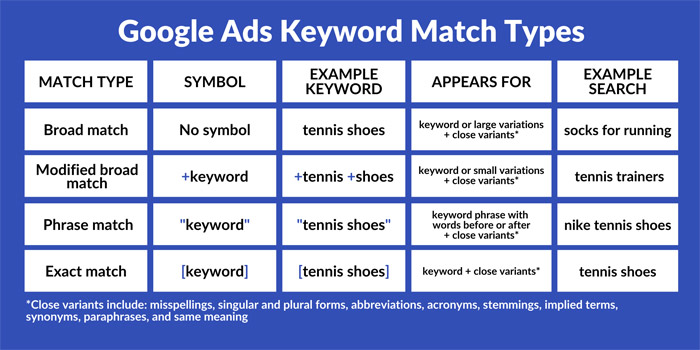
A keyword match type is a Google Ads keyword option that delivers an ad on Display Network and Google Search Network and controls how your keywords connect to real search queries. According to the keyword option you select, the ads are shown to either a special user group or a broad target group.
However, the keywords are quite generic and broad to ensure that you factor in for the maximum number of users.
Think of it like a filter.
A loose filter brings in more people, including some who may not be a great fit. A tighter filter brings in fewer people, but those people are usually closer to what you want.
Neither option is automatically good or bad. The right match type depends on your budget, offer, account history, conversion tracking, and how much room you have to test.
In Google Ads, advertisers mainly work with broad match, phrase match, and exact match. Each match type gives Google a different level of flexibility when deciding which search queries should trigger your ad.
Why Are Keyword Match Type Important For Your Brand?
When you select a PPC keyword match type, you ask Google to match your ads to the user searches in a particular way. For instance, an exact match can be too specific and picky, while a broad one will show many user searches that may not apply to your product or service and therefore be of no use to you.
The keyword match type integration of your choice helps the algorithm decide the platforms where your ads appear. As a result, you can target the right and more specific audience. A person searching “best PPC agency for ecommerce” has a very different intent than someone searching “free PPC training.” Both searches may include similar keywords, but only one is likely to become a serious lead. In addition, the keywords match type you select determines the relevancy of the presented ad and the search keywords.
Match type and keyword selection both help to target people when they search in Google. With this match type option, you can use all the available matches and get a high return on investment for your PPC ad campaigns.
It is essential to understand the different match types and execute a combination of them to help you create an effective Google Ads campaign. You can avoid irrelevant keywords, which will help you save the budget that you can use to drive more conversion rates.
Relationship Between Match Types And ROI
Your keyword match types ensure you get the most value from your PPC advertisement budget. The four main PPC keywords match types determine how a search query matches your Google Ads account keywords. These include phrase match keyword, Broad match keywords, Exact Match, and Modified broad match keywords.
With a proper understanding of each of these match types, you can choose the most suitable one for your campaign to improve your ROI ultimately.
Types of PPC Match Types
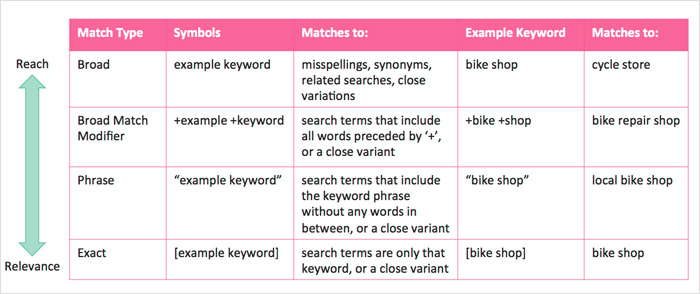
Broad Match
Broad match gives Google Ads the most flexibility.
Your keywords are assigned a default type which is the broad match. This lets search engines display your ads for terms that are your account’s keyword variations. Your ads can be displayed on searches with synonyms, related searches, misspellings, other relevant variations, and singular or plural forms.
This casts the widest net possible, bringing in all kinds of searches to show your ad. However, it is essential to realize that broad match keywords can waste PPC’s budget when it displays your ad on irrelevant keyword variations.
For instance, if you own musical instruments with a good variety of acoustic guitars at an Orange County shop, your selected keyword will be “Acoustic Guitar Orange County,” and Google can interpret it for the following search matches:
- “Orange Guitar Acoustic County”
- “Acoustic Guitar LA County”
- “Orange County Green Acoustic Guitar”
- “Electric Guitar Orange County”
Broad match works best when your account has reliable conversion tracking, a reasonable testing budget, strong negative keywords, and enough data for Google Ads to learn from.
Use broad match when:
- You want to discover new search queries
- You have room in the budget to test
- Your conversion tracking is accurate
- You review search terms often
- Your negative keyword list is already in decent shape
Be careful with broad match when every click needs to count. It can bring in useful traffic, but it can also invite people who were never going to buy.
The Iceberg Effect
When you use the broad match type, you can end up paying for results or search terms that are different from the keywords you bid on, resulting in the Iceberg Effect. As a result, you can overpay for irrelevant search topic ads and have minimal control over the search queries your ad is displayed for.
If you want to generate the maximum traffic for your landing page, a broad match keywords is beneficial. However, you can get lost in the vast amounts of irrelevant terms that show up in your search term report, which will be of no use since you want to attract potential customers.
A broad match generally generates many clicks for your website, but not all of them are from your targeted audience. The chances of conversion are significantly less, resulting in high ad costs with less ROI.
Benefits
A broad match is a good option for your ad campaign if you cannot create in-depth keyword lists. It can reveal similar keywords, long-tail searches, and new customer language. If a particular ad gets no clicks on some keyword variation, your ad will no longer be displayed by Google’s system for that search term. As a result, the click charges will decrease for your low-performing keyword variations so that you can spend more on relevant keywords.
Pair broad match with strong conversion tracking, smart bidding when appropriate, and regular search term reviews. Keep broad match in a carefully themed ad group so the traffic does not become too scattered. When used well, broad match can help you learn faster. When used carelessly, it can spend fast.
Negative Keywords
You can use negative keywords with phrase and broad match keywords, as the addition of negative keywords helps increase targeting, improving your ROI when you use the broad match. This means that when you designate a negative keyword, Google Ads can never display your ad when that term is used in a search. Negative keywords help clean up irrelevant search queries before they waste more money. They also make your ad group data easier to read because fewer unrelated searches are mixed into the results.
Use a minus sign with a keyword to create a negative keyword and clock a significant amount of irrelevant traffic. But know that this will limit your reach. If a search performs especially well, you may even give it its own ad group with a more specific ad and landing page. That kind of cleanup is not glamorous, but it is one of the easiest ways to improve ROI.
Broad Match Modifiers
This is a more trustworthy and responsible version of the broad match type for your Google Ads budget. It acts as a moderation between the broad type and other restrictive match types. In addition, it allows you to pick specific search terms that should be in your ad for it to be displayed. For current campaigns, focus on choosing the right match type, building clean ad group themes, and using negative keywords to filter out irrelevant traffic.
Add the plus sign with one or more words and create your broads match keywords. These appear in a user’s search in no specific order. Broad match modifiers give more control and visibility over how you spend your ad budget than the broad match type.
Furthermore, broad match modifiers are safer with a greater click-through rate (CTR) than broad matches. This happens because synonym or related search keywords do not trigger your ads.
Pros And Cons
This match type gives a range of searches with helpful keywords that you had not previously considered, but that still have the potential to trigger your ad. With a modifier like the plus sign in your broad match keywords, your ad traffic’s relevancy increases as they generate highly targeted traffic.
It is best to use this match type to increase your impression count and decrease the irrelevance the broad match generally gives.
Phrase Match
Phrase matches are keyword match types that eliminate the unnecessary and risky traffic that the other match types produce. With the phrase match keywords type usage, when someone searches for your keyword phrase, your ad is displayed in the search results in proper order.
Unlike broad match or modified broad match keywords, phrase match keywords does not have search terms with the middle words of your phrase. Phrase match is also a better option when your keyword’s meaning changes with the order of terms. It ensures that your keyword is displayed in the order that you choose.
Phrase match type has better flexibility than an exact match keywords which makes it so important, and it also lets Google show more discretion than the broad match types. Furthermore, since you don’t have to follow exact match, you can enjoy the phrase match’s wide audience. However, you can expect irrelevant traffic here as well.
Phrase match keywords is essential to maintain the word order and ensures that you reach the correct searchers. As a result, a specific keyword of your choice has increased traffic, and your ad budget is better focused on more relevant traffic.
There will be a difference between the traffic volume that broad match and phrase match bring to your site. However, phrase match keywords does get higher-quality traffic with more conversions using a more niche-targeted ad, which makes up for the lesser traffic.
Use phrase match when:
- You want controlled reach
- You are testing a new offer
- You need cleaner search queries than broad match usually provides
- You want to compare exact or phrase match performance
- You are building tightly themed ad group structures
Phrase match will not eliminate every irrelevant click, but it usually gives advertisers a more manageable starting point.
Exact Match
The most restrictive PPC keyword match type is the exact match keyword type since it restricts the display times of your ad. So while this match type gives you the most relevance, it provides the lowest reach to your ad.
It would be best to use the exact match keywords type when you want to serve your ad for a particular keyword. With an exact match keywords, you can choose to show your ad to only those customers who search for that same keyword or one that is closely related to it. It gives you the highest level of control because your ad is shown for searches with the same meaning or intent as your keyword.
These closely related terms include misspellings, accents, abbreviations, stemming, singular and plural forms, recorded with the same meanings, conjunctions, and prepositions. Again, you can create an exact match keyword type with brackets around a specific keyword. In Google Ads, exact match keywords use brackets, like this:
[ppc management agency]
This exact match type lowers your ad’s traffic and generates fewer clicks or impressions than other match types. However, exact match keywords generates highly targeted traffic with the maximum conversion chances because users search for the exact term you have created your keyword around.
Additionally, exact match keywords help increase your Quality Score because of lowering the search term-to-keyword ratio. This match type has ads that create the most click-through rates but at the greatest cost-per-click.
Use exact match when:
- You know the term converts
- You want tighter control
- You need cleaner reporting
- You are protecting a limited budget
- You want one exact phrase to receive special attention
- You want to separate high-value terms into their own ad group
The exact match type is not about getting the most traffic. It is about getting closer to the right traffic.
Exact Match Risks
The exact match type can help to decrease your overall costs because you only pay for fewer targeted clicks. However, it is also essential to note that you also risk missing helpful keyword-related traffic with the further inability to get long-tail data.
People search in messy, unpredictable ways. They add locations, questions, extra details, brand comparisons, and buying signals. If your campaign only uses exact match, you may miss valuable long-tail searches.
That is why many advertisers combine exact match with phrase match. The exact term gets tight control, while phrase match catches close variations and useful longer searches.
This is also where a keyword match type tool can help. It can show which terms should stay exact, which ones should move into phrase match, and which similar keywords might deserve testing.
A keyword match tool can also help prevent overlap between campaigns or ad groups. That matters because keyword overlap can make reporting harder to read and optimization harder to trust.
Conclusion
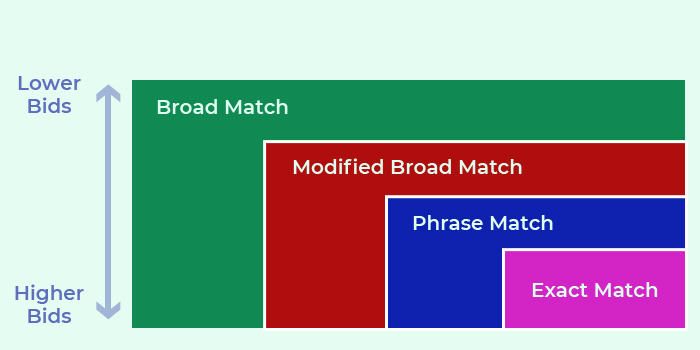
It is essential to choose the right PPC keyword match types for an effective PPC strategy. There are four match-type keywords that you can select for your campaign, depending on which one fits your needs closely.
If your Google Ads campaign is spending money but the leads feel off, look at your keyword match type setup first. Review your search queries, clean up your negative keywords, tighten each ad group, and consider using a keyword match type tool to organize your terms more clearly.
Since the match type decides the extent to which a search query matches your keyword in the Google Ads account, you have several options to choose from. These include Broad, Broad Modifier, Phrase, and Exact match types, where each of these has its pros and cons, making them optimal for various types of campaign goals.
In any case, keyword match types play an essential role in online marketing, and marketers and advertisers must use them for effective marketing campaigns.
We are a PPC management agency with a focus on direct and white label PPC clients. Whether you own a single online-focused business or are a new online marketing agency, contact us today to get started!
Match types are just one lever. For the full playbook on platforms, ad copy, landing pages, and bidding, check out our ultimate guide to PPC management.
For home service businesses like plumbing companies, match type strategy is really a proxy for search intent — broad matches tend to pull in casual how-to searches, while tighter match types on phrases like “24-hour plumber” capture the callers who are ready to book. Our guide to PPC tips that help plumbers get real leads without wasting money on clicks covers how to apply that same high-intent filtering across an entire plumbing campaign.
Match type discipline matters even more when the cost of a bad click is a wasted storm-season lead. Our tactical PPC guide for roofing contractors shows how phrase and exact match combine with negative keywords to keep roofing campaigns focused on purchase-intent searches.
Rental car searches range from vague ("car rental") to razor-specific ("car rental near Union Station"), and match type is how you control which ones you pay for. See our PPC guide for car rental services for the negative-keyword list that keeps exotic-car and one-way searches from draining a standard rental budget.