
How to Stop Bot Traffic from Draining Your PPC Budget
Bots quietly burn 10 to 30 percent of paid media spend. Here is how to detect invalid clicks, block them across Google and Meta, and recover ROAS.

Most paid-media teams treat bot traffic as a rounding error. The platforms filter it, Google issues credits, and the monthly report moves on. That framing was defensible a decade ago. It is not defensible in 2026, when automated traffic accounts for more than 53% of all web activity and a growing share of it is sophisticated enough to slip past platform-level filters, generate a session, bounce, and quietly inflate the denominator on every conversion-rate calculation on the account.
The real cost is not the invalid click itself. It is the downstream damage: bid algorithms training on garbage signals, lookalike audiences seeded with fake users, remarketing pools polluted with headless browsers, and a CAC number that keeps drifting the wrong direction with no obvious cause. This piece walks through what modern bot traffic actually looks like on a PPC account, how to diagnose it, and the specific controls that recover the most spend.
What Bot Traffic Actually Looks Like in 2026
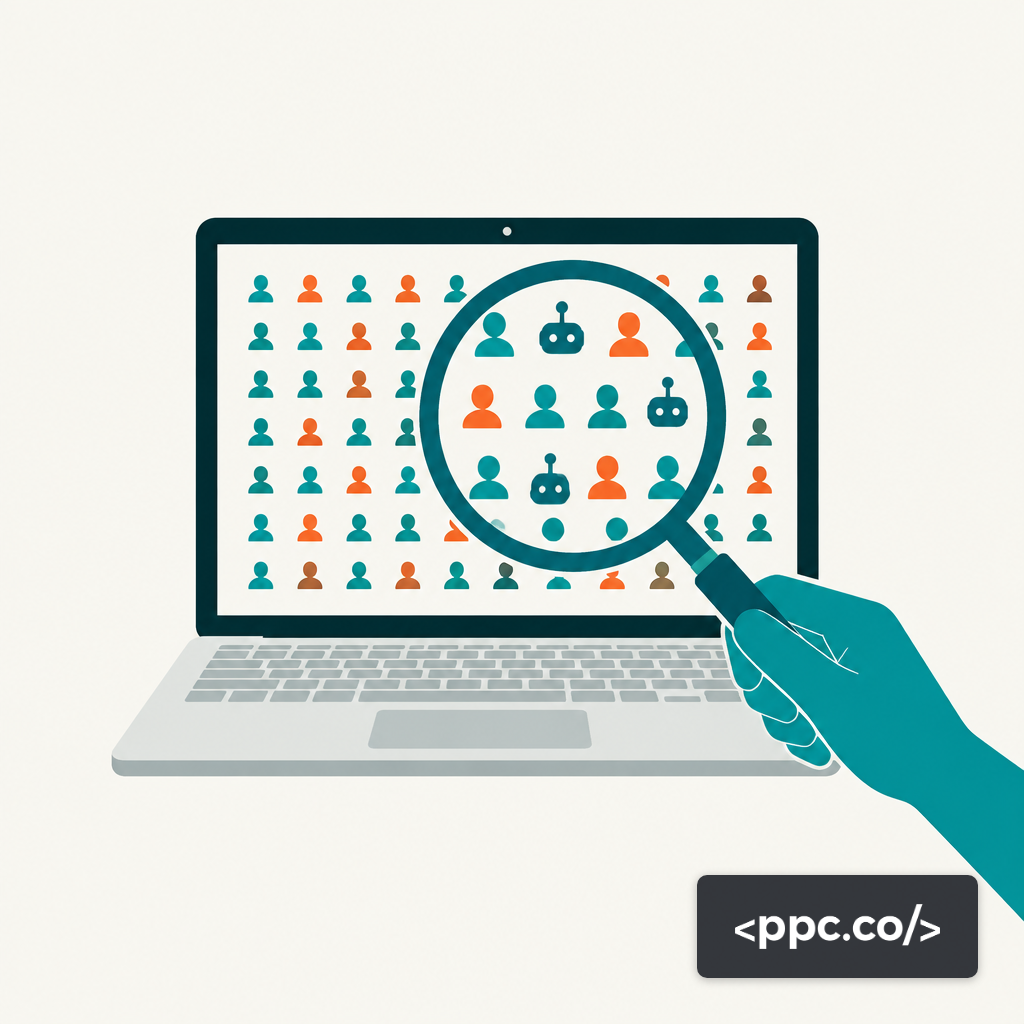
The old mental model of click fraud, a competitor manually hammering an ad, is a footnote. Today's problem has three overlapping layers. General invalid traffic (GIVT) is the easy stuff: declared crawlers, data-center IPs, known bot signatures. Google's ad traffic quality team catches most of it before you are billed. The harder layer is sophisticated invalid traffic (SIVT), which requires human intervention or deeper analysis to identify because it uses residential proxies, real browser fingerprints, and mouse movement to look human.
The third layer is new. LLM crawlers and autonomous AI agents now sit alongside good and bad bots as a distinct category, and 27% of bot attacks target APIs directly, bypassing the front-end entirely. On the ad side, this shows up as ghost sessions from OpenAI, Anthropic, and Perplexity user agents crawling landing pages linked in generative answers, plus a rising share of headless traffic that touches your ad, loads the page, and leaves no fingerprint a standard GA4 view would flag.
Retail and travel absorb the worst of it. Bad bots made up 59% of retail traffic and 48% of travel traffic in the most recent measurement year, both well above the 37% web-wide average at that time. If either category is in the media plan, the baseline assumption should be that a meaningful slice of paid clicks is not a person.
How to Diagnose Bot Traffic on a Live Account
Before deploying any defense, quantify the problem. A diagnostic pass takes a few hours and produces a defensible baseline against which to measure recovery. Start in Google Ads with the Invalid clicks and Invalid click rate columns applied at the campaign, ad group, and network level. Anything above roughly 15% on Search, or above 25% on Display and video, warrants investigation regardless of what the platform says it already filtered.
Move to GA4 and pull sessions by paid campaign against three signals: sessions with engagement time under two seconds, single-page sessions from ISPs that are actually hosting providers (DigitalOcean, OVH, Hetzner, AWS, Google Cloud), and repeat sessions from the same IP or device within short windows. Cross-reference against a server-log sample from the same period. GA4 will miss a great deal of what hits the origin server because bots increasingly refuse to execute JavaScript, so the delta between server logs and GA4 sessions is itself a useful bot-load estimate.
On Meta, the diagnostic is different. Meta does not expose an invalid click column, so the tell is a spread between reported link clicks and landing-page views that exceeds 20% on campaigns pointing to a fast, well-instrumented page. That gap is bots and misfires. Layer in a Meta pixel event that only fires after scroll or a defined dwell time, then compare against reported clicks. The ratio is your effective quality rate.
The Defense Playbook That Actually Recovers Spend
Nothing about bot defense is a single toggle. Recoverable waste sits in the 10 to 25% range for most accounts and the controls compound. Deploy them in this order, because each one narrows what the next has to catch.
Platform-Level Exclusions First
In Google Ads, build an IP exclusion list from three inputs: known data-center ranges (Google, AWS, Azure, DigitalOcean, OVH), any IPs your GA4 or server-log diagnostic flagged as high-frequency, and competitor office IPs where identifiable. The Search Network cap is 500 IPs per campaign, so prioritize ruthlessly. Add placement exclusions for the low-quality mobile app inventory that reliably shows up on Display and Discovery, and pull Search Partners off any campaign where post-click behavior meaningfully underperforms Google.com. On Meta, exclude an audience of users who trigger the pixel but never scroll, and layer in Advantage+ audience exclusions for known scraper user agents surfaced by your CDN logs.
Edge Filtering With Cloudflare or Equivalent
Move detection upstream of the ad platform. A Cloudflare WAF rule set that challenges known bot ASNs, blocks residential-proxy providers by reputation score, and rate-limits repeat requests from the same fingerprint will stop a large share of SIVT before it becomes a billable click. The AI-crawler control panel released in 2025 lets you allow, meter, or block individual LLM user agents by name, which matters because those crawlers do not convert and should not be training your bid algorithms. Similar functionality exists in Fastly, Akamai, and AWS WAF Bot Control.
Analytics Hygiene
Configure GA4 to filter known bots and spiders in every data stream (it is not on by default for custom events), add internal-IP filters for the agency and client, and build an exploration that segments paid traffic by engagement-rate bucket. Anything under 10% engagement is a candidate for exclusion from remarketing audiences and lookalike seeds. The point is not perfect measurement; it is preventing the smart-bidding model from optimizing toward the wrong shape of user.
Third-Party Fraud Tooling Where the Math Justifies It
Tools like ClickCease, Fraud Blocker, Lunio, and CHEQ layer on click-level fingerprinting, automated IP exclusion sync back to Google Ads, and forensic reports that hold up in a Google credit dispute. They earn their keep on accounts spending north of roughly $20,000 per month on Search, or any account in a high-CPC vertical where a single fraudulent click costs $40 or more. Below that threshold, the manual playbook above generally clears enough waste to make the subscription optional.
Benchmarks for How Much Spend Is Actually Recoverable
The honest answer is that no vendor can tell you a precise recovery number without seeing the account. What the industry data supports is a range. Independent measurement of Google Ads traffic has found more than 11.5% of clicks in Google Ads are invalid in aggregate, and that figure sits on top of what Google already filters. Meta, LinkedIn, and the smaller platforms tend to run higher because their post-click verification is weaker.
A reasonable planning assumption for a mid-market Search account after a full diagnostic pass is 8 to 15% recoverable spend in the first 90 days, with a further 3 to 7% recovered over the next two quarters as edge rules mature and audience exclusions retrain the bidding algorithm. Display and video sit higher, often 15 to 30%. Meta lead-gen campaigns, particularly in categories bots target for form-fill fraud, can be higher still.
Two caveats matter. First, recovered spend is not the same as recovered pipeline. Some of what the bots were consuming was already being wasted on genuinely uninterested humans; cleaning it up sharpens ROAS but does not always lift raw conversion volume in the short term. Second, smart-bidding recalibration takes real time. Expect a two to four week noise window after major exclusion changes before the trend line is readable. That is worth building into any PPC audit deliverable so the client is not spooked by the transition.
Where This Fits in the Broader Media Operation
Bot defense is not a project; it is a maintenance discipline that belongs in the same monthly cadence as negative-keyword pruning and creative refresh. Most agencies get it wrong by treating it as either a paranoid one-off, run once and forgotten, or as something the platforms handle. The platforms handle a lot. They do not handle enough, and the gap is growing as agentic traffic normalizes and adversaries get cheaper access to residential proxy pools.
The operators who protect ROAS through this shift will be the ones who build bot hygiene into the same infrastructure they use for scaling PPC campaigns and for AI-assisted account management. That means edge rules that update themselves, analytics views that flag drift the day it starts, and exclusion lists that sync automatically between the CDN, GA4, and the ad platforms. For teams already leaning into AI-driven PPC workflows, adding a bot-signal feed to the same orchestration layer is a small lift with an outsized effect on how clean the training data feeding smart bidding actually is.
The temptation is to keep treating this as a security problem that sits outside the media team. It is a media problem. Every dollar the algorithm spends chasing a headless browser is a dollar not chasing a lead, and the cumulative distortion of bidding models that learn from bot behavior is worse than the click waste itself. Fix the inputs and the ROAS math starts telling the truth again.