
Why Google Ads Shows More Conversions Than Your CRM
Google Ads reports 40% more conversions than your CRM. Here is a diagnostic framework to find the gap, reconcile the numbers, and trust your reporting again.

A 20% difference between the Google Ads conversion column and your CRM lead count is not a tracking failure. It is the arithmetic of two systems measuring different events under different rules, and that 10-20% baseline difference has been the expected state since Consent Mode v2 rolled out.
The sections below isolate each source of variance and the test that quantifies it, so a media buyer can report a single adjusted, defensible conversion count instead of two unreconciled ones. Treat the output as a decomposed delta, not a verdict on which platform is lying.
What Each System Is Actually Counting
Google Ads counts conversion events: tag fires on your site, plus any offline conversions uploaded against a GCLID. The record is stamped by click time, credited to the campaign that earned the click, and adjusted for Google's current attribution model. A CRM counts records, keyed on email or phone, time-stamped by create date, and credited by whatever source field the inbound workflow wrote.
Those are different objects. One click can fire two conversion events. One CRM record can absorb three clicks across devices. Before touching any reconciliation workflow, write down what each count actually represents. A PPC audit that opens with this definitional step almost always finds the largest variance is a category error, not a bug.
Modeled Conversions Fill the Consent Mode Shortfall
When a user rejects cookies, Google Ads cannot observe the conversion. Consent Mode v2 reports a modeled estimate instead. Google states this modeling recovers more than 70% of lost journeys on average. Those modeled rows appear in your conversion column. They do not reach the CRM, because the user who refused cookies never finished the form, or finished it under a session the CRM could not join back to a click ID.
Size this bucket directly. In Google Ads, the segment for "Conversions (by conversion time)" shows modeled versus observed. If modeling contributes 8% of total conversions, expect the CRM to run short by roughly that share before any other factor is applied.
Attribution Windows and View-Through Inflation
Google Ads currently offers two attribution models, Data-Driven and Last Click, after first-click, linear, time-decay and position-based were retired in 2023. The default click lookback is 30 days, engaged-view 3 days, view-through 1 day. A CRM has no view-through concept at all, and its source field is typically last-touch by cookie or UTM at form submit.
Every view-through conversion in Google Ads is a near-guaranteed mismatch. The lead exists in the CRM, but credited to organic, direct, or another paid channel. Pull the "View-through conversions" and "Cross-network" columns and subtract them before comparing. On Display and Performance Max, the view-through share can account for a double-digit percentage of the reported total, which is one reason Performance Max audits often show inflated conversion counts against a lead-gen CRM.
Duplicate Counting Across Ad Platforms
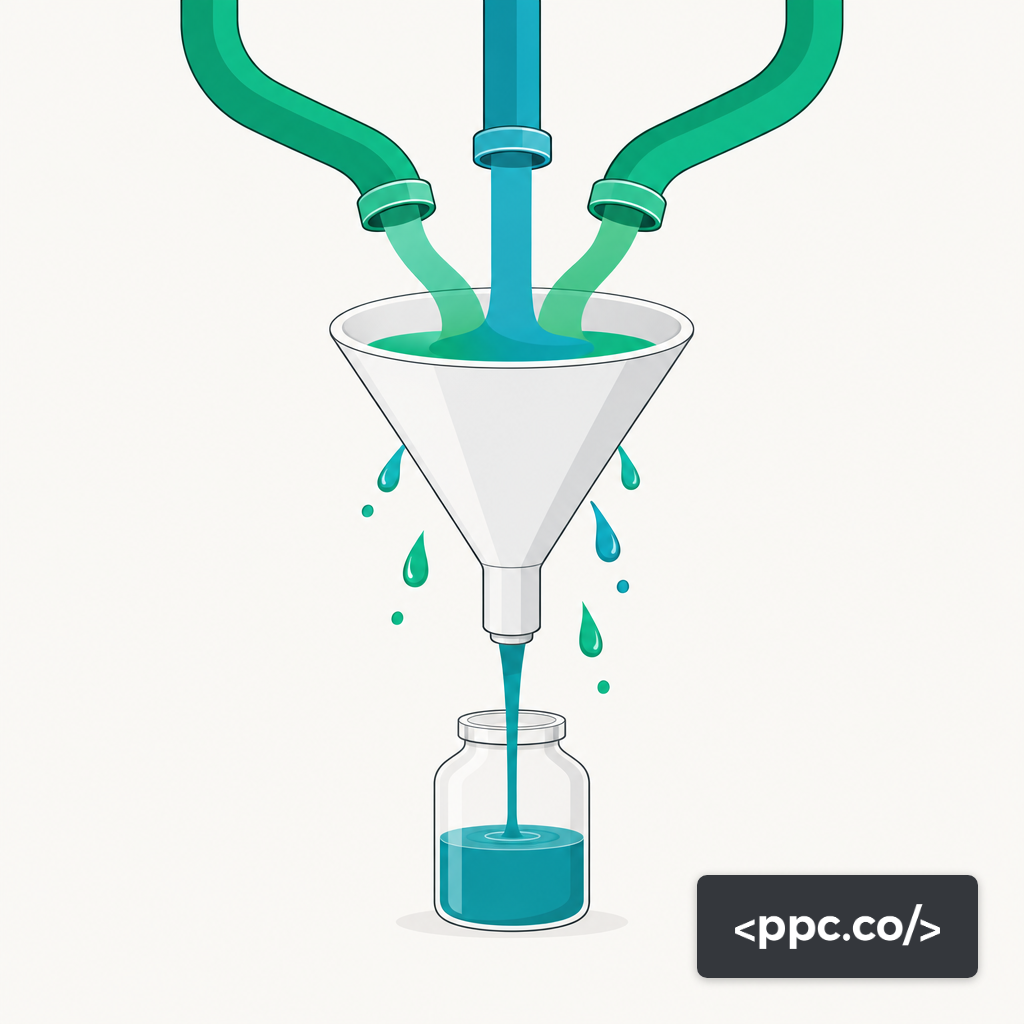
When Google, Meta, and LinkedIn run on the same funnel, each platform claims the conversions it can plausibly take credit for. The CRM, deduplicated by email, holds one record per lead. The platforms sum to well over 1x, and the overcount compounds when a Meta CAPI pipeline fires the same event through browser and server endpoints without proper event ID deduplication.
Reconcile by exporting the platform-reported conversion IDs, joining them on CRM record ID, and flagging any record claimed by more than one source. The flagged records are the overlap; the subtraction is your first platform-level adjustment.
Invalid Clicks the CRM Never Sees
Bot-submitted form fills appear in Google Ads as conversions because the tag fired. They are then rejected or merged out by CRM dedupe, SDR screening, or MAP spam rules. Google filters a portion of invalid traffic before billing, but filtering does not catch everything that reaches the form, and the residual delta between "Google conversion count" and "CRM lead count" in a bot-heavy vertical is often one of the largest line items in the reconciliation.
Techniques to block bot traffic upstream shrink both the paid conversion count and the CRM dedupe loss at once. Isolate the magnitude of invalid traffic by campaign type before deciding where to apply filtering.
Enhanced Conversions and Match-Rate Decay
Enhanced Conversions hash first-party data from the form and send it to Google, where the system attempts to match the hash against a signed-in Google account. When the match succeeds, a conversion previously unattributable gets credited to the original click. When it fails, the conversion still fires on the site, so it still appears in Google Ads, but under the "user-provided" category rather than a modeled or observed row.
Low match rates introduce variance in two directions. Successful matches can inflate Google Ads above the CRM when the same lead is also submitted through a non-Google channel. Failed matches can leave a conversion in Google Ads with no GCLID attached, which means your offline conversion import cannot overwrite it with the real downstream outcome.
A Numbered Reconciliation Pass
A clean reconciliation produces one adjusted number per side and an explained delta. The sequence below is the order that stops downstream errors from contaminating upstream math. Run it monthly against the previous calendar month closed in the CRM, and cohort by click date rather than create date, so a January click that became a February lead stays with January's spend.
The output is a single table: Google Ads reported, minus modeling, minus view-through, minus bot share, minus platform overlap, versus CRM leads plus unattributed inbound. The residual is labeled as uncategorized variance. Across 500 Google Ads audits, the most common reporting mistake is quoting a single blended ROAS without disclosing which conversion source was in the denominator.
- 11. Audit conversion actionsReview all active conversion actions and fix duplicate or mis-set 'Include in Conversions' flags.
- 22. Verify tag implementationUse Tag Assistant to confirm each tag fires exactly once per conversion.
- 33. Align attribution windowsMatch click lookback to sales-cycle length and choose 'One' vs 'Every' counting deliberately.
- 44. Reconcile lead-quality rulesSeparate CRM qualification gates from tracking loss by comparing raw submissions to qualified leads.
- 55. Enforce UTM and GCLID captureTurn on auto-tagging and verify the parameters survive the full funnel to CRM record creation.
- 66. Set up offline conversion importsSend qualified-lead and closed-deal outcomes back to Google Ads to feed Smart Bidding.
The Residual Is the Metric That Matters
After every adjustment above, a residual of 3-7% usually remains. That is acceptable, so long as it is labeled as uncategorized and tracked over time. A residual that climbs month over month indicates a specific drift, a new campaign type, a changed tag, an expired consent banner, not a systemic failure. A residual that collapses to zero usually indicates one side was forced to match the other through a reporting convenience. The point of the reconciliation is to defend the delta, not to erase it.
What a Defensible Reconciliation Looks Like
Put one question to the agency or in-house team that owns Google Ads reporting: "Produce a month-over-month reconciliation showing Google Ads reported conversions, modeled contribution, view-through share, platform-overlap conversions, bot share, CRM lead count, and uncategorized residual, in that order, for the last three closed months." A good answer delivers the table in under a week, labels the residual explicitly, and flags which bucket moved most since the prior month. A weak answer pushes back on the premise, insists the Google Ads number is the ground truth, or quotes a single blended ROAS figure without decomposition.