
How to Maximize Impression Share in PPC
Discover how to maximize impression share in PPC campaigns. Increase visibility, expand your reach, and effectively connect with your target audience.

PPC ad campaigns are complicated.
Getting started is easy enough. You can choose a small handful of keywords, set a campaign budget, and watch your advertisements roll out for users that are, presumably, relevant for your brand.
But if you’re interested in making the most out of every dollar you spend on PPC advertising, you’ll need to think critically about your keyword targeting strategy, your campaign budget planning, and more.
That also means making strategic changes to your PPC campaign overall so it performs better, ultimately earning you more visitors and more conversions for less money.
One of the most important concepts to understand in pursuit of this goal is impression share.
But what exactly is impression share and how can you maximize it in your Google Ads PPC campaign?
What Is Impression Share in PPC?
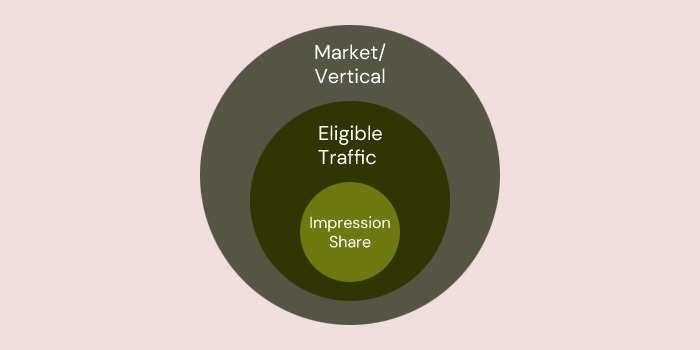
“Impression share” is a relative measurement of how frequently your ads appear in a given search engine results page (SERP) when a user searches for a relevant query.
For example, let’s say your ad is in position 1 for each search relevant for your settings – and you have unlimited funds to sustain this ad placement indefinitely. In this scenario, you’d have an impression share of 100 percent.
Obviously, impression share metrics are valuable. The higher your impression share is, the more frequently your customers are going to see your advertisements.
But when it comes to PPC strategy, maximizing impression share isn’t just about flatly increasing this metric.
That’s because impression share in Google is usually a byproduct of your ad Quality Score, your budget, and the nature of your competitors. Since you have no direct control over how many competitors are competing with you, and we can safely assume you’re already optimizing your ad Quality Score as much as possible, we can quickly identify the main problem holding back your impression share: budget.
Yes. If your only goal is increasing total impression share, there’s a very straightforward path to achieving it: spend more money.
But if you’re like 99 percent of PPC advertisers, this probably isn’t doable. You’re already spending as much money as you can afford on this strategy.
That means we need to take a different route. Assuming you can’t just throw money at this problem, how can you optimize and rearrange your PPC spending to make your impression share work in your favor?
Ultimately, this strategy boils down to increasing the impression share of your best performing keywords, potentially at the expense of decreasing impression share and spending on your worst performing keywords.
Let’s dig in.
The High Level: What’s the Value in Maximizing Impression Share in PPC?
First, why does this really matter?
In your PPC advertising campaign, you’re going to have some winners and losers. There are going to be some keywords and advertisements that return exceptional value to your brand, and some keywords and advertisements that are barely worth pursuing.
If you’re interested in getting the most value from the money you spend, it’s useful to move resources away from underperformers and toward your best performers. Maximizing impression share for your most valuable target keywords achieves this.
Maximizing impression share can also be a competitive advantage. If you’re running PPC advertisements in a highly competitive environment, it may be advantageous to get the highest impression share possible for a contested keyword; in this way, you can minimize the impression share for competitors’ advertisements.
How to Identify Your Best Performing Keywords in PPC
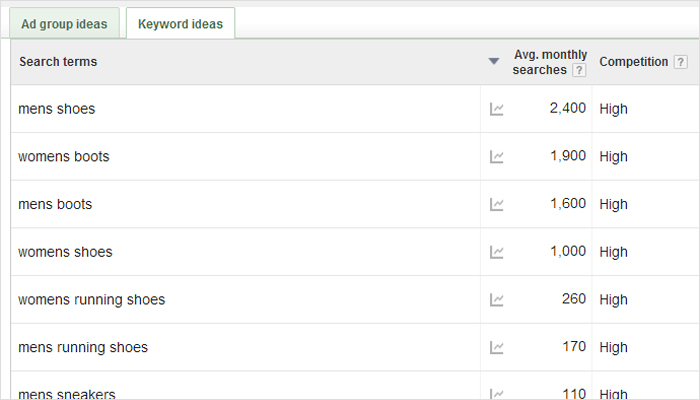
The first step in the process of maximizing impression share for your best performing keywords is identifying your best performing keywords.
There are a few key metrics that are especially important in making this determination. The most straightforward indicator of value is conversion rate, since conversion rate is often tied to revenue.
There are many actions that can qualify as conversions, so it’s important to track all of them. Making a purchase, filling out a form, or even watching a video could be a meaningful user action that predicts revenue generation in the near future.
The higher the conversion rate is for a target keyword, the more generally valuable we can assume it is. Would you rather have 1,000 visitors on a landing page capable of achieving a conversion rate of 8 percent? Or 1,000 visitors on a landing page with a conversion rate of only 1 percent?
In Google Ads, you can do this in the Keywords report, where you’ll see a breakdown of all your target keywords – including conversion rates for those keywords. You can use filters to selectively ignore your worst performing keywords, and bring your best performing keywords straight to the top.
Depending on the goals of your campaign and the nature of your target audience, conversion rate may not be the only variable worth considering. You may also want to consider the value of each conversion, the value of different types of landing page behavior, and other factors.
Still, conversion rate is a great place to start.
Analyzing Low Impression Share
In the Keywords report, you’ll also see a breakdown of impression share.
Ideally, all your best performing keywords would have an impression share of 100 percent – but we can pretty much guarantee this isn’t the case.
How can we push that impression share higher?
First, we need to analyze low impression share.
In other words, why are we seeing the impression share that we are?
You’ll need both Keywords and Campaigns reports to uncover more details.
- Search Lost Impression Share (Rank).Search Lost Impression Share (Rank) tells you the percentage of time your planned ad didn’t appear for relevant users because of a poor ad rank. Ad appearances are calculated based on a complex formula that includes your bid, your ad quality, and the bids and ad qualities of your competitors, so unfortunately, this can’t give you a perfectly clear picture of why your impression share is lower than you expected. Start by looking at your ad Quality Score to see if there are any noticeable problems in that area. After that, look at your top competitors and seeing if they’re taking a different approach. Beyond that, your only reasonable path forward is increasing your budget for your best keywords.
- Search Lost Impression Share (Budget). In the Campaigns report, you’ll be able to see Search Lost IS (Budget), which can tell you what percentage of potential impressions you’re losing due to budget limitations. In other words, the higher this percentage is, the more impressions you’re losing simply because your budget isn’t high enough. Search impression share is another indication of a budget allocation problem in your PPC campaign.
Keys to Optimizing for Impression Share in PPC
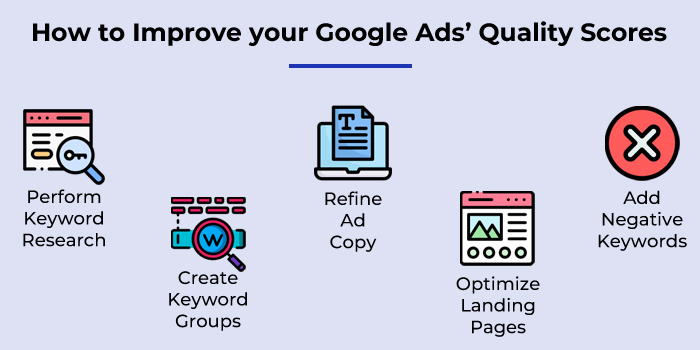
These are the most important steps to take if you’re interested in maximizing impression share to improve the overall return on investment (ROI) for your PPC campaign.
- Study the objective data. It’s impossible to make solid strategic decisions if those decisions are based on biased, subjective interpretations. Instead, you need to make sure all of your decisions are rooted in objective data.
- Cut budget to underperforming keywords. If you don’t have unlimited money to spend on your PPC advertisements, your best option is to free up some extra money by cutting your budget on underperforming keywords. Though target metrics are going to look a little different for every brand, you can usually identify an underperforming keyword if it has a conversion rate of less than 2 percent.
- Increase budget for top performing keywords. After slashing the budget to your worst performers, consider increasing your budget for the best keywords of your campaign. Sort by conversion rate and split this budget among the top few keywords in your report.
- Optimize for a higher Quality Score. Your Quality Score, available at the keyword level, is an indication of how your ad is expected to perform, according to Google Ads. The higher your Quality Score is, the more likely your ad is to appear, thus improving Google Ads impression share. You can optimize for a higher Quality Score by focusing on the three main factors used to determine it: expected clickthrough rate (CTR), perceived relevance to users, and overall landing page experience. Sometimes, making simple tweaks to the wording and design of your ad and landing page can make a huge difference.
- Revisit your conversion optimization strategy. It’s also worth revisiting your existing conversion optimization strategy. Remember, maximizing impression share is a strategy with the ultimate goal of helping you secure more conversions. It may be worth closely examining your existing landing pages and tweaking them to achieve a higher conversion rate, so you can boost the value of specific keywords that are especially important to your campaign. After that, you can increase your spending on those keywords.
Do you need help understanding which of your keywords are most valuable for increasing impression share in Google Ads?
Are you totally lost when it comes to doing deep dives into the analytics of your Google Ads PPC campaign?
PPC.co is here to help. Whether you’re thinking about starting a brand new campaign or you’re working out the kinks and negative keywords of a nascent Google Ads campaign that’s been running for years, we have the experts and tools you need to succeed. Contact us for a free consultation today!