
How to Improve Facebook Ads Conversions
Boost your Facebook ad conversions with expert tips to enhance targeting, messaging, and audience engagement.

Facebook is undoubtedly the most preeminent social media network in the world. More than two billion people use Facebook, making Facebook ads one of the most powerful tools for modern advertising campaigns. That’s nearly ⅓ of the entire world population. If you’re considering promoting your products and services, improving brand awareness, and driving sales and conversions, then Facebook is the perfect option for scaling advertising investment.
Getting started with Facebook advertising is as simple as owning a business page, setting up an ad account in Meta Business Manager, and launching your first ad campaigns through Facebook Ads Manager (also known as Ads Manager). With the right ad strategy and advertising budget, businesses can test what works while controlling ad spend.
Though, if you’re new to Facebook Ads (or any other PPC advertising platform, for that matter), you may quickly figure out that attracting eyes to your campaign is simple. Improving Facebook ad performance—by convincing complete strangers to buy, sign up, or convert—is a very different challenge.
But, it’s not impossible and you may find that improving Facebook Ads conversions is more straightforward than you originally thought.
To help you get more value from your advertising campaigns, here are proven strategies to improve Facebook ads conversions and overall campaign performance.
Define the Conversion
A conversion means something different to every business involved in marketing and advertising campaigns. If your audience is B2C, then a conversion may mean a sale or purchase.
If your audience is B2B instead, then you may consider a conversion of a new email list subscriber. In either case, conversions are valuable to your bottom end and considered to be a success, rather than impressions. Conversions may include lead ads submissions, email sign-ups, or demo requests.
With that said, what is considered a conversion event in your campaign? In other words, what do you want people to do once they see your ad?
Facebook Ads support standard conversions, such as:
- View content
- Add to wishlist
- Checkout
- Purchase
You can also create custom events using the Facebook Pixel and track them through Events Manager, if you want your target audience to do something else. Don’t expect all of your ads to serve the same purpose. Therefore, create separate ads for different conversion events.
Proper Facebook Pixel implementation allows Facebook algorithms to optimize ad delivery and improve engagement and conversion rates based on real user behavior. By monitoring Facebook analytics inside Facebook Ads Manager, you can better understand Facebook ad performance and refine your bid strategy.
First, consider how your goals will fit into your buyer’s journey, and plan accordingly.
Optimize Your Landing Page
An ad’s success is ultimately based on the performance of its landing page. High-converting Facebook ads rely on a strong value proposition, continuity between the ad and page, and a clear call to action. When you decide where your planned conversions will take place, make sure that your landing page has everything in place to be successful.
Here is everything you should do to ensure your landing page’s success:
- Use the Facebook Pixel — Once you’ve determined where you want your conversion to take place, you’ll need to add the Facebook Pixel code to that landing page to make sure you can track website visitors and conversions in real-time.
- Strive for Continuity across your Advertising Campaigns— If your ad makes a promise, ensure that your landing page delivers. You don’t want your potential customers looking for pants on a shoes product page. The landing design and copy should play an integral role here.
- Integrate Helpful Apps — Because a great number of people are willing to purchase on mobile devices like smartphones and tablets, you can steer potential customers to your app. Highlight your value proposition clearly to attract highest value customers. In this case, make sure that your app is registered with Facebook SDK.
When landing pages deliver on expectations, website visitors are far more likely to convert.
Use Captivating Visuals
Did you know that it only takes 2.6 seconds for a person’s eyes to scan a website page. Eye-catching visuals are essential for high converting ad creatives. Facebook users scan content quickly, so your visuals must immediately communicate social proof and value.
Generally speaking, your ad’s visuals will be either a great or horrible first impression. Therefore, treat your visuals like a first handshake by following these core principles:
- Avoid using too much text with images. Facebook recommends that advertisers don’t overload images with text, if at all. Instead of using text in visuals, place it in a designated place. If you’re going to use text in your images, use Facebook’s tool to check its rating.
- Make sure the sizing is correct. Visuals with low resolution represent your brand poorly. Make sure that your carousel ads, collection ads, and stories ads meet the right size requirements.
- Try video ads or GIFs. Moving images can better catch eyes than stationary ones. If you do choose to use videos or GIFs, make sure to test them on mobile devices such as tablets and smartphones first.
Following these practices will help your ads stand out directly in front of your target audience. Using the right mix of ad formats improves Facebook ad performance and reduces ad frequency.
Use Concise Copy
Copywriting doesn’t have to be difficult. In fact, effective copywriting involves psychology and human nature more than prose. High-performing Facebook ads rely on clarity and relevance. Avoid jargon and reinforce your value proposition in simple language when targeting people unfamiliar with your brand.
Instead, strive to create crisp copy. Otherwise, your audience may not even read it. Here are some effective copywriting tips every advertiser should strive for:
- Get Personal — Using you, your, and other personal pronouns indicate that you have a strong connection with your target audience. With that said, stay away from using “we” in your ads. A recent study maintained that using “we” is best used for returning customers.
- Avoid Jargon — Speak in the language that your audience will understand and relate to. Avoid using highly-technical lingo that no one will understand.
- Make it Clear — Too much text is difficult and time-consuming to read for anyone. Ad copy is meant to be clear and brief. Focus on the bare essentials of what your ad is supposed to communicate. You can use the Hemmingway App to help.
Copywriting is all about communicating in a way that doesn’t make you appear like an unscrupulous salesperson. The more natural and concise your copy appears, the more willing your target audience will be to read it and convert.
Master the Call-to-Action
The call-to-action (CTA) is the singular most important aspect of your ad. Whether you’re promoting lead ads, purchases, or subscriptions, your CTA should align with your conversion goal and overall ad strategy. When a person is finished observing your ad’s copy and visuals, the next thing they may do is click on the CTA.
A clear call to action motivates someone to commit the action you want them to do. Therefore, they must be persuasive and dynamic. To do so, use strong verbs like explore, find, discover, and start if you want to direct potential consumers to visit a product page.
If you want to drive subscriptions and purchases, use more direct phrases like “sign up” and “buy now”. Creating the right CTA is a paradox. The best CTAs are both direct and clever. Strong CTAs help improve campaign performance without increasing ad budget.
As you can see, using “buy now” in eCommerce ads is a straightforward way to compel someone to buy something. It’s important to note that your CTA should not be doing all of the heavy lifting for your ad.
Your ad’s copy and visuals should explain what the offer is. The CTA should seal the deal. Therefore, don’t spend too much time trying to come up with flamboyant CTA phrases to inspire conversions.
Oftentimes, the simplest approach will work best.
Expand Your Audience
When creating your ad, check the box for “target expansion”. This will allow more groups similar to your audience to be targeted by your ad. Custom audiences and lookalike audiences help expand reach while maintaining strong Facebook ad performance. However, you must indicate the parameters of this feature in the “interest targeting section”.
Not only will this feature allow you to reach more people. You can also improve your conversions while reducing your cost per conversion (CPC). Make sure that you create custom audiences before continuing.
What’s more is that if you already have an email subscriber list or other data sets, you can integrate them into Facebook Ads to automatically find similar people on Facebook. You can take all of this work a step further and use custom audiences to discover lookalike audiences.
You can build custom audiences using:
- Email lists
- Website visitors
- Engagement from previous ad campaigns
These are people who have similar demographics and profiles to your existing target audience. Lookalike audiences are especially effective for scaling advertising campaigns and reaching new highest value customers.
Naturally, if your ad is targeting the right people, your conversion rate will improve on its own. Luckily, Facebook employs a bunch of helpful features to aid in creating both broad and granular audiences.
This will ultimately help you to achieve laser-focused ad delivery and boost your conversion rate.
Optimize for Conversions
Facebook Ads has a bunch of settings that are obscure to many beginners. Some prefer to run their campaigns on autopilot, forgetting to make use of certain functions like this one.
Within Ads Manager, in the Budget and Schedule section, under the “Optimization for Delivery” function, make sure to select the “conversions” option. This will help optimize ad delivery and improve results. Pairing this with the right bid strategy helps control ad spend, advertising budget, and overall campaign performance. Managing ad frequency carefully also prevents ad fatigue while protecting ROI.
As you can guest, choosing this option is optional. Nonetheless, there are a lot of case studies that prove how effective this feature is. Save the Children ran a test campaign pitting both ads optimized for traffic and conversions against each other.
They wanted to find out which option would help spur the most donations. Interestingly, they found that ads optimized for conversions received four times more donations than the alternative.
This test was conducted by a non-profit organization. If you sell products and services, just imagine the type of results you can achieve. Ads optimized for conversions are modeled after Facebook’s organic algorithms to reach your desired audiences.
No one knows the exact manner in which Facebook “optimizes” these ads, but this option is well worth a try.
Select the Right Ad Format
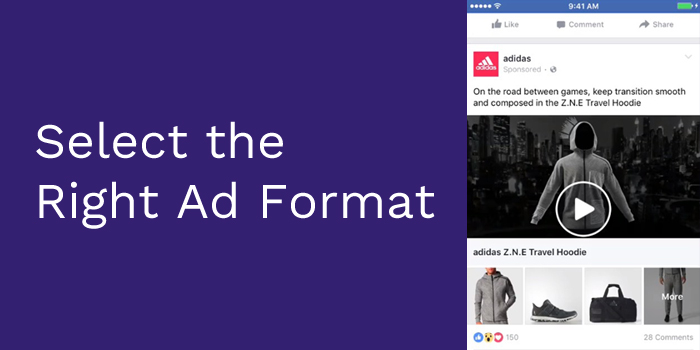
Different ad formats may best suit your campaign needs better than others, depending on your goals. For example, Adidas conducted a case study showing that using video was the perfect format to unveil different visuals of their Z.N.E Road Trip Hoodie. Video ads work well for storytelling, while carousel ads, collection ads, and lead ads often perform best for ecommerce and lead generation.
Because of this, Adidas reduced their CPC by 43%. If you want to achieve the same results, here are some key things to consider:
- If you have multiple products or features you want to showcase, you can never go wrong with using collection and carousel ads.
- If you want to broadcast special deals and discounts as purchase incentives, use Facebook Offers. When someone views and interacts with your ad, Facebook will send them notifications reminding them to redeem their offer.
- If your ad will provide experiences and visuals that are viewed best on full screen, Facebook Canvas is the best way to go.
As you can see, setting up a successful Facebook ads campaign goes beyond creating ad copy and captivating images. Choosing the right ad format can position it to reach and convert your target audience.
Testing different ad formats can significantly reduce CPC and improve Facebook ad performance.
Measure Across Multiple Devices
No matter where you plan for your conversions to take place, you should ensure that all your conversions can be tracked from a desktop to a mobile phone. This is helpful, especially if you want to drive traffic to a mobile app.
You can’t assume that everyone who visits your mobile app will download it, interact, and convert. Therefore, tracking potential customers to your mobile app and gaining insights from Facebook analytics are great ways to figure out if you need to make changes to your ad or your app.
Even if you don’t intend to drive traffic to your mobile app, you should still install Facebook’s SDK for your app. This will help Facebook algorithms receive more data about your audience and optimize advertising campaigns more effectively.
Turn Analytics into Helpful Insights
Once you run your campaign, you’ll receive analytical data about how it’s performing. Essentially, it’s up to you to determine what worked and what didn’t to make the necessary changes.
Take note of all of the analytics of your campaign and transform them into insights. Take what you learned from your previous campaign to elevate your next one. Not every campaign will be successful. Reviewing Facebook analytics, campaign performance, and engagement and conversion rates helps refine your ad strategy and reduce wasted advertising investment.
However, if you’re learning from your mistakes and willing to try new things, you’ll quickly figure out how to run a successful and affordable Facebook Ads campaign.
Need Help With Facebook Ads?
Running Facebook ads is a full-time job. If you’re busy running your business, you may find that you don’t have the time or expertise to manage your campaign. On top of that, your campaign may not be as successful as you imagined.
If your advertising budget isn’t delivering results, then we can help. At PPC.co, we specialize in optimizing ad spend, managing successful PPC advertising campaigns, and improving Facebook ads conversions. If you want to learn more about how we can help you, contact us today to speak to a member of our team.
Roofing companies in particular tend to see strong results from Facebook’s zip code and homeowner-status targeting, especially layered on top of a Google Ads campaign. Read more about how that combination works in our high-performance PPC guide for roofing contractors.
Coaches relying on Facebook remarketing are working with one of the most granular retargeting toolsets available — especially useful since coaching clients rarely convert on a first visit. Our guide to getting coaching leads through cost-effective PPC campaigns covers how to combine Facebook and Google remarketing with platforms like TikTok that most coaches ignore.
Web hosting providers researching competitors should be watching Facebook just as closely as Google — that’s where a lot of hosting companies run their acquisition ads. Our guide to generating quality web hosting leads with PPC covers how to turn competitor research into better hooks instead of copycat ads.