
Outsourcing Google Ads at Scale Across 20 Plus Client Accounts
Compare white label agencies and AI agents for managing 20 plus Google Ads accounts, with the controls, SLAs, and audit cadence needed to protect ROAS.

Outsourcing Google Ads across 20 plus client accounts works whether you lean on a white label human team or an AI agent stack, provided the MCC permissions, change-history audits, and budget guardrails stay in your hands. It stops being true the moment either partner owns the account structure rather than operates inside yours.
The practical question is not which model delivers better ROAS in the abstract. It is which model fits your account count, reporting cadence, and tolerance for after-hours intervention when a Performance Max campaign veers off budget.
Both approaches collapse to the same control surface: MCC role permissions, change history logs, budget guardrails, and labeling conventions. Where they diverge is cost structure, ceiling on accounts per operator, and failure mode when something breaks.
The MCC Is the Only Durable Control Point
Google Ads administrator, standard, email-only, and read-only roles each carry distinct write authority, and manager account links inherit permission from the parent downward as the Google Ads access model documents. For an agency carrying 20 plus accounts, the MCC is the only durable control point. Whoever you outsource to operates through role grants you issue, and every edit shows up in the change history of the account they touched. An AI vendor that refuses a standard role, or a white label team that insists on administrator access to work efficiently, has already compromised the first guardrail.
Keep administrator reserved for principals at your agency. Issue standard access to the human operator or to the service account the agent stack uses, and require sub-account linking to flow through the parent MCC rather than individual client logins. Labeling conventions should name operator and campaign intent together, for example wl-brand-search or agent-pmax-exp-04, so the change history reads as attribution rather than noise.
White Label Economics Hinge on Operator Load
The economics favor outsourcing at this scale. A senior PPC analyst burdened costs an agency roughly 70 to 95 thousand dollars a year, and a white label partner priced at 15 to 30 percent of spend or a flat fee per account typically runs cheaper than the salaried alternative once workload is counted honestly. The ceiling that matters is not price. It is accounts per operator.
A Databox survey of agencies found that nearly 70 percent of agencies report account managers handle fewer than 10 clients, while more than 10 percent assign 15 or more clients to a single manager. The latter correlates with longer response times and shallower weekly optimizations. Any white label vendor that quotes a per-account price without naming the analyst's current book of business is quoting a ceiling they cannot defend. Ask for the ratio. Where white label earns its fee is pattern-recognition work across verticals: negative keyword mining, bid adjustment logic for shoulder seasons, and search term reviews on accounts spending under 30 thousand a month where the signal is still noisy enough to confuse an agent.
What AI Agent Stacks Handle Reliably
An AI PPC agent stack in practice is a service account linked at the MCC level, orchestrated by code or an LLM calling the Google Ads API through a defined tool set. The capable layer today handles campaign structure proposals, negative keyword generation from search term reports, ad copy variants scored against performance history, and Performance Max asset group recommendations. It does not reliably handle strategic reallocation across accounts during a demand shift, or the judgment call that an underperforming campaign is underperforming because the landing page is broken rather than the bidding.
For an agency at 20 plus accounts, the realistic deployment is an agent that runs on a nightly or hourly cron for mechanical work (bid adjustments, placement exclusions, search term classification) with human review before anything above a budget threshold ships. Scope the agent's role to standard, not administrator, and route every write through a change log the human operator audits weekly. The specific permission patterns are covered in our writeup on automating Google Ads without losing account control.
Four Guardrails Carry Both Models
Google's February 5, 2026 launch of Multi-Party Approval requires a second administrator to sign off on adding or removing users and changing user roles, with requests expiring after 20 days if no admin acts. That closes the most common MCC hijack vector, but it does nothing for the daily failure mode in a multi-account book: budget drift from an agent or a junior operator pushing an ill-considered change.
Four guardrails do the heavy lifting:
- Shared budget limits at the MCC level for any account with a hard daily spend ceiling, so no single campaign can exceed it by API.
- Weekly scheduled export of the change history across every linked account, filtered by user. An unexplained pattern in one operator's edits is the leading indicator of trouble.
- Scripted alerts that fire when CPA drifts more than one standard deviation from a 30-day rolling average on any account spending over 10 thousand a month.
- A quarterly PPC audit against the operator's work, scored to a fixed checklist rather than the operator's own narrative.
Deciding Which Model Fits Which Client
The decision rule gets cleaner once the controls above are enforced. White label human teams fit accounts where creative judgment, landing page diagnosis, and cross-channel attribution questions are the work. AI agent stacks fit accounts where the work is high-volume mechanical optimization on structured campaign types (standard search, shopping, demand gen) and the monthly spend justifies the orchestration overhead.
PPC agencies lead agency categories in annual client churn, a function of commoditization that both outsourcing paths intensify. Neither model fixes churn on its own. Both lower the cost of servicing an account enough that retention math can stay in the black even when a client leaves after nine months.
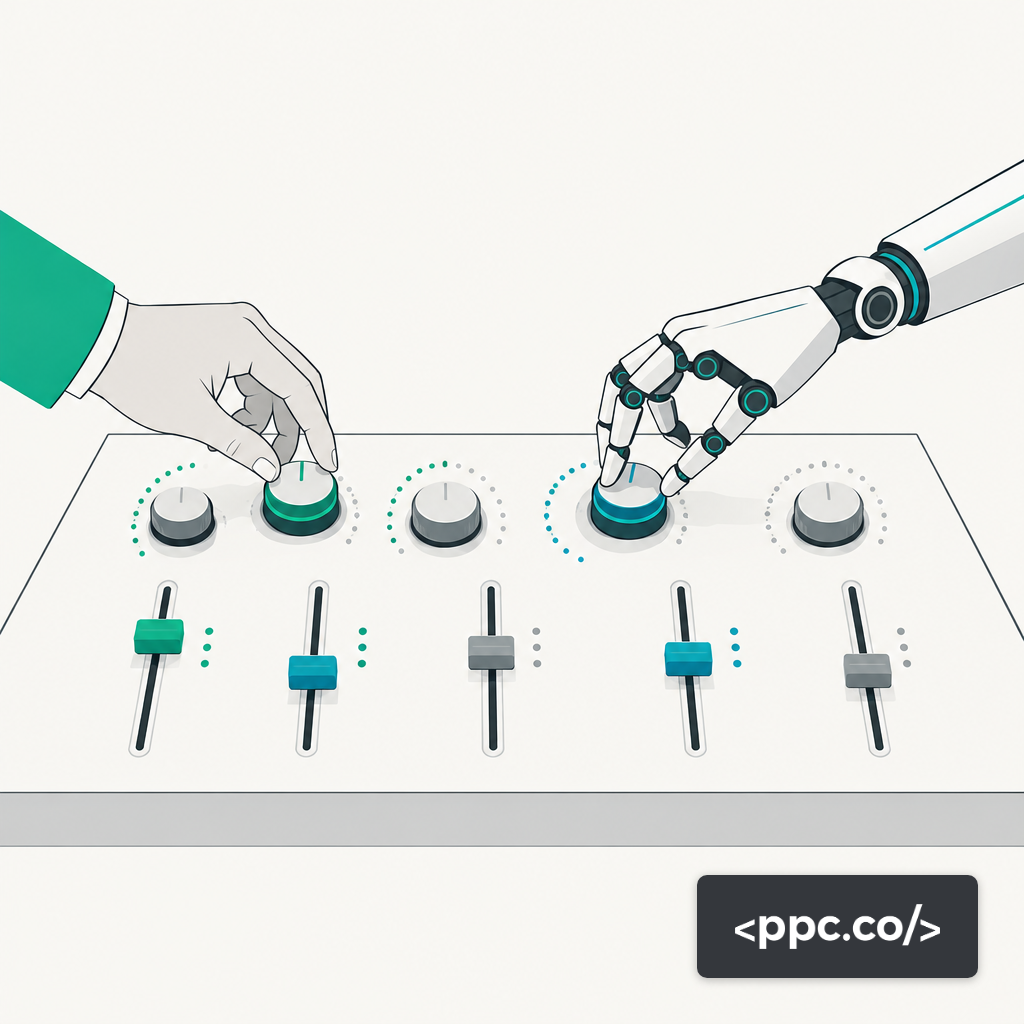
A hybrid is the honest answer for most agency owners at this scale: agent stack on the mechanical layer, white label operator on the strategic layer, and your own principals holding administrator role and sign-off. The failure mode this guards against is the one that ends agency relationships. A client calls about a 40 percent CPA spike and the owner cannot say, within an hour, which change produced it.
Hybrid Beats Either Pure Model at This Scale
The single question worth putting to any outsourcing partner, white label or AI vendor, is this: what role level will you accept in our MCC, and what is your weekly change-history review cadence? A good answer names standard-user access, a specific audit day of the week, and a willingness to be measured against the change log rather than the slide deck. A bad answer asks for administrator access and reports progress in screenshots.