
Optimizing for Profit (Instead of CPA, CPL, or even ROI) in PPC
Shift your focus to optimizing PPC campaigns for profitability, not just traffic or conversions, to achieve sustainable growth.

What does it mean to optimize a PPC campaign?
In the abstract sense, optimizing a PPC advertising campaign is simply making changes so that the campaign performs better. But then, what exactly is “better”?
It’s a tricky and complicated equation. Your optimization practices will require tweaks to your advertising, your targets, your landing pages, and possibly even what you sell to your customers.
Most optimizers make all of these changes in pursuit of one or a small handful of different metrics. But I’m here to make the case that if you optimize for CPC, CPA, CPL, or even ROI, you might be missing out on your true potential.
Instead, you need to optimize for profit.
Too Many Metrics in PPC?
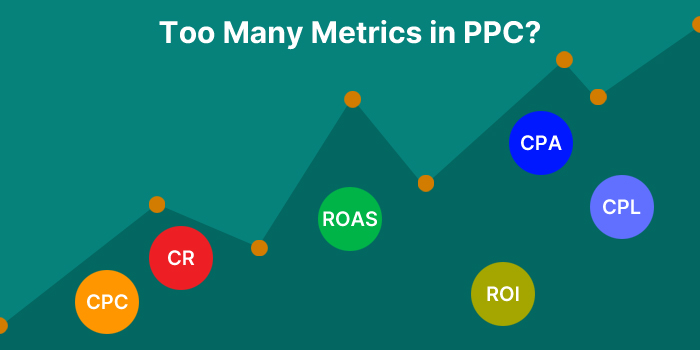
Part of the problem here is that there are so many different metrics you can track in a PPC campaign. We live in an era where data is abundant, and where even inexperienced marketing managers must take on the role of a data analyst at least occasionally.
When there are so many different variables and metrics to juggle, it can become overwhelming.
Just take a look at the following:
- CPC. Cost per click measures the price of each click in your campaign.
- Conversion rate.Conversion rate is a measure of how many people are taking a meaningful action once they explore your landing page.
- CPA. Cost per action measures how much you’re spending for each meaningful action taken by your users.
- CPL. Cost per lead measures how much you’re spending per each new lead.
- ROI. Return on investment is a measure of how much new revenue you’re generating, compared to what you’re spending.
- ROAS. Return on ad spend is like ROI, but focused on one campaign.
All of these metrics can tell you how your campaign is performing, and all of them are worth optimizing for. But when it comes down to it, are some of these superior to the others? If you have high marks in each area, does that really mean you’re performing to your fullest potential?
Let’s explore this idea.
Optimizing for Profit in PPC: A Simple Thought Experiment
Now let’s make the case for why profit should be your number one concern when optimizing a PPC campaign.
Let’s say we have two different businesses, Alpha and Beta.
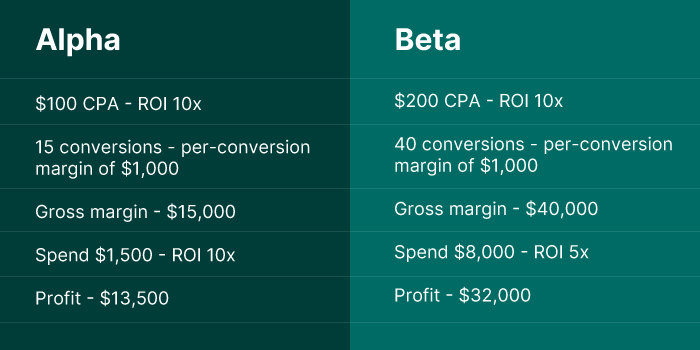
Alpha is currently operating with a $100 CPA and an impressive ROI of 10x, ultimately earning 10 times their initial investment.
Beta is currently operating with a $200 CPA and an ROI of 5x, ultimately earning 5 times their initial investment.
Which business is doing better overall?
Your first instinct should tell you that Alpha is doing better. Getting your CPA lower is a mark of higher efficiency, and many advertisers treat ROI as the gold standard for measuring campaign effectiveness. With both a higher CPA and a higher ROI, we should expect Alpha to be better.
But of course, we wouldn’t present a hypothetical situation like this if the answer was so obvious.
The reality is, either one of these advertisers could be doing better; we simply don’t have enough information to tell.
We’re already using our imaginations, so let’s imagine a few more details.
Let’s say Alpha currently gets 15 conversions with a per-conversion margin of $1,000.
Beta, however, currently gets 40 conversions with a per-conversion margin of $1,000.
The margins are the same – but which company is doing better?
Alpha’s gross margin with 15 conversions should be $15,000.
Beta’s gross margin with 40 conversions should be $40,000.
Alpha spent $1,500 to get there, leading to an ROI of 10x.
Beta spent $8,000 to get there, leading to an ROI of 5x.
Cool! Alpha still has better overall metrics than Beta.
But let’s look at their total profitability. Alpha made $15,000 and spent $1,500, giving them $13,500 in profit. Beta made $40,000 and spent $8,000, giving them $32,000 in profit.
Now tell me – would you rather have a $13,500 profit or a $32,000 profit?
In this scenario, Beta is actually doing better. Are you surprised?
The Trick: Why Profit Optimization (Sometimes) Does Better
Seeing this scenario unfold is like witnessing a magic trick. It feels like there’s something wrong or something missing in this equation, but the crux of the trick is actually quite simple. The big difference is volume. Though the efficiency metrics of Alpha are far superior, Beta is securing more conversions. Assuming the profit margins are the same, Beta is doing better because the company is ultimately seeing more conversions from their campaign.
If you choose to focus on optimizing profits, rather than optimizing for other metrics, you can see similarly powerful results. Instead of trying to chase peak efficiency metrics or brag about your low CPA, you’ll be maximizing profit by leveraging sophisticated pricing strategies to stay competitive. This approach ensures that you are not only increasing conversions but also securing the highest possible returns – greatly benefiting in the long run.
The Dangers of Status Quo Thinking in PPC
Too often, PPC ad managers suffer from status quo thinking.
They believe that as long as they’re getting clicks with a positive ROI, the campaign is worth continuing to run as is.
Part of this is a fear of loss; if you tinker with too many variables, you could end up compromising your results rather than improving them. Another part of this is sheer laziness; why bother trying to improve your PPC campaign if it’s already performing decently enough?
In any case, it’s your responsibility to step up and continue optimizing your campaign for better performance. That doesn’t mean you can’t be satisfied with good results – it just means that you have to keep pushing for better results.
What Steps Can You Take to Optimize for Profit in PPC?
So, how do you see those better results?
What actionable steps can you take to optimize for profit in your PPC campaign?
- Look beyond the vanity metrics. All marketers have fallen into the temptation of looking at vanity metrics at some point. In social media marketing, that means focusing on your follower count instead of the number of people buying from you because of what they saw on social media. In PPC advertising, that means focusing on efficiency metrics like CPA, rather than bottom-line metrics like profitability. You need to look at the entire spectrum of variables and metrics to understand the big picture, so you can plan your campaign as effectively as possible while also factoring in customer behavior and market demands to ensure success.
- Don’t fall prey to confirmation bias.Confirmation bias is a killer in PPC advertising analytics. If you’re just looking for data points you can brag about, or if you’re looking to prove that your campaign is increasing in efficiency, you’ll probably find exactly what you’re looking for. Unfortunately, focusing too heavily on the metrics that prove you’re right, or prove that your campaign is working, could prevent you from discovering room for improvement. Instead, consider profit optimization strategies that align with business profit goals and maximize profitability in the long run.
- Optimize your entire business. This article is primarily focused on PPC advertising, but if you want to make the most of your ad campaign, you may need to optimize your entire business. As you can see from our example, a higher profit margin could instantly disrupt our equations; if you can find a way to make more money per transaction, or do a better job of incentivizing more transactions, your ad campaign will instantly become more effective. Analyzing customer demand and your target market will also help you refine your approach for profit maximization.
- Be willing to spend more. Assuming you can see steady returns and maintain your performance, consider spending more on your PPC ads. If every dollar you spend on advertising returns $10 to you, it makes perfect sense to spend more dollars. Bigger campaigns may be more complex, but they’re worth pursuing.
- Don’t sacrifice growth for efficiency. The biggest trap to watch out for is sacrificing growth for efficiency. In the pursuit of chasing a lower CPA or a higher ROI, you could end up making changes that hurt your long-term profitability. You have to remember that profitability is the ultimate goal of your campaign – and anything that compromises your profitability is going to set you back. There’s nothing wrong with optimizing for CPA, CPC, ROI, or ROAS, but these metrics all need to be secondary considerations, with the primary consideration being profit. And of course, never lose sight of customer satisfaction, as a loyal customer base is key to sustained business profit.
Are you interested in optimizing your PPC advertising campaign for profit?
Or are you struggling to get your PPC engine up and running?
PPC.co could be the perfect partner for you. Contact us today for a free consultation or to learn more about our PPC advertising services!
Accounting firms are a great example of an industry where client lifetime value should drive your acquisition math, not just cost-per-lead. See our PPC guide for accounting firms for the exact formula to find your max cost per client.