
How to Get a Lower Cost Per Click for Your Google Ads
Reduce your cost-per-click (CPC) with proven strategies. Maximize your PPC budget while improving ad performance and ROI.

There are few variables as important to your PPC campaign as your cost per click (CPC).
It represents what you’ll pay for each user who clicks on your targeted ads – which means a difference of even a few cents can add up to thousands of dollars in a large-scale campaign.
Unfortunately, you can’t directly manipulate this variable the way you can, say, the number of ads you run or the total budget of your campaign. Your CPC is determined by Google (or the advertiser of your choice, though we’ll be mostly focusing on Google Ads in this guide).
If you’ve ever looked at your Google Ads account and thought, “Why am I paying this much for a single click?”, you’re not alone. Cost per click can creep up fast, especially when you’re targeting competitive keywords or running poorly optimized campaigns without a clear structure. And once your ad spend starts climbing, it can feel like you’re just throwing money into the void.
But you can influence your CPC with the right strategies. With a few smart adjustments, you can reduce Google Ads cost, improve your conversion rate, and make every dollar work harder across your Google Ads.
And if you’re persistent, you can bring it down to a very reasonable number.
So how do you do it?
Why You Should Lower Your Cost Per Click in PPC Advertising
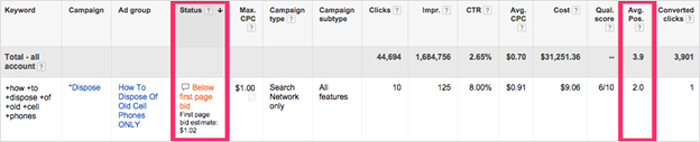
Why should you care about lowering your cost per click in PPC?
The obvious benefit is that it can save you money.
Think about it; if you can maintain a consistent conversion rate, with a consistent conversion value, a lower CPC will lead directly to a higher ROI for your strategy. It’s a lower cost per result, with all other factors being (mostly) equal.
Lower CPCs can also help you target better keywords more aggressively, make the most of a thin ad budget, and compete with rivals that would otherwise outspend you easily on Google search and Google Ads.
Two Approaches to Lower Your Cost Per Click in PPC
In this guide, we’ll focus on several tactics that can help you lower your CPC. These factors can be grouped into two main categories:
- Improving your Quality Score. In Google Ads, your Quality Score is a measure of the quality and relevance of your ads and target keywords. A high Quality Score isn’t just a flattering comment; higher Quality Scores are associated with better ad positions and – you guessed it – a lower cost per click. If you can boost your Quality Score enough, your average CPC should go down.
- Avoiding competition. Like all other goods and services, the price of online advertising fluctuates in response to changes in supply and demand. Since advertising supply is practically unlimited in the digital world, demand is the more important variable; excessive demand for a specific type of ad or a specific platform is going to push prices higher. If you can find a less competitive, lower-demand space on Google search, you can score a lower CPC.
Improve Your Quality Score
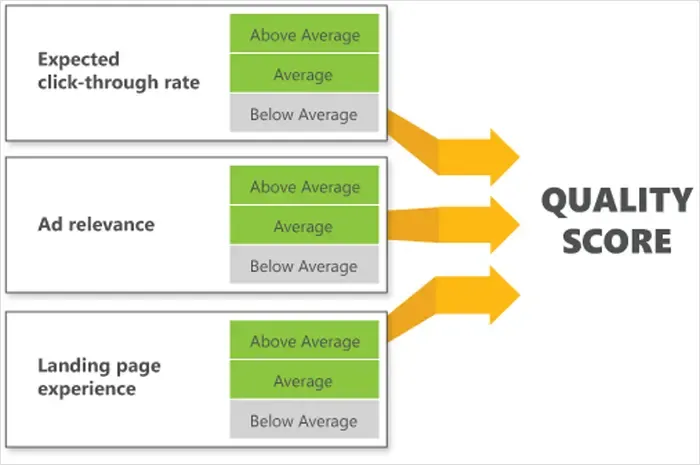
We’ll start by focusing on your Quality Score; again, the higher this rating is, the lower your cost per click should be.
In this section, we’ll be focusing on Quality Score in Google Ads. Keep in mind that other PPC platforms, like Instagram Ads and other paid search ads, have similar advertiser ratings that may function differently.
According to Google, Quality Score is typically calculated based on three factors. Each of these three factors is rated as average, above average, or below average.
- Expected click through rate (CTR). Based on aggregated data from historical performances, Google Ads estimates the clickthrough rate (CTR) for each ad. In other words, if a user sees this ad, how likely are they to click on it? A higher anticipated CTR is associated with a higher Quality Score and a lower cost per click.
- Ad relevance. The ad relevance also matters. This is more of a qualitative measure, defining how closely aligned your ad copy is with the user’s search keywords and search intent. You need to give people what they’re looking for. Strong search queries ad relevance leads to better outcomes.
- Landing page experience. Quality Score also depends on the overall landing page experience. Do users spend time on your landing page? How likely are they to convert? Is your landing page content aligned with your ads and target keywords? When users find what they expect, your conversion rate improves, which lowers your cost per conversion.
Above average ratings in all three areas should lead to a higher Quality Score, which in turn, should lower the cost per conversion.
Here are some of the best tactics you can use to boost your Quality Score reliably:
- Use single keyword Ad Groups (SKAGS). Landing pages and text ads are keyword specific, so consider using single keyword Ad Groups (SKAGS). Structuring campaigns with highly focused ad groups makes it much easier for you to ensure that all your ads and landing pages are closely aligned with search terms and user search intent. This improves ad copy, click through rate, and lowers cost per click. Sure, it’s a bit more work on your end, and it might disrupt your existing grouping strategy, but if it means boosting your ad rank, it’s worth it.
- Don’t worry about match type. Quality Score is based on historical impressions for exact searches – so there’s no need to worry about match type. While broad match can expand reach, combining it with exact match keywords and phrase match gives you more control and better CPC optimization. This is an important variable to consider in your Google Ads campaign, but don’t waste your time experimenting with match type for the sake of pumping up that ad rank.
- Focus on user intent. Strong keyword research and strategic keyword research help you understand what users actually want. When targeting a specific keyword, it’s a good idea to include that keyword (or a close variant) in your ad to maximize its relevance. But you also need to go a step further; you need to understand why a user is searching for this term so you can give them what they want in each ad. For example, if a user searches for “sturdy bookshelf,” we can reasonably conclude they’re looking to buy a shelf that serves the specific purpose of holding lots of heavy books (or similarly heavy items). It’s not illegal to advertise similar products, like ornamental bookshelves or decorative shelves, but it’s much better to focus on the primary user intention to increase search volume and visibility on the search engine results page. Matching your ad copy to intent increases conversion rate and lowers cost per conversion.
- Split test and rotate your ads. It’s hard to tell exactly which types of ads will result in higher Quality Scores and CTRs, which is why we need to practice ongoing experimentation. The best way to do this is to split test (AB test) and rotate your ads. Split testing means circulating two different ads under similar conditions to see which one performs better; you can then ditch the loser, keep the winner, and analyze the results so you can use those insights to create better ads in the future. From there, you’ll need to continuously rotate in new ad varieties. This way, you can keep pushing your Google Ads campaign to perform better while improving your overall results at the same time. Regular testing helps improve performance across your search ads, Google search ads, and even Google display ads. Better-performing ads lead to lower cost per click.
- Avoid ad cannibalization. High Quality Scores require strategic focus, so avoid ad cannibalization; in other words, don’t have multiple ads competing with each other for digital real estate. Running too many similar ads across different ad groups can dilute performance and increase cost per conversion. Each ad should be perfectly optimized for a unique niche to maximize relevance; if another, less relevant ad could also appear for a similar hypothetical search, it could compromise your results.
- Optimize your landing pages for target keywords. It’s tempting to spend all your efforts on ad optimization, but your landing pages need love too. Make sure your landing pages are optimized for specific long tail keywords and user intents – and create new, original landing pages if necessary. If you have only one landing page for all your different ad campaigns, it’s a bad sign; you’re much better off with hyper-specifically targeted pages that match user intent and boost ad rank.
- Pay close attention to landing page behavior (and take action).Landing page optimization is about more than just ensuring keyword relevance. It’s also about improving user behavior metrics – which can boost your conversion rate at the same time. If your landing page has a high bounce rate or a disappointing dwell time, analyze the page to try and figure out why. Is the content misaligned with user search intent? Is the content lackluster or missing something? Are there insufficient visuals or trust signals? You can split test and rotate your landing pages just like you do with ads to improve your position on the search engine results page.
- Carefully adjust bids. Lowering your maximum bids can set you up for a lower cost per click as well, but you need to exercise caution. If you lower your maximum bids too much or too quickly, you could end up with a lower position and worse overall result. Your best bet is to lower your bidding strategy slowly and incrementally so you can find the sweet spot for cost and performance. Gradual bid changes help you find the right balance between visibility and cost per click.
- Pause ads with high cost to conversion ratios. If something is driving up your cost per conversion, pause it and reallocate your ad spend to better performers. Sort your Google AdWords keywords by cost, then filter by conversions so you can compare the cost and conversion of each advertising opportunity. Find the ads with the highest cost to conversion ratios and consider pausing them. You can spend more money and energy on ads with a lower relative cost basis. Optimize this enough, and you’ll end up with highly cost-efficient ads across your campaigns.
- Keep introducing new keywords. Never stop experimenting. It’s tempting to stick with the keywords you understand best, but you’ll see better results if you keep introducing new keywords and tinkering with new strategies. Expanding into new terms using tools like Google Keyword Planner helps uncover lower-cost opportunities and improves overall CPC optimization. You’ll better understand your demographics, flesh out your ad portfolio, and iteratively push your Quality Score higher.
- Look into other variables. There are many secondary and tertiary variables that can influence user behavior in response to your Google Ads campaign, so take them into consideration. Users may behave differently based on the device they’re using, their location, the ad schedule, the time of day in which they see the ad, and other factors. Even things like ad blockers affecting browsing behavior elsewhere can indirectly influence campaign performance. Google asserts that these variables don’t directly influence your Quality Score, but they may have an indirect impact; even if this impact is negligible, these variables are worth considering to improve the performance of your ad campaigns and landing pages. Smart adjustments here can reduce your cost per conversion.
- Check your Quality Score regularly. In your Google Ads account, head to the Keywords section of the left menu. In the upper right corner, click the columns icon, then open the Quality Score section under “Modify columns for keywords.” Here, you can find all your ad rank data. Be sure to check your scores regularly so you can analyze your momentum, determine whether your tactics are working, and brainstorm future strategic decisions. You should also connect performance trends back to Google Analytics so you can compare traffic quality, engagement, and conversion behavior after the click.
Avoid the Competition
Let’s say you’ve maxed out your Quality Score and you’re still not satisfied with your CPC.
What can you do?
A secondary option is to avoid high-demand niches and limit your competition.
Apart from strategic business decisions (like a full pivot), these are your best tactics here:
- Know your top competitors. Your first job is to know who your top competitors are and analyze the threat they pose. Who are the top rivals in your industry, how aggressively are they advertising, and do they seem to have an adversarial or aggressive approach? Are there any areas of weakness that you could exploit? Are there platforms they aren’t using or keywords they aren’t targeting at all? Understanding how others approach Google search and search ads helps you identify gaps.
- Use multiple platforms and networks. Google Ads is (understandably) the top dog in the PPC advertising world, but Bing is better in many cases. One of the critical advantages that Bing has is a lower average cost per conversion. The reach may not be as broad, but the cost basis is attractive, and if conversions are your bottom line, tapping into the power of Bing is a no brainer. Of course, Bing isn’t the only alternative platform to Google; you can also consider any number of social media platforms, like Instagram Ads, Google Display Ads, and other ad networks relevant to your brand.
- Use both high-funnel and low-funnel strategies. Sometimes, you can lower your average CPC and see better results by shifting up or down in the sales funnel. If all your competitors are clamoring for attractive, immediately valuable low-funnel users, consider targeting neglected high-funnel users. In other words, target customers who are still in the earliest phases of the buying decision making process. Just keep in mind that users in different stages of the sales funnel are going to require different ad and landing page optimizations. Targeting different stages of intent can help you find lower-cost opportunities and improve maximize conversions outcomes.
- Target unique demographics. Finally, consider targeting unique demographics. You may be able to avoid or minimize your competition by, say, targeting users in a different geographic location, users in different age groups, or users with different behavioral patterns. To be truly effective here, you’ll likely need to experiment – and there’s no guarantee your “alternative” demographics will be as valuable as your primary targets. Smarter audience targeting can help you avoid bidding wars and reduce your cost per click.
Always Keep Testing
Run small experiments. Create ads, test variations in ad copy, and refine your audience targeting. Even small improvements tied to search queries ad relevance can make a big difference.
There’s no single trick that fixes everything overnight. But when you combine these advanced CPC reduction techniques into a centralized ad content strategy and commit to systematic ad improvement, you’ll start to see real momentum.
Lower costs. Better results. And a campaign that actually feels under control.
That’s what proper CPC optimization looks like in real life within modern online advertising.
PPC.co Can Help You
Do you want to lower your overall CPC?
Do you find yourself hoping for a more cost effective, higher-ROI PPC campaign?
Are you unsure where to start?
PPC.co has the experts who can help – so contact us for a free consultation today!
Google isn’t the only lever you can pull to bring CPC down. Bing Ads vs. Google Ads for electronics and gadgets looks at how much cheaper Bing’s clicks run for this category, and when the switch is worth it.
Insurance keywords are some of the most expensive in any industry, which makes lowering CPC especially valuable here. See our PPC guide for insurance agencies for product-specific and situational keyword strategies that cost less than the generic terms everyone else is bidding on.