
Understanding Google’s Ad Rank Formula in PPC
Understand the ad rank formula to improve your ad position. Learn how quality score and bid influence campaign success.

Everyone that has worked with pay-per-click (PPC) ads knows how competitive the landscape is. PPC is all about jockeying for ad position, and it’s an endless struggle against your fiercest competitors across the search results.
Needless to say, PPC is a cutthroat industry in digital marketing.
If only there was a way to gain some type of advantage…
Actually, Google Ads uses an ad rank formula that’s responsible for advertisers fighting for online placement in the search results page. Understanding Google ad rank (and how the google ad auction works) can provide you with a competitive advantage.
At a high level, Google ad rank is broken up into three different parts:
- The maximum cost per click (CPC) of your bid
- Your auction time ad quality score/quality score
- The impact from ad configuration and ad extensions
Honing in on these areas and ensuring they are top quality will undoubtedly help your ads earn the highest ad rank in the ad auction and show above other ads. Below, you’ll learn all about Google ad rank formula, how to calculate ad rank, why ad rank determines which ads show versus other ads, and begin putting in the work to outrank your top competitors.
Cost Per Click (CPC)
The first area of Google’s ad rank formula we’ll discuss is the CPC of your bids. When you think of a Google ad rank position, think of how popularity existed in high school. Everyone wants the top spot, but you’ll have to be willing to pay to get there.
By using Google’s keyword research tool and browsing your own dashboard in your Google ads account, you can quickly learn where you ad ranking in relation to the top spot of your chosen keywords. In fact, Google Ads does all of the hard work in telling you how much you’ll need to bid to reach the top spot for a keyword.
Though, sometimes this feature isn’t completely accurate, you can use it as a benchmark for your maximum bid. A general rule of thumb to follow is when you add a new keyword to your dashboard, view the estimate from Google’s dashboard, and round up to the nearest ten to determine your maximum CPC bid.
For example, if Google shows an estimate of $14.26, you should expect to spend at least $20. After a few days of running your campaign, you can start lowering your bid if your google ads are doing great and lowering it if they are performing poorly.
The status column will let you know if your bid is below the first page bid. This impacts your ad position and whether your ad can compete effectively in the ad auction. Until you receive any information otherwise, you should place your maximum CPC bid at the amount Google requests for your ad rank on the first page.
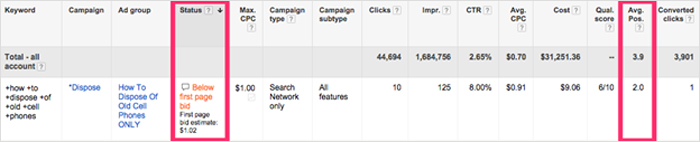
Lastly, the average position column on the Google Ads dashboard is where your ads are showing up live. To recap, the first three positions are at the very top of Google search results page/Search Engine results page and are the most likely to be clicked on.
All other positions will fall to the other pages on Google and will likely never be clicked on. This column should help any advertiser let you know when to raise and lower your build. Your choice should be based on where you want your ad rank to be positioned on Google and the budget you have to spend.
When you are in a very low position, you should double your bid. On the other hand, if your ad is in a top position, you should slowly lower your bid to take advantage of a few extra clicks for your budget. Or, you can use automated bidding.
When you’re new to setting up a Google ads campaign, expect to raise your bid at first to optimize your placement and budget. When you begin to figure out the right budget to achieve your desired placement, you can scale back your spending.
In addition, you may want to visit our guide for methods on how to lower your cost-per-click.
The Quality Score
To use another analogy, your campaign’s quality score is similar to being a well-rounded student when it’s time to complete college applications. Your quality score is determined by:
- Expected Click Through Rate — This is how many people will click on your ad and travel to your landing page (your click through rate is influenced by your offer, your ad copy, and your match to intent).
- Landing Page Relevance — This is a measurement of how relevant your landing pages is to your ad. For example, if you’re selling shoes through an ad, your landing pages can’t be focused on pants.
- Ad Relevance — This is a measurement of how your ad relevance to the targeted keywords you’re using, including keyword relevance to the query.
Strong ad quality signals increase your ad rank without requiring a higher bid. That’s how some advertisers achieve the highest ad rank even when competitors have a larger maximum bid.
With all of that said, here are some tips to follow to make sure that your campaign has an exceptionally high quality score and ad quality:
- Make sure that your ad matches your keywords. For example, if your ad group is focused on winter boots, your ad should mention winter boots. Include relevant keywords in the display URL and headline of your ad.
- Your landing page experience should also include your focus keywords. If you don’t have a specific landing page, you should send people to the most relevant page on your website.
- Improve your CTR by making sure that your bid is in a great position (1 or 2). You can do this by including a bunch of negative keywords, a compelling call-to-action (CTA), and captivating ad copy.
Improving quality score is one of the most powerful ways to improve google ad rank.
Ad Formatting and Ad Extensions
Ad extensions (assets) increase visibility and can directly impact ad rank values during the Google ad auction. Google offers more than seven Ad extensions to provide your prospects more information or ad formats, make your ad take up more room in the search results, improve your ad rank, and compete more effectively with other ads. Extensions can undoubtedly make your ads look better.
In fact, with ad extensions, your ads can look like this:
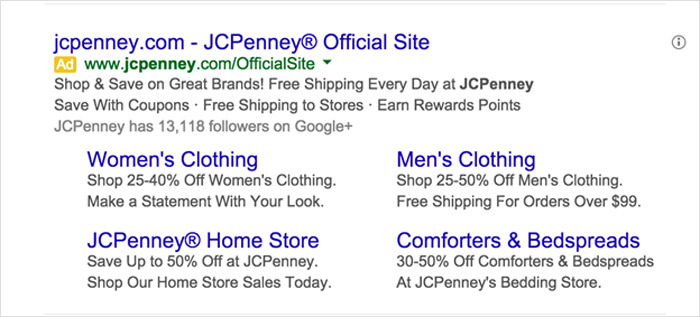
You’re free to use as many ad extensions as you want. This will make it possible for you to showcase multiple site links and CTAs. You can also use extensions to display call and location icons.
Finally, make sure that your sitelink extensions are written in title case to achieve the best presentation, and write callout extensions in sentence case. You also won’t need to use all 25 characters for callout extensions. These enhancements contribute to a stronger ad rank and improve your chances of achieving better ad positions.
How the Ad Rank Determines Placement
During each ad auction, Google evaluates all eligible ads and performs an ad rank calculation to determine ad placement. Your ad rank is compared against other ads, and the system orders them from highest to lowest while also applying an ad rank threshold for visibility.
In simple terms, you can calculate ad rank conceptually with this ad rank equation:
Ad Rank = Bid × Quality Signals × Expected Asset Impact
While you can’t directly see the exact ad rank values, you can influence them by improving quality score, increasing relevance, and optimizing your landing page. Your results can also depend on meeting the ad rank threshold for a given auction.
Ultimately, ad rank determines:
- Whether your ad shows at all
- Your ad position
- How you stack up against other ads
If you want to calculate ad rank improvements over time, track impression share, top-of-page rate, and click through rate inside your Google Ads account.
Improve Your PPC Ads Today!
Improving ad rank takes a lot of work and tinkering to improve your PPC campaign and turn your budget into a revenue stream. By understanding Google ad rank, improving quality score, and strengthening ad quality, you can consistently outperform other ads in competitive search results. If you don’t have the time or expertise to manage your campaigns in Google Ads, hiring a PPC agency is definitely in your best interest if you want to lead more people to your website.
At PPC.co, we specialize in running successful campaigns for all kinds of industries. If you want to take your campaign to the next level, contact us today to speak to a member of our team.
Ad Rank is exactly why a good Quality Score and a generous budget both matter for law firms — higher bids push ads into better positions, but only when paired with relevance. See our mini-guide to better PPC campaigns for law firms for how to set a realistic-but-generous budget in a market where clicks can cost $100 or more.